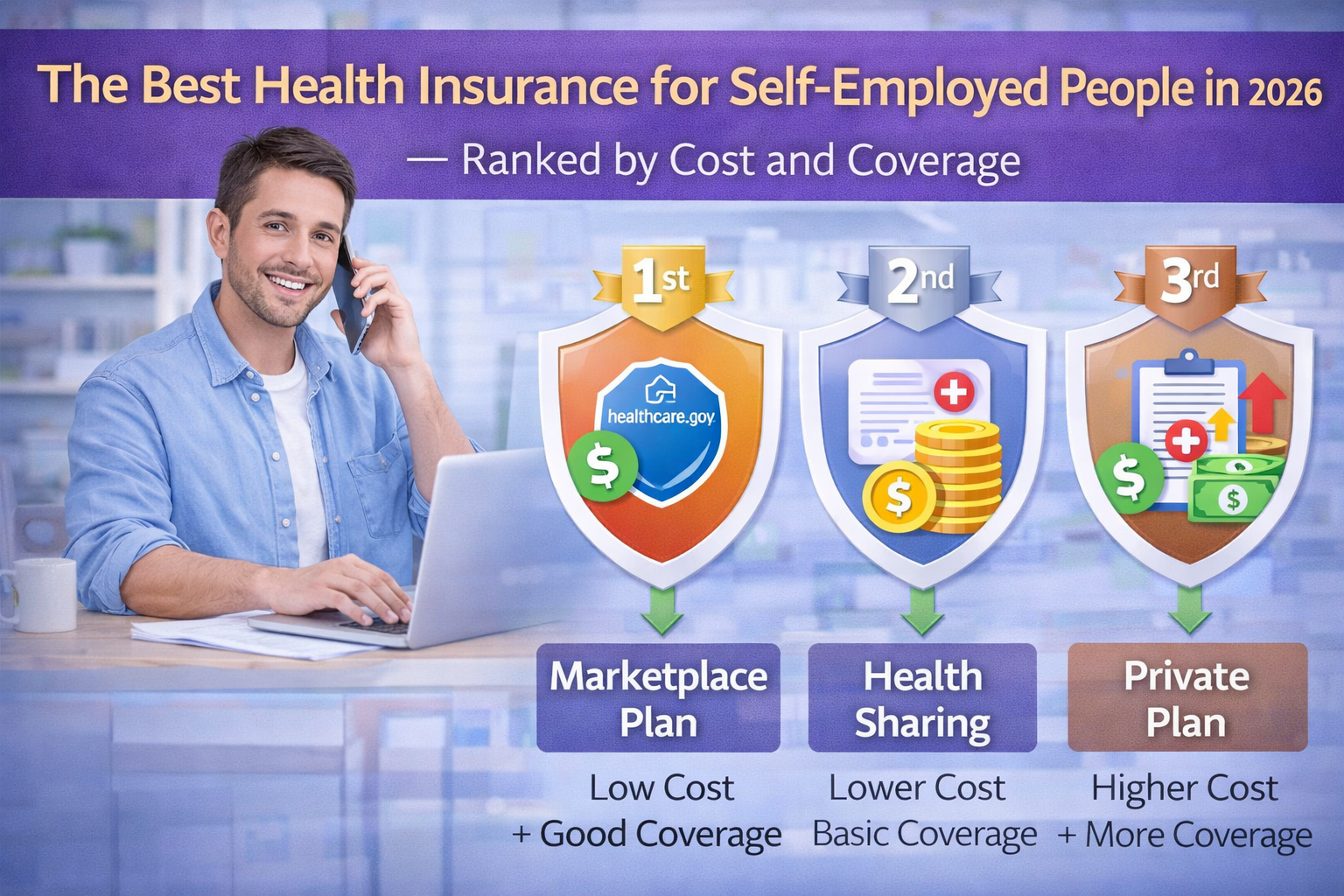
Health insurance is the financial challenge that stops more people from pursuing self-employment than any other single factor — and for good reason. The employer-sponsored health insurance that most American workers take for granted represents a significant subsidy that disappears the moment someone leaves traditional employment. The self-employed person who replaces that subsidy with individual market coverage faces premiums that reflect the full cost of the coverage rather than the fraction that employees see in their paycheck deductions — and that full cost is high enough to be genuinely disruptive to the financial planning of someone building a business or freelance practice from scratch.
The good news is that the health insurance options available to self-employed people in 2026 are more varied and more financially accessible than the sticker shock of individual market premiums suggests — because the combination of Affordable Care Act marketplace subsidies, health sharing arrangements, professional association group plans, and high-deductible plan structures creates a range of options that produce coverage at costs significantly below the unsubsidized individual market rate for most self-employed people.
The Subsidy Calculation That Changes Everything for Lower and Middle Income Self-Employed
The most important piece of information for any self-employed person evaluating health insurance is the income threshold at which ACA marketplace subsidies — the premium tax credits that reduce the cost of marketplace plans — apply to their situation. For self-employed people whose income falls within the subsidy-eligible range, the effective cost of marketplace coverage is dramatically lower than the unsubsidized premium that dominates the headline comparison.
The premium tax credits that reduce marketplace plan costs are calculated based on modified adjusted gross income — which for self-employed people includes business income minus the self-employment tax deduction and other above-the-line deductions. The subsidy calculation is on a sliding scale that provides the most generous credits to lower incomes and phases out as income rises — with the exact phase-out threshold varying based on household size and the benchmark plan premium in the specific geographic market.
The practical implication for a self-employed individual whose income is variable — as most self-employed income is — is that proactive income management can affect subsidy eligibility in ways that produce meaningful health insurance cost reductions. A self-employed person who can manage their MAGI to remain within the subsidy-eligible range through retirement account contributions, health savings account contributions, and business expense deductions may produce a subsidy that reduces their effective health insurance premium significantly below what the unsubsidized rate would suggest.
The enrollment process for marketplace coverage — through healthcare.gov for most states or the state-specific exchange for states with their own platforms — requires income estimation rather than income documentation, which means self-employed people can enroll based on their best estimate of the current year’s income and reconcile with actual income at tax filing. The reconciliation produces either additional credits if actual income was below the estimate or repayment of excess credits if actual income exceeded the estimate — a dynamic that requires careful income monitoring throughout the year rather than one-time enrollment.
The Four Main Coverage Options and What Each Produces
The health insurance landscape for self-employed people in 2026 includes four main coverage pathways — each with different premium structures, coverage characteristics, and financial implications that make them appropriate for different self-employed profiles.
The ACA marketplace plan is the most comprehensive and most regulated option — plans that meet the ACA’s minimum essential coverage requirements, cover preexisting conditions without exclusions or premium surcharges, and provide the essential health benefits that include hospitalization, prescription drug coverage, mental health services, and preventive care. For self-employed people who qualify for premium tax credits, the marketplace plan often provides the best combination of coverage quality and net cost after subsidies.
The metal tier structure within the marketplace — Bronze, Silver, Gold, and Platinum — reflects the actuarial value of each plan level and determines the cost-sharing structure rather than the coverage breadth. Bronze plans have the lowest premiums and the highest out-of-pocket costs, with actuarial values around 60% — meaning the plan covers approximately 60% of average covered medical costs. Silver plans at 70% actuarial value balance premium and cost-sharing more evenly and are the tier at which cost-sharing reductions apply for income-eligible enrollees. Gold plans at 80% and Platinum plans at 90% produce lower out-of-pocket costs in exchange for higher premiums.
The cost-sharing reduction that applies to Silver plans for income-eligible self-employed people is one of the most underutilized benefits in the marketplace — providing enhanced cost-sharing that reduces deductibles, copayments, and out-of-pocket maximums for enrollees whose income falls within the eligible range. A self-employed person who qualifies for both a premium tax credit and cost-sharing reductions on a Silver plan receives a combination of premium reduction and cost-sharing improvement that can make a Silver plan more financially favorable than a Bronze plan despite the higher premium — because the effective out-of-pocket maximum at actual usage levels is lower for the enhanced Silver plan than for the Bronze plan.
The High-Deductible Health Plan and HSA Combination for Higher Income Self-Employed
For self-employed people whose income exceeds the subsidy threshold — or who have sufficient income that the premium reduction from subsidies doesn’t significantly change the financial analysis — the high-deductible health plan paired with a health savings account is the coverage structure that produces the best combination of premium savings and tax efficiency.
High-deductible health plans carry lower premiums than equivalent comprehensive plans — reflecting the higher out-of-pocket exposure that the deductible structure creates. For 2026, an HDHP must have a minimum deductible of $1,650 for individual coverage and $3,300 for family coverage, with out-of-pocket maximums of $8,300 for individuals and $16,600 for families.
The health savings account that pairs with the HDHP creates the tax efficiency that makes the combination particularly advantageous for self-employed people. HSA contributions are tax-deductible regardless of whether the contributor itemizes — which means the contribution reduces federal income tax and self-employment tax simultaneously. For a self-employed person in the 24% federal tax bracket with a 15.3% self-employment tax rate, each dollar contributed to the HSA produces approximately $0.39 in combined federal income and self-employment tax savings — a 39% effective return on the HSA contribution before any investment return on the account balance.
The 2026 HSA contribution limits of $4,300 for individual coverage and $8,550 for family coverage produce maximum annual tax savings of approximately $1,677 for individuals and $3,335 for families at the 24% federal bracket plus the self-employment tax deduction. These savings partially offset the HDHP’s lower premium relative to comprehensive coverage, making the total effective cost of the HDHP-HSA combination lower than the headline premium comparison suggests.
COBRA as a Transition Option
Self-employed people who recently left employer-sponsored coverage have a transitional option that exists for eighteen months following the employment separation — COBRA continuation coverage that extends the former employer’s group health plan coverage at the employee’s expense.
COBRA coverage is the most expensive health insurance option for most people — the premium reflects the full group plan cost including the employer’s contribution that the employment relationship previously subsidized — but it provides continuity of coverage without underwriting, which means preexisting conditions, ongoing treatments, and established provider relationships continue without interruption during the transition period.
The COBRA comparison against marketplace coverage requires looking at both premium and coverage quality simultaneously rather than premium alone. COBRA’s premium is typically higher than the unsubsidized marketplace alternative but may be lower than the net marketplace premium after subsidy for income-eligible self-employed people. COBRA’s coverage quality — the specific plan that the former employer provided — may be higher or lower than available marketplace plans depending on the former employer’s plan quality and the available marketplace options in the specific geographic market.
The eighteen-month COBRA window provides enough time to establish the self-employment income history that makes marketplace enrollment and subsidy estimation more accurate — which makes COBRA a rational transition strategy for people who are uncertain about their first-year self-employment income and who want to delay marketplace enrollment until the income picture is clearer.
Professional Association and Trade Organization Group Plans
The health insurance options that most self-employed people overlook are the group plans available through professional associations, trade organizations, and industry groups — coverage that is structured as group insurance rather than individual coverage and that sometimes produces pricing advantages not available in the individual market.
The Freelancers Union, the National Association for the Self-Employed, various industry-specific professional associations, and some chambers of commerce offer health insurance products to members at group pricing that reflects the collective bargaining power of the membership. The specific products and pricing vary significantly by organization and geographic market — some offer genuinely competitive coverage at rates below the individual market, and others offer products that aren’t competitive with marketplace alternatives after subsidies.
The evaluation process for association health plans requires the same comparison as any other coverage option — getting the specific premium and coverage details and comparing them against the marketplace alternatives available in the same geographic market. The comparison should account for the membership cost of the association alongside the insurance premium to produce a total effective cost that’s comparable to the marketplace option that doesn’t require membership.
Short-Term Health Insurance for Specific Gap Situations
Short-term health insurance — coverage that provides limited benefits for defined periods of ninety days to twelve months depending on state regulations — is available to self-employed people who need gap coverage during transition periods or who are in specific situations where comprehensive coverage isn’t the right immediate solution.
Short-term health insurance is explicitly not ACA-compliant coverage — it doesn’t cover preexisting conditions, doesn’t provide the essential health benefits that ACA plans require, and can impose benefit limits that comprehensive coverage doesn’t. These limitations make short-term health insurance inappropriate as a primary coverage solution for self-employed people who need comprehensive protection — but potentially useful for specific short gap situations where the alternative is a period of complete uninsurance rather than inadequate coverage.
The specific situations where short-term coverage is worth considering — a self-employed person waiting for the next ACA open enrollment period, someone between business launches who expects comprehensive coverage to be available within ninety days — are narrower than the marketing for short-term health insurance suggests. For most self-employed people, the qualifying life event provisions that allow marketplace special enrollment outside the standard open enrollment period — including the loss of employer coverage that triggers a sixty-day special enrollment window — make short-term insurance less necessary than it appears.
The Deduction That Reduces the Effective Cost for All Self-Employed People
The self-employed health insurance deduction is a tax provision that allows self-employed individuals to deduct 100% of health insurance premiums paid for themselves and their families from federal income tax — an above-the-line deduction that reduces adjusted gross income regardless of whether the taxpayer itemizes.
The deduction applies to premiums paid for medical, dental, and long-term care insurance — not to out-of-pocket medical costs but to the premium itself. The deduction is limited to the net profit of the self-employment activity — a self-employed person whose business produces $30,000 in net profit can deduct up to $30,000 in health insurance premiums but not more than the profit amount.
The effective cost reduction from the self-employed health insurance deduction depends on the marginal tax rate — at a 22% federal tax rate, a $600 monthly premium produces a $1,584 annual tax savings that reduces the effective premium from $7,200 to $5,616. At a 24% rate, the same premium produces a $1,728 annual savings. The deduction doesn’t reduce self-employment tax — only income tax — but it reduces the MAGI that determines subsidy eligibility, which can affect the subsidy calculation for income-borderline self-employed people in a way that compounds the direct deduction benefit.
Understanding the health insurance options for self-employed people is the foundation — understanding exactly what those plans cost at different ages and income levels is the next layer of specificity that makes the coverage decision concrete. Our guide on how much does health insurance cost per month in 2026 — real numbers by age, plan type, and state covers the specific premium ranges that self-employed people actually pay across the major coverage options, with enough geographic and demographic specificity to make the comparison relevant to your specific situation.
Currently self-employed and navigating the health insurance decision for the first time — or already covering yourself as a self-employed person but wondering whether you’re on the most cost-effective option for your current income level? Leave a comment with your approximate income range, household size, and state. We’ll help you identify which coverage pathway is most likely to produce the best combination of coverage and cost for your specific situation.
Leave a Reply