Life insurance premiums are a long-term financial commitment — a monthly or annual obligation that stretches across ten, twenty, or thirty years for term policies and potentially for a lifetime for permanent policies. Over that period, financial circumstances change in ways that occasionally make the premium payment difficult or impossible — a job loss, a medical crisis, a business failure, or simply a period of financial pressure that makes every recurring expense subject to review. Understanding what happens to a life insurance policy when premium payments stop — and what options exist to preserve coverage before the policy lapses entirely — is information that most policyholders need at some point and that most don’t have until the situation is already in progress.
The answer depends on the type of policy — term or permanent — and the specific provisions that the policy includes. The difference between the outcomes for term policyholders and permanent policyholders who miss premiums is significant enough to address separately rather than as a single unified answer.
What Happens to Term Life Insurance When Premiums Stop
Term life insurance is the simpler case — the policy structure doesn’t include the cash value component that gives permanent policies additional options when premiums are missed. The term policy provides a death benefit in exchange for a fixed premium during the coverage period, and the coverage exists only as long as the premiums are paid.
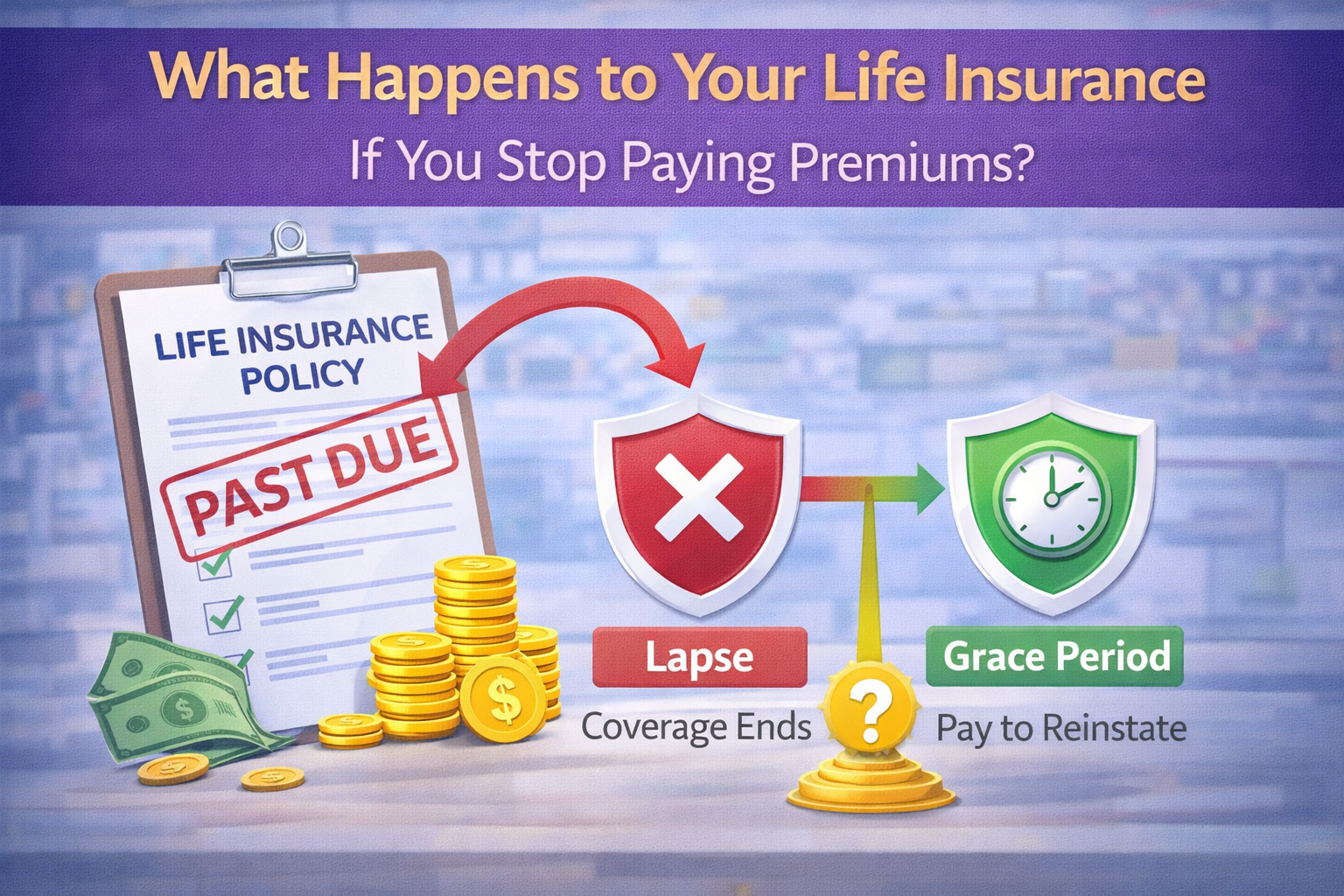
When a term life insurance premium payment is missed, the policy enters a grace period — a defined window during which the coverage remains in force despite the missed payment. The grace period is typically thirty-one days for monthly premium policies and thirty-one days for annual premium policies — long enough to catch a payment that was missed due to a banking issue, an oversight, or a short-term cash flow interruption without requiring an immediate reinstatement application.
During the grace period, the death benefit remains fully in force — a policyholder who dies during the grace period before the missed premium is paid is covered, and the insurer pays the death benefit minus the unpaid premium amount. The grace period exists specifically to prevent coverage lapses from minor payment interruptions that the policyholder would have resolved if given a brief window, and the death benefit continuation during that window is a genuine protection rather than a technicality.
If the premium is not paid within the grace period, the term policy lapses — coverage ends, the policy is no longer in force, and the insured has no death benefit protection. The lapse is not necessarily permanent — most term policies include a reinstatement provision that allows the policyholder to restore coverage within a specified window — typically two to five years from the lapse date — by paying all past-due premiums with interest and demonstrating insurability through a new medical review. The reinstatement provision is valuable but has two significant limitations — the accumulated past-due premiums plus interest may represent a meaningful sum for a policy that has been lapsed for several months or years, and the medical review requirement means that health changes that occurred between the original application and the reinstatement request can result in reinstatement denial if the current health status doesn’t meet the original underwriting standard.
The Reinstatement Window and Why It Matters
The reinstatement provision in most term policies is the option that most policyholders don’t know they have until they’ve allowed it to expire — and understanding it before a lapse occurs produces better decisions than discovering it after the window has closed.
The reinstatement window — typically two to five years depending on the insurer and the policy form — begins at the date of lapse rather than the date of the last payment. A policyholder who allows a policy to lapse in January has until January of the second through fifth year following the lapse to apply for reinstatement rather than applying for a new policy. The significance of the window is that reinstating an existing policy restores the original underwriting classification and premium rate — the preferred plus classification obtained when the policy was originally issued continues to apply to the reinstated policy rather than the current health classification that a new application would produce.
For a policyholder whose health has declined since the original policy was issued — who would now qualify for a standard classification rather than the preferred classification on the lapsed policy — reinstating the original policy produces coverage at the original preferred rate rather than the higher standard rate a new application would generate. The premium catch-up cost of reinstatement — past-due premiums plus interest — needs to be compared against the present value of the rate difference between reinstatement and a new policy over the remaining term to determine whether reinstatement or new application produces the better financial outcome.
What Happens to Permanent Life Insurance When Premiums Stop
Permanent life insurance — whole life, universal life, and variable life policies — responds differently to missed premiums than term insurance because the cash value component creates options that term policies don’t have. The specific options available depend on the policy type and the cash value that has accumulated at the time the premiums stop.
Whole life policies are the most straightforward permanent case because the cash value accumulation is contractually defined and the nonforfeiture options that apply when premiums stop are specified in the policy contract. Nonforfeiture options are the provisions that determine what coverage remains when the policyholder stops paying premiums — and they represent one of the most significant consumer protections in permanent life insurance.
The extended term nonforfeiture option uses the accumulated cash value to purchase a paid-up term policy with the same death benefit as the original whole life policy — extending full death benefit coverage for a period determined by the cash value amount and the insured’s current age. A whole life policy with $50,000 in accumulated cash value might purchase fifteen years of term coverage at the original death benefit amount — providing continued protection during a financial difficulty period without requiring any additional premium payment. The extended term option trades the permanence of whole life coverage for a defined period of continued full coverage funded by the cash value.
The reduced paid-up nonforfeiture option uses the accumulated cash value to purchase a smaller permanent policy that requires no further premium payments — a permanent death benefit that is proportionally reduced from the original face amount but that never expires and requires no ongoing premiums. A $500,000 whole life policy with sufficient cash value might convert to a $150,000 reduced paid-up policy that provides permanent coverage without any additional premium obligation. The reduced paid-up option preserves the permanence of whole life coverage at a reduced death benefit amount rather than trading permanence for a full benefit over a defined term.
The cash surrender value option allows the policyholder to receive the accumulated cash value as a lump sum in exchange for terminating the policy entirely — ending all coverage and all premium obligations in exchange for the accessible portion of the cash value. The surrender value is typically the full cash value minus any surrender charges that apply during the early years of the policy and minus any outstanding policy loans against the cash value.
Universal Life and the Premium Flexibility That Creates a Specific Risk
Universal life insurance introduces a premium flexibility that whole life doesn’t provide — the ability to vary premium payments within defined minimums and maximums rather than paying a fixed premium on a fixed schedule. The flexibility is a genuine advantage in normal circumstances and a specific risk when it creates the misunderstanding that low or no premium payments can continue indefinitely.
Universal life policies accumulate cash value in a separate account that earns a credited interest rate — and the cost of insurance is deducted from that account monthly regardless of whether the policyholder makes a premium payment. When premium payments are reduced or stopped, the cost of insurance continues to be deducted from the cash value — which means the cash value declines with each monthly deduction until it’s either exhausted or the policyholder resumes premium payments.
The risk that universal life’s flexibility creates is the policy lapse from cash value exhaustion — a scenario where the policyholder reduces premiums during a financial difficulty period and doesn’t resume adequate premiums before the cash value is depleted by the ongoing cost of insurance deductions. When the cash value reaches zero, the policy lapses — coverage ends — unless the policyholder pays the minimum premium required to prevent lapse. For older policyholders whose cost of insurance has increased with age, the minimum premium required to prevent lapse may be significantly higher than the premium paid during the low-payment period.
The universal life lapse scenario is most common for policies that were illustrated at high credited interest rates in earlier decades — interest rate assumptions of 8% to 10% that produced projections showing the cash value remaining robust despite low premium payments. When actual credited interest rates fell significantly below those projections, the cash value growth didn’t materialize as illustrated, the cost of insurance continued at the projected rate, and the cash value depleted faster than the original illustration suggested it would. Policyholders who relied on the original illustration without monitoring the actual cash value performance discovered policy lapse risk at ages when new coverage was prohibitively expensive or unavailable.
The Policy Loan Option That Provides a Premium Alternative
Permanent life insurance policyholders facing temporary financial difficulty have an option that term policyholders don’t — the policy loan provision that allows borrowing against the cash value to cover premium payments during a financially difficult period without triggering the nonforfeiture provisions or the reinstatement process.
A policy loan against the cash value is not a bank loan — it doesn’t require a credit check, it doesn’t have a defined repayment schedule, and it doesn’t create a legal obligation to repay on a specific timeline. The loan reduces the available cash value and the death benefit by the outstanding loan balance — a $20,000 loan against a $100,000 death benefit policy reduces the net death benefit to $80,000 until the loan is repaid. The interest that accrues on the outstanding loan balance is typically added to the loan balance rather than billed monthly, which means the loan can be maintained without any cash payment as long as the remaining cash value exceeds the loan balance plus accrued interest.
The policy loan option for premium continuity works as follows — a policyholder facing financial difficulty uses a policy loan to pay the premiums that would otherwise be missed, keeping the policy in force without a cash outlay from the policyholder’s personal finances. The loan balance grows with each premium payment that the loan covers plus the interest that accrues, reducing the available cash value and the net death benefit proportionally. When the financial difficulty period ends and premium payments resume, the policyholder can repay the loan balance or allow it to remain outstanding against the cash value.
The policy loan strategy for premium continuity is most appropriate for temporary financial difficulties — periods of months rather than years — where the cash value is sufficient to support the loan balance growth without risk of exhausting the cash value and triggering the universal life lapse scenario. For extended financial difficulties, the nonforfeiture options that reduce or eliminate the premium obligation entirely are more appropriate than the policy loan that defers the obligation without eliminating it.
The Automatic Premium Loan Provision That Prevents Accidental Lapse
Many permanent life insurance policies include an automatic premium loan provision — a feature that automatically uses the cash value to pay premiums when the scheduled payment is missed rather than requiring the policyholder to initiate the loan request. The automatic provision prevents accidental lapse from payment oversights or temporary cash flow interruptions without any action from the policyholder.
The automatic premium loan provision is typically elected at policy issuance rather than activated at the time of a missed payment — which means policyholders who don’t know to elect it during the application process may not have it available when a missed payment occurs. For permanent life insurance applications, specifically requesting the automatic premium loan provision and confirming that it has been added to the policy is a worthwhile step that prevents the most common form of accidental permanent life insurance lapse.
The provision doesn’t eliminate the loan balance accumulation that manual policy loans create — the automatic loans carry the same interest accrual and cash value reduction as manual loans. But the prevention of accidental lapse during a period when the policyholder is distracted by the financial circumstances that caused the missed payment is a genuine protection that the provision provides in exactly the scenarios where it’s most needed.
What to Do When Premium Payment Becomes Difficult
The action sequence that produces the best outcome when life insurance premium payment becomes difficult is specific enough to follow as a practical guide rather than a general principle.
Contacting the insurer before missing a payment produces more options than contacting after a lapse — many insurers have hardship provisions or payment arrangements that are available for policyholders in financial difficulty if requested before the policy lapses rather than after. The hardship options that exist vary by insurer and policy type, but they exist more commonly than most policyholders know because most policyholders don’t ask before missing payments.
Reviewing the policy provisions for grace period, nonforfeiture options, and automatic premium loan before making any decision about reducing or stopping premium payments produces an informed choice rather than a default outcome. The nonforfeiture option that’s most appropriate for a specific situation — extended term, reduced paid-up, or cash surrender — depends on the specific coverage need and the cash value available, and choosing deliberately among those options produces a better outcome than accepting the insurer’s default nonforfeiture option without comparison.
Reinstating a lapsed term policy within the reinstatement window, rather than applying for new coverage, preserves the original underwriting classification and premium rate for the remaining coverage need — which is almost always the preferable outcome compared to a new application that reflects current age and health status.
The next step after understanding what happens when life insurance premiums stop is understanding the no-exam life insurance options that simplify the application process for buyers who want coverage without the traditional medical examination. Our guide on no-exam life insurance in 2026 — is the convenience worth the higher premium covers the specific trade-offs between simplified issue and fully underwritten policies, with enough detail to evaluate whether the convenience justifies the cost difference for your specific situation.
Have you faced a period where life insurance premium payments became difficult and navigated the policy loan, nonforfeiture, or reinstatement options — or discovered after a lapse that the reinstatement window was still open and used it to restore coverage? Leave a comment with what happened and how it resolved. Real experiences with these policy provisions are the most useful information available for policyholders facing the same situation.
Leave a Reply