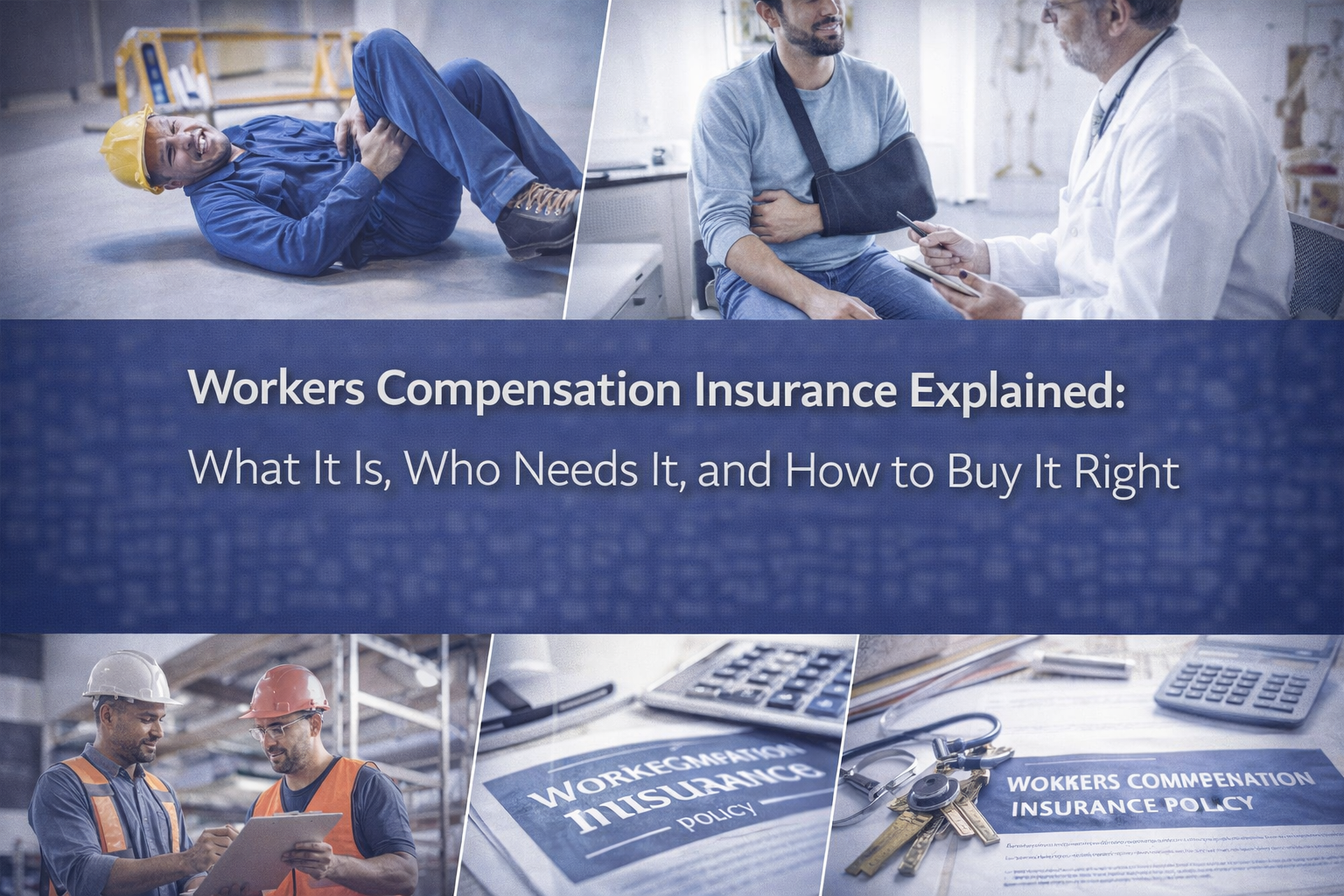
Workers compensation insurance is the coverage category that most small business owners think about least until the moment they need it — and at that moment, whether the coverage is in place, structured correctly, and adequate for the specific injury or illness determines whether a workplace incident produces a managed insurance response or a personal financial crisis that threatens both the business and the owner’s personal assets. The legal requirement that workers compensation represents for most businesses with employees is reason enough to take it seriously — but the financial protection it provides for both the injured employee and the business owner is the more compelling reason to understand it rather than simply purchasing the minimum required coverage without knowing what that coverage actually does.
What Workers Compensation Insurance Actually Is
Workers compensation insurance is a no-fault system for addressing workplace injuries and occupational illnesses — a coverage structure that compensates injured employees for medical expenses and lost wages without requiring them to prove that the employer was negligent, and that protects employers from the tort liability that would otherwise apply to workplace injuries by providing an exclusive remedy for covered injuries through the workers compensation system.
The no-fault structure is the defining characteristic that distinguishes workers compensation from every other liability coverage — there is no fault determination, no litigation over who was responsible for the injury, and no requirement for the injured employee to prove employer negligence. An employee who is injured on the job — regardless of how the injury occurred, whether through their own carelessness, a coworker’s error, or equipment failure — is entitled to workers compensation benefits if the injury arose out of and in the course of employment.
The exclusive remedy doctrine that accompanies workers compensation in most states is the trade-off that makes the no-fault system function for both parties. By accepting workers compensation benefits, the injured employee typically gives up the right to sue the employer in tort for the workplace injury — the workers compensation benefit is the exclusive remedy available against the employer for covered injuries. This protection — which limits the employer’s liability for workplace injuries to the workers compensation system rather than exposing the employer to unlimited tort liability — is the financial protection that workers compensation provides to the business alongside the benefit it provides to the injured employee.
What Workers Compensation Benefits Actually Cover
The benefits that workers compensation provides to injured employees are defined by state law rather than by the insurance policy — which means the specific benefit levels, waiting periods, and duration limits vary by state in ways that make state-specific knowledge essential for understanding the actual benefits available in any particular jurisdiction.
Medical benefits cover all reasonable and necessary medical treatment for work-related injuries and illnesses — physician visits, hospital care, surgery, physical therapy, prescription medications, and medical equipment needed for the injury. Medical benefits are provided without a deductible and without a copayment in most states — the workers compensation insurer pays the medical provider directly rather than requiring the employee to pay and seek reimbursement. The medical benefit is not subject to a dollar limit in most states — all reasonable and necessary treatment for the covered injury is covered regardless of the total medical cost.
Temporary disability benefits replace a portion of the injured employee’s lost wages during the period when the injury prevents them from working — typically two-thirds of the pre-injury average weekly wage up to a state-determined maximum. The temporary disability benefit begins after a waiting period — typically three to seven days — and continues until the employee returns to work at full or modified duty, reaches maximum medical improvement, or exhausts the maximum benefit duration allowed by state law. The waiting period for most states is retroactively compensated if the disability extends beyond a specified duration — typically fourteen to twenty-one days — which means short absences may not receive temporary disability benefits while extended absences receive benefits from the first day.
Permanent disability benefits address the lasting impairment that some workplace injuries produce — the reduced earning capacity or physical limitation that remains after maximum medical improvement is reached. Permanent disability benefits are calculated using a combination of the medical impairment rating produced by the treating physician, the employee’s age and occupation, and the state’s benefit schedule — producing a dollar amount that compensates for the permanent reduction in the employee’s earning capacity or physical function.
Death benefits provide compensation to the surviving dependents of employees who die from work-related injuries or illnesses — typically a portion of the deceased employee’s pre-injury wages paid for a specified period to qualifying survivors and a burial expense benefit that covers the cost of the funeral.
Who Is Required to Carry Workers Compensation
The legal requirement to carry workers compensation insurance varies by state in the employee threshold that triggers the requirement — and understanding the specific threshold that applies in the relevant state prevents both the compliance failure that occurs when a business assumes it’s exempt and the unnecessary cost that occurs when a business purchases required coverage it doesn’t need.
Most states require workers compensation insurance when the first employee is hired — which means the hiring decision and the workers compensation purchase decision occur simultaneously rather than sequentially. The states with higher employee thresholds — which allow small businesses to operate with a small number of employees before the workers compensation requirement triggers — are the exception rather than the rule, and the specific threshold for each state is specific enough to verify directly rather than assume from general knowledge.
The employee versus independent contractor distinction is the most common source of workers compensation compliance risk for small businesses — the business that treats workers as independent contractors to avoid the workers compensation requirement faces significant exposure if those workers are later determined to be employees under the state’s classification rules. The classification determination is based on the degree of control the business exercises over the worker’s activities rather than the label that the parties apply to the relationship — a worker who is functionally an employee is classified as an employee for workers compensation purposes regardless of how the business characterizes the relationship in the contractor agreement.
Industry-specific requirements affect the workers compensation obligation for certain business types in specific states — construction contractors, for example, are subject to workers compensation requirements in most states even when working as sole proprietors without employees, because the high-risk nature of construction work and the history of misclassification in the construction industry have produced regulatory requirements that go beyond the standard employee threshold rules.
How Workers Compensation Premiums Are Calculated
The workers compensation premium calculation is more complex than the flat-rate pricing of most other insurance products — and understanding the calculation allows evaluating whether the premium reflects accurate business information rather than accepting a calculated premium without knowing how it was derived.
The class code is the foundation of the premium calculation — each job classification is assigned a numerical code that reflects the injury frequency and severity history for that type of work. The class code rate — expressed as a dollar amount per $100 of payroll — reflects the actuarial cost of providing workers compensation benefits to the specific occupation. A clerical worker class code might carry a rate of $0.25 per $100 of payroll while a roofing contractor class code might carry a rate of $25 or more per $100 of payroll — a one-hundred-fold difference that reflects the dramatically different injury probability and medical cost associated with each occupation.
The payroll — specifically, the total compensation paid to employees in each class code — is the rating base that is multiplied by the class code rate to produce the base premium. The payroll figure used in the calculation should reflect the actual payroll rather than estimated payroll — workers compensation policies are typically written on an estimated payroll basis and audited at year-end to adjust the premium for the actual payroll that was paid during the policy period. The audit adjustment that results from a payroll that was higher than estimated produces an additional premium that the business must pay — and a payroll that was lower than estimated produces a return premium.
The experience modification factor — the comparison of the business’s actual claims history against the expected claims for similar businesses — applies as a multiplier to the base premium once the business has accumulated sufficient claims history to generate a calculated modification. A modification below 1.0 reduces the premium while a modification above 1.0 increases it — and the modification compounds across years of favorable or unfavorable claims experience to produce cumulative premium credits or surcharges that can be significant.
The Audit Process That Most Business Owners Don’t Anticipate
The workers compensation audit — the annual review of the actual payroll that was paid during the policy period — is a process that most first-time workers compensation buyers don’t know to expect and that produces unexpected premium adjustments when the actual payroll differs significantly from the estimated payroll used to calculate the deposit premium.
The audit is not optional — it’s a standard condition of workers compensation policies that allows the insurer to adjust the premium for the actual exposure rather than the estimated exposure. The audit typically occurs within ninety days after the policy period ends and involves the insurer or an audit firm reviewing the business’s payroll records, tax filings, and employee records to verify the actual payroll in each classification.
The payroll classification accuracy that the audit reviews is the most financially significant component — because payroll that is classified in an incorrect class code at a lower rate than the actual work warrants produces both an audit adjustment and potentially an allegation of misrepresentation that can affect future coverage. A contractor who classifies all workers as clerical to minimize premiums — a practice that audits consistently identify — faces an audit adjustment that retroactively applies the correct class code rate to the misclassified payroll, plus the potential for policy cancellation and difficulty obtaining future coverage.
The documentation that supports audit accuracy includes payroll records by employee, time records that distinguish work in different classifications if employees perform work in multiple categories, subcontractor certificates of insurance that exclude subcontractor payroll from the business’s audit base, and any other records that verify the actual payroll in each classification.
How to Buy Workers Compensation Correctly
The workers compensation purchasing process produces the best outcome when it follows a sequence that establishes accurate classification and payroll information before obtaining quotes rather than accepting the first quote received without verifying that it reflects accurate underlying data.
Identifying the correct class codes for the specific employees and work activities is the first step — the National Council on Compensation Insurance maintains the class code system used by most states, and the specific codes that apply to each type of work are specific enough to verify directly rather than accept from an insurer who may apply a conservative classification that produces a higher rate than the accurate classification would.
Obtaining quotes from multiple insurers — the state workers compensation fund if available, private insurers through a broker, and the professional employer organization model if the business size and structure make PEO coverage appropriate — produces the comparison that identifies competitive pricing rather than accepting a single quote as the market rate.
Verifying that subcontractors the business uses carry their own workers compensation coverage is the step that prevents the most expensive workers compensation audit surprise — because the payroll of uninsured subcontractors is frequently added to the business’s audit base by the insurer, producing a retroactive premium adjustment for payroll the business owner didn’t expect to insure.
The Safety Program That Reduces Workers Compensation Cost Over Time
The experience modification factor that compounds across years of claims experience makes the safety program the most impactful long-term workers compensation cost reduction strategy — because a reduction in claim frequency and severity improves the experience modification over time, which reduces the premium multiplicatively rather than through a one-time discount.
The safety investment that produces the best return in workers compensation cost reduction is the specific hazard identification and mitigation that addresses the injury types most common in the specific industry — not a generic safety program that addresses a broad range of hazards regardless of relevance, but a focused program that targets the specific injury mechanisms that produce the most frequent and most costly claims for the specific business type. For a contractor, that focus is fall protection and tool safety. For a warehouse operation, it’s lifting technique and forklift safety. For a healthcare provider, it’s patient handling and sharps safety.
The return-to-work program that facilitates injured employees returning to modified duty during their recovery — performing work that accommodates the physical restrictions of the recovery period rather than being completely absent during the recovery — reduces temporary disability costs significantly by shortening the period of wage replacement that the insurer must provide. The return-to-work program’s financial benefit extends to the experience modification — reduced temporary disability costs produce lower total claim costs that improve the modification over time.
Workers compensation is the last of the business insurance coverages that most small businesses need to address — completing the coverage portfolio that protects the business from the full range of financial exposures it faces. Our guide on how to lower your insurance premium without reducing your coverage — 11 legal strategies that actually work covers the premium reduction strategies that apply across all insurance categories including business insurance, with enough specificity to identify which approaches produce the most meaningful savings for each coverage type in the specific business situation.
Currently employing workers without workers compensation coverage — or carrying workers compensation but uncertain whether the class codes and payroll figures used in the calculation are accurate enough to avoid an audit adjustment? Leave a comment with your state, the number of employees, and the type of work they perform. We’ll help you identify whether your current coverage is compliant and whether the classification and premium calculation reflects the accurate risk profile for your specific workforce.
Leave a Reply