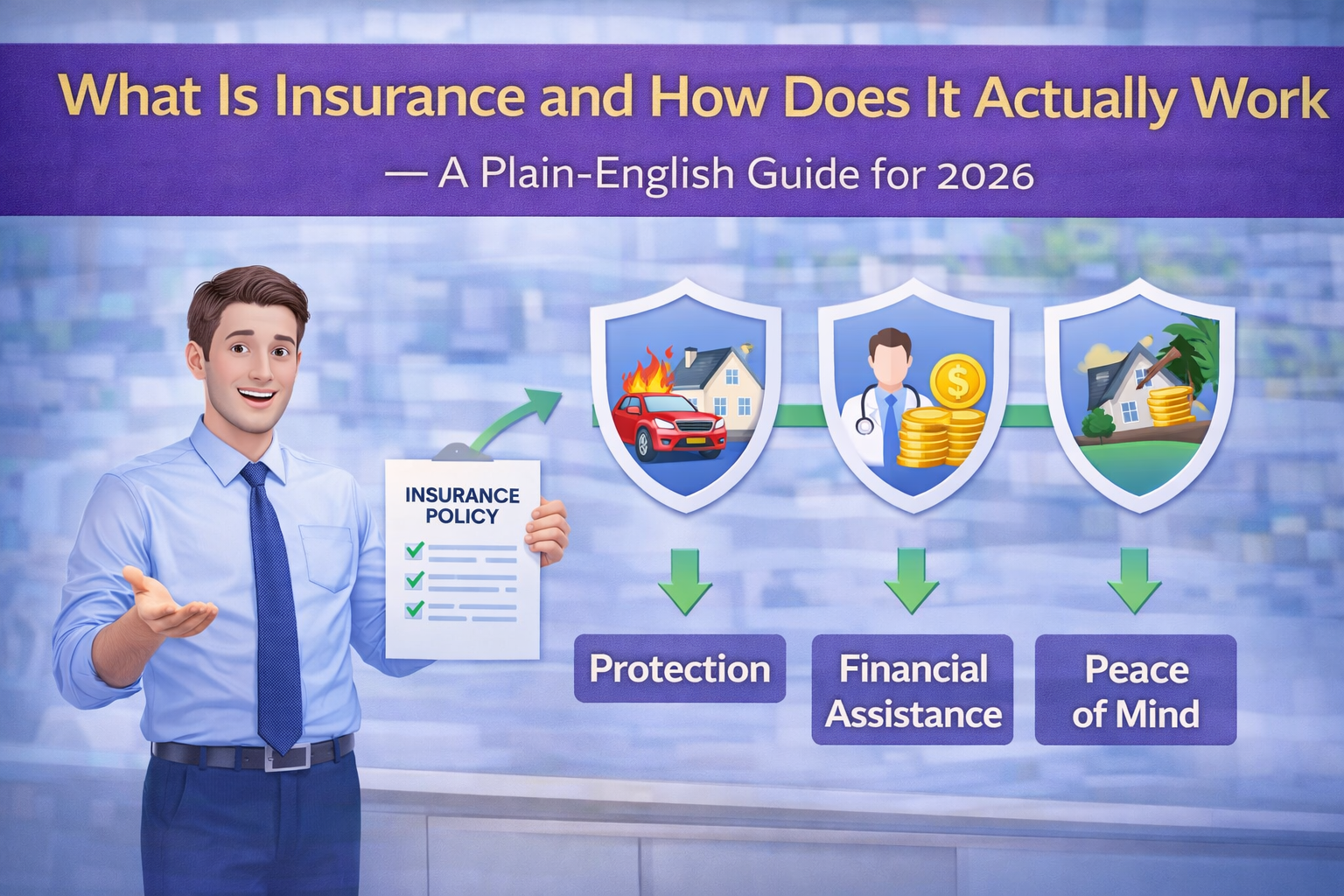
Most people buy insurance without fully understanding what they’re actually purchasing — and that gap between paying for coverage and understanding it is where the most expensive insurance mistakes happen. The person who buys the wrong policy, underinsures their home, or files a claim incorrectly isn’t usually making a careless decision. They’re making an uninformed one — and the difference between those two situations is that uninformed decisions are fixable once the information is clear.
This guide explains what insurance actually is, how the financial mechanism behind it works, and why understanding the basics changes every insurance decision you’ll make — from the policy you buy this year to the claim you might file years from now. No jargon, no assumption of prior knowledge, and no agenda beyond making the concept genuinely clear.
The Core Idea Behind Every Insurance Policy Ever Written
Insurance is a financial arrangement where a large number of people each contribute a relatively small amount of money into a shared pool, and that pool pays out to whoever among them experiences a specific type of financial loss. The insurance company manages the pool, prices the contributions, and pays the claims — earning its profit from the difference between what comes in and what goes out.
The reason this arrangement works financially is probability. Not everyone who insures their car will have an accident this year. Not everyone who insures their home will experience a fire or a flood. Not everyone who buys life insurance will die during the coverage period. The insurance company uses historical data and statistical modeling to predict, with reasonable accuracy, how many claims they’ll receive and how much those claims will cost — and they set premiums high enough to cover those expected claims, their operating costs, and a profit margin.
From the individual’s perspective, insurance converts an unpredictable large loss — a $40,000 car accident, a $300,000 house fire, a $500,000 medical event — into a predictable small cost, which is the monthly or annual premium. That conversion is the fundamental value of insurance regardless of the type of coverage being purchased.
Why Insurance Exists: The Problem It Solves
The problem that insurance solves is not the risk of bad things happening — it’s the financial devastation that follows when bad things happen without financial preparation. Most people cannot self-insure against catastrophic losses. A family with $30,000 in savings cannot absorb a $200,000 medical bill. A small business owner with $50,000 in reserves cannot absorb a $500,000 liability lawsuit. A homeowner with a mortgage cannot absorb the total loss of a $400,000 home.
Insurance exists because the alternative — absorbing catastrophic financial losses out of pocket — is impossible for most people and financially ruinous for nearly everyone else. The premium paid for insurance is not lost money when no claim is filed. It’s the cost of eliminating the possibility of a catastrophic outcome — a cost that most financial advisors would describe as one of the most rational purchases a person or business can make.
The analogy that makes this clearest is this: you don’t consider your car’s seatbelt a waste of money because you didn’t have an accident this year. The seatbelt’s value is in what it prevents if something goes wrong — not in the daily experience of wearing it when nothing does. Insurance works the same way.
The Four Elements Every Insurance Policy Contains
Every insurance policy ever written — regardless of the type of coverage, the insurance company, or the country where it was issued — contains four fundamental elements that define what the policy does and doesn’t do.
The premium is the amount you pay for the coverage — monthly, quarterly, or annually. The premium is determined by the insurance company based on the assessed risk of insuring you specifically, which is why two people buying identical policies from the same company often pay different premiums. Your age, location, claims history, credit score in most states, and dozens of other factors all affect what the company charges for your specific risk profile.
The deductible is the amount you pay out of pocket before the insurance coverage begins. A $1,000 deductible on a car insurance policy means that if you have a $5,000 accident, you pay the first $1,000 and the insurance company pays the remaining $4,000. Higher deductibles produce lower premiums because you’re absorbing more of the risk yourself — a trade-off that makes financial sense for some people and not for others depending on their savings and risk tolerance.
The coverage limit is the maximum amount the insurance company will pay for a covered loss. A $300,000 liability limit on a homeowners policy means the company will pay up to $300,000 for a covered liability claim — but not a dollar more. Understanding the coverage limit is essential because a limit that seems adequate at policy purchase can be dangerously inadequate when a major claim actually occurs.
The exclusions are the specific situations, events, and types of damage that the policy explicitly does not cover. Every policy has them, most policyholders don’t read them carefully, and the exclusions are almost always where the most painful surprises occur at claim time. Flood damage excluded from a standard homeowners policy. Wear and tear excluded from an auto policy. Pre-existing conditions excluded from some health policies. The exclusions define the boundary of what the policy actually does — and that boundary is as important as what the policy covers.
How Insurance Companies Make Money
Understanding how insurance companies make money demystifies the relationship between policyholders and insurers in a way that makes every insurance interaction more navigable.
Insurance companies make money through two primary mechanisms. The first is underwriting profit — the difference between the premiums they collect and the claims they pay out plus their operating costs. When an insurance company collects $100 million in premiums and pays out $85 million in claims and $10 million in operating costs, it earns a $5 million underwriting profit. When claims exceed premiums — which happens in catastrophic loss years for property insurers — underwriting produces a loss.
The second mechanism is investment income. Insurance companies hold the premiums they collect before paying them out as claims — and during that time, they invest those funds in bonds, stocks, and other financial instruments. The investment returns on this float — the term for the money held between collection and payout — represent a significant portion of insurance company revenue that exists independently of underwriting results.
Understanding these mechanisms explains several insurance behaviors that seem puzzling without context. Why do insurance companies raise rates after a major hurricane even for customers far from the affected area? Because catastrophic losses affect the entire pool, and the company needs to rebuild reserves to cover future claims. Why do insurance companies sometimes deny claims on technicalities? Because underwriting profit depends on paying legitimate claims while controlling illegitimate or inflated ones. Understanding the financial logic behind insurance company behavior makes you a more effective insurance consumer.
The Difference Between Types of Insurance
Insurance products fall into three broad categories that cover different types of risk — and understanding which category addresses which risk clarifies why specific types of coverage exist and when each is appropriate.
Property insurance protects against financial loss from damage to or destruction of physical assets — your car, your home, your business equipment. The covered loss is the cost of repairing or replacing the physical property, and the coverage is relevant any time you own an asset whose loss would create financial hardship.
Liability insurance protects against financial loss from legal claims made against you by others — a car accident where you injure another driver, a customer who slips and falls in your business, a professional mistake that causes financial harm to a client. The covered loss is the legal judgment or settlement plus defense costs, and the coverage is relevant any time your actions could create legal liability for others’ losses.
Life and health insurance protect against financial loss from events affecting your physical wellbeing — illness, injury, disability, and death. The covered loss ranges from medical bills to income replacement to the financial impact of death on dependents, and the coverage is relevant any time your health or continued life represents a financial dependency for yourself or others.
Most people and businesses need coverage from all three categories — which is why a complete insurance review looks at property, liability, and life and health coverage together rather than addressing each category in isolation.
Why Most People Are Either Over-Insured or Under-Insured
The uncomfortable truth about how most people manage their insurance is that they’re rarely at the right coverage level — they’re either paying for coverage they don’t need or exposed to risks their current coverage doesn’t address. Both situations are common, both are expensive, and both are correctable once the underlying dynamic is understood.
Over-insurance happens when people keep coverage levels, deductibles, and policy types that made sense at an earlier life stage without reassessing as circumstances change. The comprehensive coverage on a ten-year-old car worth $4,000 may cost more annually than the car is worth replacing. The life insurance policy purchased when children were young and a mortgage was new may exceed what’s needed once the children are grown and the mortgage is paid down.
Under-insurance happens when people choose minimum coverage to minimize premiums without modeling what a major claim would actually cost. The liability limit that seemed adequate at policy purchase represents a fraction of the judgment in a serious lawsuit. The homeowners coverage that insures the home for its purchase price rather than its replacement cost leaves a gap that the policyholder discovers only when rebuilding after a total loss.
The solution to both problems is the same — an honest annual review of every insurance policy against current circumstances, current asset values, and current risk exposure. That review is the most financially productive hour most people spend on their finances each year, and it’s the subject of the insurance audit guide covered elsewhere on this site.
What Understanding Insurance Actually Changes
Reading a plain-English explanation of how insurance works doesn’t make you an insurance expert. What it does is give you the framework for asking better questions, evaluating coverage decisions more critically, and recognizing the moments when the gap between what you’re paying for and what you actually need is costing you money in one direction or the other.
Every insurance decision — the policy you buy, the deductible you choose, the coverage limit you set, the claim you decide whether to file — is a financial decision with calculable consequences. Making those decisions from a position of understanding rather than from a position of trusting that whoever sold you the policy made the right choices on your behalf produces better financial outcomes over the course of a lifetime than any specific policy optimization can.
The guides throughout CoverageMastery cover every major insurance category with the same level of honest, specific, actionable detail that this introduction aims for — because the difference between informed and uninformed insurance decisions compounds in your favor every year you make the informed ones.
The next step after understanding how insurance works is understanding the mistakes that cost people the most money — before you make them yourself. Our guide on the most common insurance mistakes that cost people thousands every year covers the specific errors that show up repeatedly across every insurance category, with enough detail to recognize and avoid them before they affect your coverage or your wallet.
Just starting to think seriously about your insurance coverage and not sure where the biggest gaps or overpayments are in your current policies? Leave a comment describing your situation — what you’re currently covered for, what you’re unsure about, and what’s prompted the review. We read every comment and often turn the most common questions into dedicated guides.
Leave a Reply