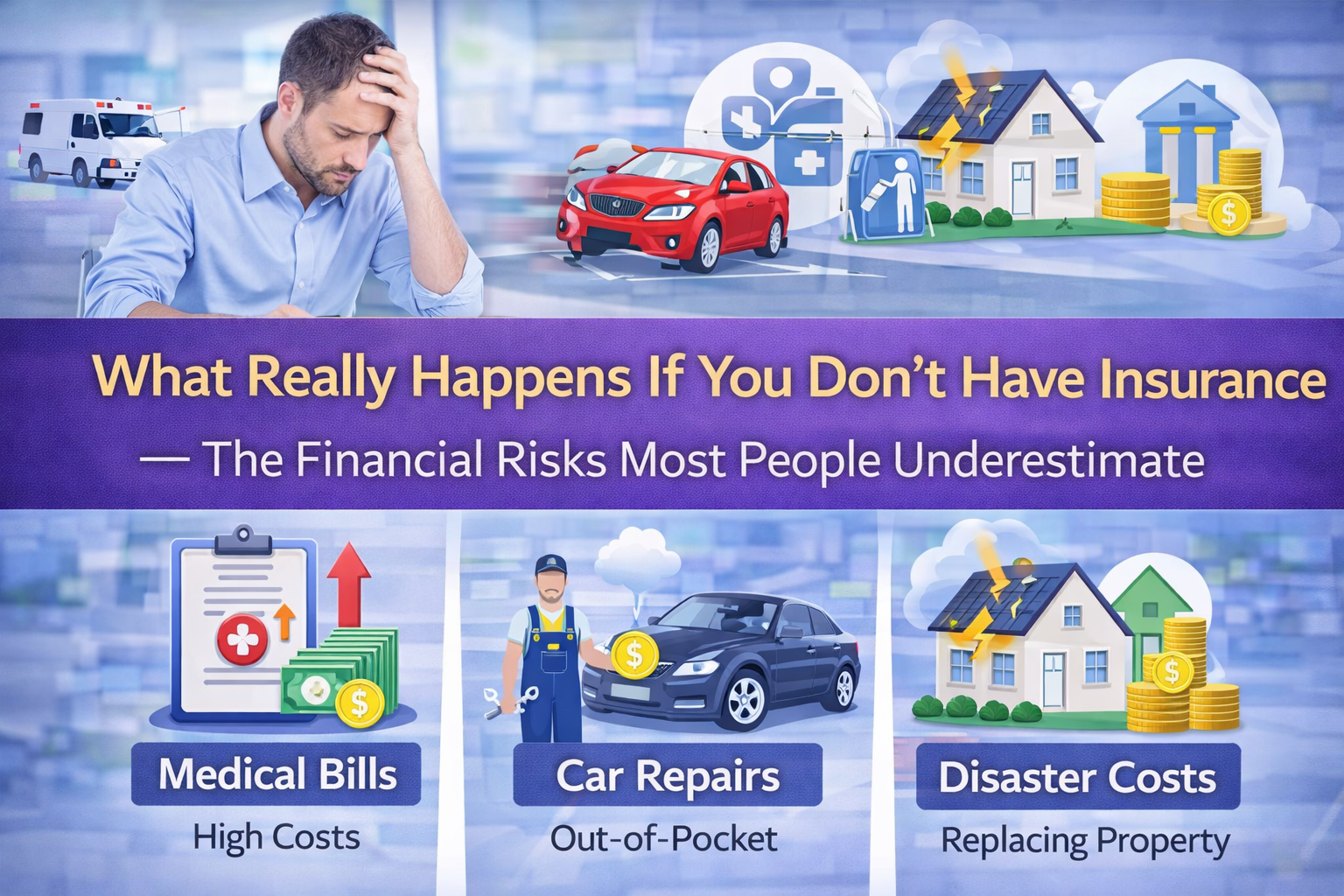
The decision to go without insurance — whether it’s skipping health coverage between jobs, dropping collision on an older car, or operating a small business without liability protection — almost never feels like a dangerous decision at the time. It feels like a practical one. The premium is a real cost that shows up every month. The risk is a theoretical one that may never materialize. When money is tight, eliminating a certain expense to avoid an uncertain one feels rational.
The problem with that reasoning is that the uncertain expense, when it does materialize, is almost always larger than the cumulative premiums that were saved by going without coverage — often by an order of magnitude. The financial risks of being uninsured are not evenly distributed across the possibility space. They’re concentrated in a small number of outcomes that are individually catastrophic rather than spread across many outcomes that are individually manageable.
This guide covers what actually happens — financially, legally, and practically — when specific types of insurance are absent at the moment a covered event occurs. Not hypothetically. Specifically.
What Happens When You Don’t Have Health Insurance
The financial consequences of being uninsured at the moment of a serious medical event are the most severe of any insurance category — because healthcare costs in the United States have reached levels where even a single hospitalization can produce a bill that exceeds most people’s net worth.
The average cost of a three-day hospital stay in the United States is approximately $30,000. A major surgery — a cardiac procedure, a cancer treatment, a serious accident — routinely produces bills in the $100,000 to $500,000 range. An extended ICU stay can exceed $1 million. These are not worst-case numbers. They are typical costs for common medical events that happen to uninsured Americans every day.
The legal consequence of unpaid medical bills is a debt collection process that can include wage garnishment, bank account levies, and liens on property — legal mechanisms that creditors use to recover unpaid balances that the uninsured patient cannot pay. Medical debt is the leading cause of personal bankruptcy in the United States, accounting for a significant proportion of all bankruptcy filings annually. The people filing those bankruptcies are not primarily people who were financially irresponsible in other areas of their lives — they are people who experienced a medical event without insurance and found themselves with a debt that no income or savings could realistically service.
The less catastrophic but still significant consequence of being uninsured is the cost of routine care without insurance negotiated rates. Insured patients pay the contracted rate that their insurance company has negotiated with providers — typically 30% to 60% lower than the list price billed to uninsured patients. An uninsured patient paying list price for a routine blood panel, a specialist visit, or a prescription drug pays significantly more than an insured patient receiving identical care, which compounds the cost of being uninsured beyond the dramatic acute care scenarios.
What Happens When You Don’t Have Car Insurance
Driving without car insurance is illegal in 49 of 50 US states — Virginia being the exception with a fee-based alternative — and the consequences of being caught without it before an accident are significant. The consequences of being in an accident without it are potentially life-altering.
The legal consequences of driving uninsured vary by state but commonly include license suspension, vehicle registration revocation, fines ranging from $500 to $5,000, and in some states, misdemeanor charges that can result in jail time. These consequences apply regardless of whether an accident occurred — simply being stopped and found uninsured triggers them.
When an uninsured driver causes an accident that injures another person or damages another vehicle, the financial consequences become personal liability. Without liability insurance to cover the claim, the at-fault driver is personally responsible for the medical bills, lost wages, and property damage of everyone affected by the accident. In a serious accident involving significant injuries, that personal liability can easily reach $100,000 to $500,000 or more — a debt that follows the uninsured driver through wage garnishment and asset seizure until it’s satisfied.
The consequence that surprises uninsured drivers most is what happens to their own vehicle after an accident they didn’t cause. An uninsured driver hit by an at-fault insured driver can recover damages from the at-fault driver’s liability insurance. But an uninsured driver hit by another uninsured driver — or by a hit-and-run driver — has no uninsured motorist coverage to fall back on and no recourse for their own vehicle damage or injuries beyond suing the other driver directly, which produces a judgment that may be uncollectable if the other driver has no assets.
What Happens When You Don’t Have Homeowners or Renters Insurance
The consequences of being uninsured for home and property losses divide into two scenarios with different financial dynamics — owning without homeowners insurance and renting without renters insurance.
For homeowners, carrying insurance is typically required by the mortgage lender as a condition of the loan — which means most homeowners with mortgages are insured not by choice but by contractual obligation. The uninsured homeowner scenario primarily affects people who own their homes outright and have chosen to self-insure, or people whose insurance lapsed without their mortgage servicer’s knowledge. In these cases, a total loss from fire, tornado, or other covered peril means rebuilding the home entirely from personal funds — a cost that typically ranges from $150,000 to $400,000 or more depending on location and home size.
The more common scenario is homeowners who are technically insured but significantly underinsured — carrying coverage limits that were set years ago and have not kept pace with construction cost increases that have been significant over the past several years. An underinsured homeowner who experiences a total loss discovers that their policy pays out $250,000 in a market where rebuilding the same home now costs $380,000 — leaving a $130,000 gap that personal savings or a second mortgage must fill.
For renters, the consequences of being uninsured are less dramatic but still significant. Renters insurance covers personal property — clothing, electronics, furniture, and other belongings — against theft, fire, and certain water damage events. A renter without coverage who experiences a fire or burglary replaces their belongings entirely out of pocket. The average renters insurance policy costs $15 to $20 per month and covers $20,000 to $30,000 in personal property — a premium-to-coverage ratio that makes renters insurance one of the most cost-effective insurance products available and one of the most frequently skipped by the people who need it most.
What Happens When a Small Business Operates Without Insurance
The financial consequences of operating a business without insurance are the least understood of any insurance category — partly because small business owners tend to be optimistic about risk, and partly because business insurance is a category where the consequences of being uninsured are entirely avoidable through a relatively modest annual investment.
A business without general liability insurance that is sued for a customer injury, property damage, or advertising injury faces the full cost of legal defense and any judgment or settlement from business assets — and when business assets are insufficient, from the personal assets of the business owner in the case of a sole proprietorship or partnership. A single slip-and-fall lawsuit can produce defense costs of $50,000 to $100,000 before any judgment is rendered, and settlements in injury cases regularly reach six figures.
A business without property insurance that experiences a fire, flood, or theft loses its physical assets — equipment, inventory, fixtures, and improvements — without any recovery mechanism. For a business that operates from a physical location with significant equipment or inventory investment, the uninsured loss of those assets can make continued operation impossible rather than merely difficult.
The consequence that most small business owners don’t anticipate is the reputational and contractual impact of being uninsured rather than the direct financial impact. Many commercial leases require tenants to carry liability insurance as a lease condition. Many client contracts — particularly with larger businesses and government entities — require vendors to carry specific insurance coverages and provide certificates of insurance before work begins. A small business without insurance loses those opportunities entirely rather than being exposed to risk — which affects revenue in ways that the premium savings don’t compensate for.
What Happens When You Don’t Have Life Insurance
The consequences of dying without life insurance are not experienced by the person who dies — they’re experienced by the people left behind, which is what makes life insurance the most emotionally complex insurance category and the one where the financial consequences of being uninsured are most directly felt by people other than the policyholder.
A family that loses its primary earner without life insurance coverage faces the simultaneous loss of income and the ongoing cost of living — mortgage payments, car payments, childcare, education costs, and daily living expenses that don’t pause because the income stopped. The financial pressure that follows an uninsured death is the leading cause of forced home sales, children’s education plans being abandoned, and the long-term financial setback of surviving family members who had built their financial lives around an income that no longer exists.
The cost of that outcome — measured in the financial disruption to the survivors — is almost always larger than the cumulative life insurance premiums that would have prevented it. A healthy 30-year-old can purchase a $500,000 term life insurance policy for $20 to $30 per month. The financial protection that $20 to $30 per month provides to a family with dependents is among the highest-value insurance purchases available — and the decision to go without it is one of the most financially consequential underinsurance decisions a family with dependents can make.
The Pattern That Connects Every Uninsured Scenario
Reading through the specific consequences of being uninsured across different coverage categories reveals a pattern that applies to every scenario regardless of the insurance type. The financial risk of being uninsured is not evenly distributed across all possible outcomes — it’s concentrated in low-probability, high-severity events that are individually catastrophic rather than frequent and manageable.
Most people who drive without car insurance for a year don’t have a major accident. Most people who operate a business without liability insurance for a year don’t get sued. Most people who skip health insurance for six months between jobs don’t experience a $200,000 medical event. The problem is that some people do — and the consequences for those people are severe enough to make the insurance purchase rational for everyone, because identifying in advance which people will be among those who do is impossible.
The decision to go without insurance is not a financial decision with a predictable outcome — it’s a bet that you will be among the people for whom the low-probability event doesn’t occur. That bet wins most of the time and loses catastrophically the rest of the time. Understanding that asymmetry is the foundation of every rational insurance decision.
Taking Stock of Where You Actually Stand
The most useful response to understanding the consequences of being uninsured is not anxiety about every possible risk — it’s an honest assessment of which coverage gaps currently exist in your insurance portfolio and which of those gaps represent the most significant financial exposure. Some coverage gaps are acceptable given your specific financial situation and risk tolerance. Others represent exposure to outcomes that would genuinely alter your financial trajectory.
Identifying which is which requires looking at your actual coverage levels against your actual financial exposure — which is a different exercise than checking whether you have a policy in each major category. Having a policy and having adequate coverage are not the same thing, and the gap between them can be as financially consequential as having no coverage at all.
Understanding what’s at risk when you’re uninsured is the first step — understanding the specific mistakes that leave people underinsured or overpaying is the next. Our guide on the most common insurance mistakes that cost people thousands every year covers the errors that create coverage gaps and unnecessary costs across every insurance category, with enough specificity to recognize whether any of them apply to your current situation.
After reading this, where do you feel the most exposed in your current insurance coverage — health, auto, home, life, or business? Leave a comment with your situation and what’s making you reconsider your coverage. We read every response and use the most common concerns to prioritize what we cover next.
Leave a Reply