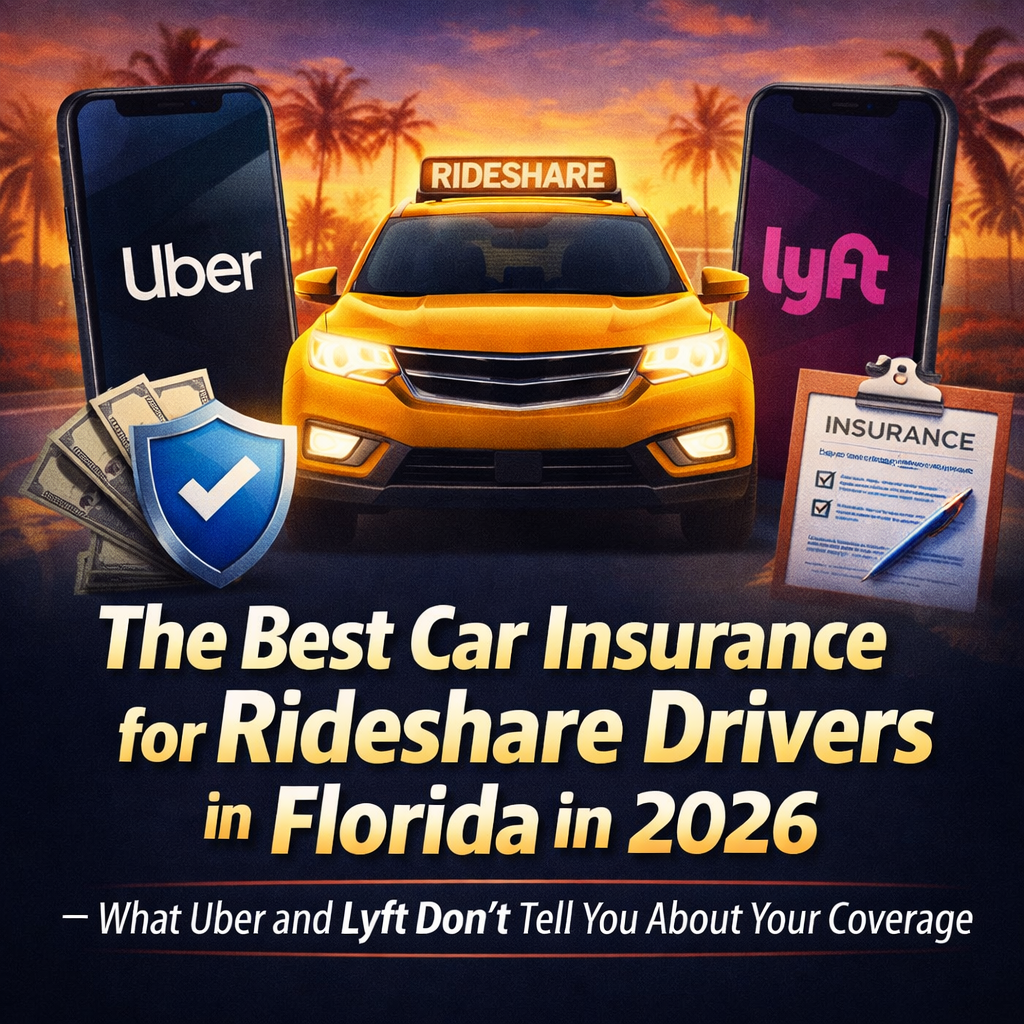
Driving for Uber or Lyft in Florida creates a specific insurance problem that most rideshare drivers discover too late — the moment a claim occurs and the coverage they assumed they had turns out to be the coverage that applies to a different phase of the trip than the one during which the accident happened. The gap between what rideshare drivers think their insurance covers and what it actually covers during different phases of the driving activity is one of the most consequential coverage mismatches in personal auto insurance — and it’s a gap that Uber and Lyft’s own insurance materials don’t make as clear as the financial stakes warrant.
This guide covers the specific coverage structure that applies to rideshare driving in Florida, what Uber and Lyft’s insurance actually provides during each phase of the driving activity, where the gaps appear, and how to structure personal auto insurance to eliminate those gaps rather than discovering them at the worst possible moment.
The Three Phases That Determine Which Insurance Applies
Understanding rideshare insurance requires understanding the three distinct phases that define coverage responsibility during any rideshare trip — because different insurance applies in each phase, and the transitions between phases are where the most significant coverage gaps historically appeared.
Phase one is the period when the rideshare app is off. The driver is using the vehicle for personal purposes — commuting, errands, driving without any rideshare activity. During phase one, the driver’s personal auto insurance policy applies exactly as it would for any personal vehicle use. No rideshare activity is occurring, and the personal policy covers the vehicle and the driver’s liability as it normally would.
Phase two is the period when the rideshare app is on and the driver is waiting for a ride request — available to accept passengers but not yet matched with a specific rider. This is the phase where coverage historically created the most significant gaps, because the personal auto policy typically excludes coverage for commercial activity while the rideshare company’s insurance provided only limited coverage. A driver involved in an accident while waiting for a ride request in phase two found that their personal policy excluded the claim because the vehicle was being used for commercial purposes, and the rideshare company’s coverage was insufficient to cover the full loss.
Phase three is the period from accepting a ride request through completing the trip and ending the ride in the app — the period when a passenger is either in the vehicle or the driver is en route to pick them up. During phase three, both Uber and Lyft provide their most comprehensive commercial insurance coverage, which addresses the liability exposure that the presence of a paying passenger creates.
What Uber and Lyft’s Insurance Actually Covers in Each Phase
The insurance that Uber and Lyft provide for their drivers has specific coverage levels in each phase — and the difference between phases is significant enough to make the phase distinction the most important factor in understanding rideshare coverage.
During phase one — app off — neither Uber nor Lyft provides any insurance coverage. The driver’s personal auto policy is the only applicable coverage, and the claim is handled exactly as any personal vehicle claim would be.
During phase two — app on, waiting for a request — Uber and Lyft currently provide contingent liability coverage in Florida of $50,000 per person and $100,000 per accident for bodily injury, and $25,000 for property damage. This coverage is contingent — it applies only if the driver’s personal auto policy doesn’t cover the claim. Since most personal auto policies exclude commercial activity, the contingent coverage typically becomes primary in practice. But the limits are significantly lower than the phase three coverage and may be inadequate for a serious accident involving significant injuries.
During phase three — en route to or transporting a passenger — Uber and Lyft provide $1 million in commercial liability coverage, uninsured and underinsured motorist coverage, and contingent comprehensive and collision coverage with a $2,500 deductible if the driver carries comprehensive and collision on their personal policy. The $1 million liability limit is genuinely substantial and addresses the most catastrophic liability scenarios a rideshare driver faces.
The Florida-Specific Factors That Affect Rideshare Coverage
Florida’s insurance regulatory environment creates specific considerations for rideshare drivers that don’t apply in every state — and understanding them is part of structuring coverage correctly for Florida-specific driving.
Florida is a no-fault state — which means that regardless of who caused an accident, each driver’s own insurance pays for their own medical expenses through personal injury protection coverage rather than the at-fault driver’s liability insurance covering the victim’s medical costs. The no-fault system requires every Florida driver to carry a minimum of $10,000 in personal injury protection coverage — but for rideshare drivers whose injuries in an at-fault accident might not be covered by the rideshare company’s commercial PIP coverage, confirming that personal PIP coverage applies during rideshare activity is an important step in coverage review.
Florida’s uninsured motorist rate is among the highest in the United States — approximately 20% of Florida drivers are uninsured, which is nearly double the national average. For rideshare drivers spending significantly more time on the road than the average personal driver, the probability of encountering an uninsured driver is elevated relative to the personal driving baseline. Carrying meaningful uninsured motorist coverage on the personal policy — coverage that applies during phase one and potentially supplements the rideshare company’s UM coverage during other phases — is more important for Florida rideshare drivers than for rideshare drivers in states with lower uninsured driver rates.
Florida’s weather patterns — tropical storms, heavy rainfall, flooding — create comprehensive coverage scenarios that are more frequent in Florida than in most states. A rideshare driver whose vehicle is damaged in a flood event during phase two of rideshare activity faces the contingent comprehensive coverage that Uber and Lyft provide in phase two — coverage that applies only if the personal policy doesn’t cover the loss. Personal policies that exclude commercial activity during phase two create a scenario where flood damage to a rideshare vehicle in phase two falls entirely on the driver if neither the personal policy’s commercial exclusion nor the rideshare company’s contingent coverage applies cleanly.
The Personal Policy Problem That Most Rideshare Drivers Ignore
The most significant coverage gap for most rideshare drivers is not the phase two coverage from the rideshare company — it’s the personal auto policy that excludes commercial activity without the driver realizing that the exclusion applies to rideshare driving.
Standard personal auto insurance policies include language that excludes coverage for vehicles used to carry passengers for compensation — language that directly describes rideshare activity. When an accident occurs during phase two or even during phase one after the insurer becomes aware that the vehicle is regularly used for rideshare purposes, the personal policy’s commercial activity exclusion can be applied to deny coverage even for claims that occur during personal use.
The disclosure obligation that most rideshare drivers don’t fulfill is informing their personal auto insurer that the vehicle is used for rideshare activity. Most insurance applications include questions about vehicle use that distinguish personal use from commercial use — and answering those questions without disclosing rideshare activity constitutes a material misrepresentation that can allow the insurer to void the policy retroactively, not just for rideshare-related claims but for all claims.
The practical consequence of operating a rideshare vehicle without disclosing the activity to the personal insurer is that the driver is simultaneously underinsured for rideshare activity — because the personal policy excludes it — and at risk of losing personal coverage entirely — because the undisclosed commercial activity gives the insurer grounds to rescind the policy. The disclosure is not optional — it’s both a contractual obligation and the trigger for the coverage discussion that leads to the correct solution.
The Coverage Solutions That Actually Close the Gap
Three coverage solutions address the rideshare coverage gap in different ways — and the right solution depends on the driver’s insurer, the frequency of rideshare activity, and the coverage levels they want to maintain during all phases of driving.
The rideshare endorsement is the most common and most accessible solution — a policy endorsement added to the personal auto policy that extends personal coverage to rideshare activity during phase two, closing the gap between personal coverage and the rideshare company’s commercial coverage. Major insurers including State Farm, Geico, Progressive, and Allstate offer rideshare endorsements in Florida at additional premium costs that typically range from $15 to $40 per month depending on the insurer and the driver’s profile. The endorsement maintains the personal policy’s coverage limits and claims handling during phase two rather than leaving the driver dependent on the rideshare company’s contingent coverage.
The commercial auto policy is the most comprehensive solution — a policy specifically designed for commercial vehicle use that covers the vehicle across all phases of rideshare activity without the phase-based coverage switching that personal policies with endorsements still involve. Commercial auto policies are significantly more expensive than personal policies with endorsements and are most appropriate for drivers who work full-time for rideshare companies and for whom the vehicle is primarily a commercial asset rather than a personal one.
The hybrid approach — maintaining a personal policy with a rideshare endorsement for phase one and phase two coverage while relying on the rideshare company’s commercial coverage for phase three — is the most cost-effective solution for part-time rideshare drivers. The endorsement cost is modest relative to a full commercial policy, the coverage continuity across all phases is maintained, and the $1 million commercial liability that the rideshare companies provide during phase three adequately covers the highest-liability phase of the activity.
The Insurers That Offer the Best Rideshare Coverage in Florida
Not every major auto insurer offers rideshare endorsements in Florida — and among those that do, the coverage terms, deductible structures, and pricing vary enough to make specific comparison worthwhile before selecting an insurer for rideshare coverage.
State Farm offers a rideshare endorsement in Florida that extends personal coverage to phase two at a competitive additional premium. The endorsement maintains the personal policy’s deductibles and coverage limits during phase two — which means the driver controls the deductible and limit structure rather than accepting the rideshare company’s default terms. State Farm’s claims handling quality and agent network make the endorsement particularly valuable for drivers who want a known claims advocate available when an accident occurs during rideshare activity.
Progressive offers a rideshare endorsement at competitive pricing and with specific advantages for drivers who are already Progressive policyholders — the Snapshot telematics program’s savings potential combines with the rideshare endorsement to produce competitive total pricing for drivers whose driving behavior scores well on the monitored metrics. Progressive’s underwriting philosophy of insuring the full risk spectrum means that drivers with non-preferred personal profiles are more likely to find rideshare endorsement availability at Progressive than at carriers with more selective underwriting.
Allstate offers rideshare coverage in Florida through a specific endorsement that is worth evaluating for drivers who are already Allstate policyholders — the endorsement cost is competitive and the coverage terms are clear enough to evaluate directly against State Farm’s and Progressive’s offerings.
USAA offers rideshare endorsements for eligible military members and veterans — and for drivers who qualify for USAA membership, the combination of USAA’s competitive baseline pricing and the rideshare endorsement produces total rideshare coverage costs that are consistently lower than the alternatives available to non-military drivers.
What to Do Before Your Next Rideshare Shift
The action steps that every rideshare driver in Florida should complete before the next shift — regardless of how long they’ve been driving and regardless of what coverage they think they have — are specific enough to execute in a single afternoon.
Reviewing the personal auto policy’s declarations page and confirming that rideshare activity has been disclosed to the insurer is the first step. If rideshare activity hasn’t been disclosed, disclosing it immediately — even if it results in a policy change or premium adjustment — is preferable to the retroactive coverage denial that undisclosed commercial activity enables.
Calling the personal insurer and asking specifically whether a rideshare endorsement is available in Florida and what it costs is the second step. If the endorsement is available, comparing the endorsement cost against the coverage gap it closes produces the information needed to make a rational purchase decision. If the endorsement isn’t available at the current insurer, getting quotes from State Farm, Progressive, and Allstate for comparable coverage with a rideshare endorsement produces the basis for a switching decision.
Reviewing the rideshare company’s insurance documentation to confirm the current coverage levels in each phase — because Uber and Lyft periodically update their insurance programs and the specific coverage levels can change — is the third step. The rideshare company’s insurance page for drivers provides the current phase-specific coverage details that should be known before every shift rather than assumed from information reviewed months or years earlier.
Understanding rideshare coverage is one piece of the auto insurance picture for drivers with specific vehicle use situations. The broader question of how to structure coverage for the lowest cost without creating gaps applies across every driver profile. Our guide on the best auto insurance companies in 2026 covers which insurers provide the best combination of coverage and pricing across the full range of driver situations — including the specific companies whose rideshare endorsement programs and overall pricing make them worth prioritizing for drivers with commercial use needs.
Currently driving for Uber or Lyft in Florida and not sure whether your current coverage actually covers you during all three phases — or recently had a claim during rideshare activity and discovered a coverage gap you didn’t know existed? Leave a comment with your current coverage structure and which phase the claim occurred in. Real rideshare coverage experiences from Florida drivers are among the most useful information we can share with other drivers in the same situation.