Category: Health Insurance

  • Open Enrollment Explained: The Decisions Most People Rush Through and Later Regret

    Open Enrollment Explained: The Decisions Most People Rush Through and Later Regret

    Open enrollment is the annual window during which most Americans make their health insurance decisions for the following year — and it’s consistently one of the most consequential financial decision periods of the year that receives the least deliberate attention. The typical open enrollment experience involves receiving a benefits packet or a marketplace notification, spending twenty minutes comparing premiums without evaluating the other variables that determine total cost and coverage quality, and selecting either the same plan as last year or the plan with the lowest premium — neither of which is necessarily the right decision for the current year’s healthcare situation.

    The decisions made during open enrollment affect twelve months of healthcare access, healthcare costs, and financial exposure — a full year during which the coverage selected will either match or mismatch the actual healthcare needs it encounters. Understanding what those decisions actually involve, what the variables mean, and how to evaluate them correctly in the time available during open enrollment produces choices that hold up across the coverage year rather than producing surprises at the first significant medical event.


    What Open Enrollment Actually Is and When It Happens

    Open enrollment is the designated period during which health insurance plan changes can be made without a qualifying life event — the annual window when the normal restriction on mid-year plan changes is suspended to allow everyone to reassess their coverage for the coming year.

    For employer-sponsored coverage, the open enrollment period is set by the employer — typically a two to four week window in the fall that precedes the January first coverage start date for most employer plan years. The specific dates vary by employer, and the consequence of missing the employer open enrollment window is being locked into the current year’s coverage for the following plan year unless a qualifying life event occurs.

    For ACA marketplace coverage, the federal open enrollment period runs from November first through January fifteenth — with coverage beginning February first for enrollments completed after December fifteenth. State-based marketplaces may have slightly different dates, and some states have extended their open enrollment periods beyond the federal baseline. Marketplace enrollees who miss the open enrollment window can only change coverage if a qualifying life event — job loss, marriage, divorce, birth of a child, moving to a new coverage area — creates a special enrollment period.

    The critical point about open enrollment timing is that the decisions made during this window are difficult to reverse before the next open enrollment period. A plan selected in November that produces unexpected out-of-pocket costs in March cannot typically be changed until the following November — which makes the twenty minutes that most people spend on the decision disproportionately consequential relative to the time invested.


    The Auto-Renewal Problem That Costs Policyholders Money Every Year

    The most financially consequential open enrollment mistake is not making an active selection — allowing the previous year’s plan to auto-renew without evaluating whether it remains the best option for the current year’s situation. Auto-renewal feels like the path of least resistance — the plan worked adequately last year, the premium increased by some amount, and switching requires research that auto-renewal avoids. The financial cost of this convenience is real and recurring.

    Plans change between coverage years in ways that make last year’s best choice potentially not this year’s best choice. Premiums are repriced annually based on claims experience, and a plan that was competitively priced last year may have repriced above the market this year while competitive alternatives maintained more stable pricing. Formularies are updated annually — drugs that were covered at favorable tiers last year may have moved to higher tiers this year, potentially making a different plan with better formulary coverage for specific medications the more economical choice. Provider networks change — physicians and hospitals leave and join networks between plan years, and a plan whose network included all the providers relevant to last year’s healthcare may have lost a provider relevant to the coming year.

    The marketplace-specific problem with auto-renewal is the benchmark plan change — the second-lowest-cost Silver plan that determines the subsidy amount may change each year, and an enrollee auto-renewing into a plan that is no longer the benchmark may be receiving a subsidy calculated against a lower-cost benchmark while paying a premium that has increased above it. The enrollee who actively shops and selects the new benchmark plan maintains the full subsidy value against the premium — the auto-renewing enrollee may pay a growing gap between the subsidy and the premium that active plan selection would have prevented.


    The Five Decisions That Open Enrollment Actually Requires

    The open enrollment process involves five distinct decisions that are often conflated into a single premium comparison — and separating them produces a more structured evaluation that each decision receives the attention it warrants.

    The first decision is whether the plan type that served last year continues to serve this year — whether the HMO, PPO, HDHP, or EPO structure that was selected previously still matches the healthcare access needs for the coming year. A significant change in healthcare situation — a new specialist relationship, a planned surgical procedure, a move to a new geographic area — may make a different plan type more appropriate than the continuation of the existing type. The plan type decision precedes the specific plan comparison because the options being compared should share the same structure rather than comparing fundamentally different plan designs on premium alone.

    The second decision is the appropriate metal tier — whether Bronze, Silver, Gold, or Platinum coverage produces the best combination of premium and cost sharing at the realistic healthcare usage level anticipated for the coming year. The metal tier decision requires honest assessment of the previous year’s healthcare usage and any anticipated changes — a year with planned surgery justifies a different tier than a year expected to involve only preventive care. The total cost calculation that compares premium plus expected out-of-pocket costs across tiers produces a more informative comparison than premium alone.

    The third decision is the specific plan within the chosen type and tier — which insurer’s plan within the selected structure offers the best combination of network, formulary, premium, and cost sharing for the specific healthcare situation. Within a given metal tier in a geographic market, multiple insurers may offer plans with similar premiums but significantly different networks, cost-sharing structures, and formularies. The specific plan comparison within the tier is where the network verification and formulary review produce the most actionable differentiation between options.

    The fourth decision is the HSA contribution strategy for HDHP enrollees — specifically, what contribution level to commit to for the coming year and whether the investment allocation within the HSA reflects the appropriate strategy for the account’s current balance and the enrollee’s time horizon. The open enrollment period is the natural time to review and adjust the HSA contribution amount alongside the plan selection — because the HDHP enrollment that creates HSA eligibility is confirmed during open enrollment, and the contribution strategy for the coming year should be set at the same time.

    The fifth decision is whether supplemental coverage — dental, vision, critical illness, accident insurance, hospital indemnity — that is offered during open enrollment fills genuine gaps in the primary health coverage or represents redundant spending. Each supplemental product should be evaluated against the primary plan’s coverage for the specific events the supplemental product addresses — not as a bundle of benefits that sounds comprehensive but as individual coverage products that either fill specific gaps or don’t.


    The Network Verification That Most People Skip

    The provider network is the most frequently overlooked open enrollment evaluation variable — and the most commonly regretted omission when a provider change mid-year is required because the selected plan doesn’t include a provider the enrollee expected to continue seeing.

    The network verification that prevents this outcome requires checking each provider that matters for the coming year — not just the primary care physician but every specialist with an established relationship, the hospital that would be used for planned or emergency procedures, and any mental health or specialty providers whose services are anticipated. The verification should be done against the specific plan being considered rather than against the insurer’s general network, because some insurers operate multiple networks with different provider sets across different plan options.

    Provider directories — the searchable databases on each insurer’s website that list in-network providers for specific plans — are the starting point for verification but not the definitive confirmation. Directory accuracy has a known problem — providers who have left the network may remain listed, and providers who have recently joined may not yet appear. Calling the provider’s office directly and confirming acceptance of the specific plan — including the specific plan name and insurance company — produces a more reliable confirmation than the directory alone and takes less than five minutes per provider.

    The consequences of enrolling in a plan without verifying provider inclusion range from inconvenient to financially significant — depending on whether the plan is an HMO or EPO with no out-of-network benefit or a PPO with out-of-network coverage at higher cost sharing. For HMO and EPO plans, an out-of-network provider generates no insurance coverage at all for planned care — the full cost of the service is the enrollee’s financial responsibility. For PPO plans, the out-of-network benefit applies but at cost-sharing levels that produce bills far higher than in-network services for equivalent care.


    The Formulary Review That Prevents Prescription Drug Surprises

    The prescription drug formulary is the plan’s list of covered medications organized by cost-sharing tier — and it changes between plan years in ways that can significantly affect the total cost of coverage for enrollees with regular medication needs.

    The formulary review during open enrollment requires looking up each regularly-used medication in the formulary for each plan under consideration — confirming the tier placement and the applicable cost sharing for each drug. A medication that was on the preferred brand tier with a $35 copay last year may have moved to the non-preferred tier with a $75 copay this year — a change that adds $480 annually to the cost of a single medication and that makes a different plan with better formulary placement for the specific drug the more economical choice despite identical premiums.

    Specialty medications — biologics, specialty injectables, and other high-cost drugs — require particularly careful formulary review because the cost-sharing difference between favorable and unfavorable tier placement can reach thousands of dollars annually. A specialty drug covered at 10% coinsurance with a $150 monthly out-of-pocket cap is a dramatically different financial exposure than the same drug covered at 30% coinsurance without a specialty drug out-of-pocket cap — and both can appear on different plans in the same marketplace at similar premiums.

    The prior authorization requirements that apply to specific medications are equally important to verify during open enrollment — because a plan change may introduce prior authorization requirements for medications that were covered without prior authorization under the previous plan. Prior authorization delays the first fill of a medication until the insurer approves the clinical justification for the specific drug, which creates a gap in medication availability that can be clinically significant for time-sensitive conditions.


    The Life Event Changes That Affect Open Enrollment Outside the Annual Window

    Open enrollment is the annual window for most coverage changes — but qualifying life events create special enrollment periods that allow coverage changes outside the annual window. Understanding which life events trigger special enrollment prevents the assumption that coverage changes must wait for the next annual open enrollment.

    The qualifying life events that trigger special enrollment periods for marketplace coverage include losing other health coverage — including employer coverage, COBRA coverage, or coverage under a parent’s plan — gaining or becoming a dependent through marriage, birth, adoption, or foster care placement, permanently moving to a new coverage area, and certain changes in income or household size that affect subsidy eligibility. Each qualifying life event triggers a sixty-day special enrollment window that begins at the date of the event — missing the sixty-day window typically means waiting until the next annual open enrollment.

    For employer-sponsored coverage, the qualifying life events that trigger a special enrollment period with the employer are similar but defined by the employer’s plan documents rather than the ACA’s marketplace rules. Life events that are qualifying events for the marketplace are typically also qualifying events for employer plans — but the documentation requirements and enrollment deadlines may differ, and confirming the specific employer plan rules at the time of a qualifying event prevents the assumption that marketplace rules apply identically to employer coverage.


    Making Open Enrollment Worth the Time It Deserves

    The gap between the time most people spend on open enrollment decisions and the financial impact those decisions produce over the following twelve months is one of the most consistent and most correctable inefficiencies in personal financial management. The twenty minutes that produces an auto-renewal or a premium-only comparison is not proportional to a decision that affects potentially tens of thousands of dollars in healthcare costs and coverage quality over the following year.

    The two to three hours that a structured open enrollment evaluation requires — reviewing the plan type, metal tier, specific plan options, provider network, formulary, and supplemental coverage decisions against the anticipated healthcare situation for the coming year — produces choices that are genuinely optimized for the specific situation rather than defaulted to the most convenient outcome. The time investment compounds across every open enrollment period where the structured approach produces a better outcome than the default approach would have — and the financial difference between the optimized and the default choice is large enough in many situations to justify the investment many times over.


    Open enrollment decisions set the coverage structure for the full year — but knowing what that coverage actually costs in total, across the full range of healthcare usage scenarios, is the context that makes each open enrollment decision most informed. Our guide on how much does health insurance cost per month in 2026 — real numbers by age, plan type, and state provides the benchmark premium data that puts the specific plan options available during open enrollment in market context, so the comparison is informed by what the broader market offers rather than only the options presented by a single employer or marketplace.


    Currently in open enrollment and finding that the decision is more complex than last year because of a significant change in healthcare situation — a new diagnosis, a planned procedure, or a significant income change that affects subsidy eligibility? Leave a comment with the specific change and the coverage options you’re evaluating. We’ll help you identify which decision matters most for your specific situation and how to evaluate the relevant variables.

  • What Is a Health Savings Account and Why Most People With High-Deductible Plans Are Leaving Money on the Table

    What Is a Health Savings Account and Why Most People With High-Deductible Plans Are Leaving Money on the Table

    The health savings account is the most tax-advantaged account available to American workers and self-employed individuals — more tax-efficient than a traditional IRA, more tax-efficient than a Roth IRA, and more tax-efficient than a 401(k) in the specific context of healthcare spending. The triple tax advantage that the HSA provides — tax-deductible contributions, tax-free investment growth, and tax-free distributions for qualified medical expenses — produces a financial benefit that no other account type replicates for the purpose it serves. And yet the majority of people who are eligible for an HSA either don’t have one, don’t fund it adequately, or don’t invest the balance in a way that realizes the full financial potential that the account structure makes available.

    This guide covers what an HSA actually is, how the tax advantages work in practice, the strategic approaches that maximize its value, and the specific mistakes that prevent most HSA-eligible people from capturing the benefit that the account is designed to provide.


    What Qualifies You for an HSA and What Doesn’t

    HSA eligibility is tied to enrollment in a qualifying high-deductible health plan — not any HDHP, but specifically an HDHP that meets the IRS minimum deductible thresholds and maximum out-of-pocket limits that define HDHP status for HSA eligibility purposes.

    For 2026, the qualifying HDHP must have a minimum deductible of $1,650 for individual coverage and $3,300 for family coverage. The plan’s out-of-pocket maximum must not exceed $8,300 for individual coverage and $16,600 for family coverage. Plans that meet these thresholds are HSA-qualifying HDHPs. Plans that are marketed as high-deductible plans but that don’t meet the IRS threshold definitions — some employer plans use the term loosely — don’t qualify for HSA contribution.

    The eligibility conditions beyond HDHP enrollment are equally specific. An HSA-eligible individual cannot be enrolled in Medicare — Medicare enrollment disqualifies HSA contribution regardless of whether the individual also maintains HDHP coverage for some period. An HSA-eligible individual cannot be claimed as a dependent on another person’s tax return. And an HSA-eligible individual cannot have other health coverage that is not an HDHP — including a spouse’s non-HDHP plan that covers the HSA account holder, a general purpose FSA that covers medical expenses, or VA health benefits for non-service-connected conditions received in the past three months.

    The spouse coverage condition catches many dual-income households that try to combine HDHP enrollment for one spouse with a non-HDHP for the other — if the non-HDHP spouse’s plan covers the HDHP spouse for any medical expenses, the HDHP spouse loses HSA eligibility. The specific household coverage arrangement that maintains HSA eligibility for both spouses requires either both spouses on HDHPs or the HDHP spouse confirming that the non-HDHP spouse’s plan provides no coverage for the HDHP spouse.


    The Triple Tax Advantage Explained in Real Numbers

    The abstract description of the HSA’s triple tax advantage — deductible contributions, tax-free growth, tax-free distributions — becomes concrete and motivating when the actual dollar value of each advantage is calculated for a specific situation.

    For a self-employed individual in the 24% federal tax bracket with a 15.3% self-employment tax rate who contributes the 2026 individual maximum of $4,300 to an HSA, the contribution deduction produces a federal income tax savings of $1,032 plus a self-employment tax savings of approximately $330 — a total immediate tax savings of approximately $1,362 from the contribution alone. The effective cost of the $4,300 contribution is therefore approximately $2,938 after tax savings — a 32% immediate return on the contribution before any investment return or healthcare spending occurs.

    For a W-2 employee whose employer offers payroll HSA contributions — which avoid not just federal income tax but also FICA payroll taxes — the tax savings on a $4,300 contribution at the 22% federal tax bracket plus the 7.65% employee FICA rate produces total tax savings of approximately $1,283 — an immediate 30% return on the contribution.

    The investment growth advantage compounds the initial contribution savings over time. An HSA balance invested in a diversified index fund portfolio grows tax-free — dividends, capital gains, and interest are not taxed within the account. A $4,300 annual contribution invested at a 7% average annual return for twenty years produces an account balance of approximately $177,000 — all of which can be withdrawn tax-free for qualified medical expenses at any point, including in retirement when healthcare spending increases significantly.

    The distribution advantage creates a specific strategic opportunity that distinguishes the HSA from every other tax-advantaged account. Unlike IRAs and 401(k)s, the HSA has no required minimum distributions — the balance can grow indefinitely without forced withdrawals. And unlike FSAs, the HSA balance carries over from year to year without a use-it-or-lose-it requirement. The combination of no required distributions and no use-it-or-lose-it provision makes the HSA ideally suited for a long-term investment strategy that treats the account as a dedicated healthcare investment fund rather than a short-term spending account.


    The Two HSA Strategies and Which Produces More Value

    Most HSA account holders use the account as a spend-as-you-go healthcare fund — contributing money, spending it on current medical expenses, and maintaining a minimal balance. This approach captures the first layer of the HSA tax advantage — the contribution deduction — but forfeits the investment growth advantage that produces the account’s most significant long-term value.

    The investment strategy that produces the maximum long-term HSA value operates differently — contributing the maximum annual amount, paying current medical expenses out of pocket from non-HSA savings, investing the full HSA balance in a growth-oriented portfolio, and preserving the account balance to grow tax-free for future use. The receipts for current medical expenses paid out of pocket are retained without a deadline — the IRS allows HSA distributions for qualified medical expenses to be taken at any point after the expense was incurred, without a time limit. This means a medical expense paid out of pocket in 2026 can be reimbursed from the HSA in 2036, 2046, or at any point when the account balance makes the distribution strategically appropriate.

    The receipt retention strategy transforms the HSA into a tax-free slush fund for future use — a growing pool of unreimbursed medical expenses that can be converted to tax-free cash at any point by submitting the retained receipts for reimbursement. A disciplined account holder who pays fifteen years of medical expenses out of pocket while investing the HSA balance at a 7% average return and retaining all receipts accumulates both a significant investment portfolio and a substantial receipt bank that can be reimbursed tax-free whenever the funds are needed.

    The practical consideration that limits the investment strategy is the requirement to pay current medical expenses from non-HSA savings — which requires maintaining a separate emergency or healthcare fund adequate to cover out-of-pocket costs during the investment accumulation phase. For households without that separate cushion, the spend-as-you-go approach captures the contribution deduction without the investment growth — still valuable, but materially less so than the investment strategy over a long time horizon.


    How to Actually Invest the HSA Balance

    The investment capability that makes the HSA most powerful is the feature that most HSA account holders never activate — because most HSA accounts default to a cash holding that earns minimal interest rather than automatically investing in a diversified portfolio.

    Most HSA providers require a minimum cash balance — typically $1,000 to $2,500 — before allowing investment of the remaining balance in a menu of mutual funds or ETFs. The investment menu quality varies significantly by HSA provider — some offer low-cost index funds with expense ratios below 0.10%, while others offer only higher-cost actively managed funds with expense ratios of 0.50% to 1.00% or more. The expense ratio difference compounds meaningfully over a twenty-year investment horizon — a $50,000 balance growing at 7% gross return loses approximately $5,000 more over ten years to a 1.00% expense ratio than to a 0.10% expense ratio.

    The HSA provider selection decision — which account provider to use for the HSA — is as important as the contribution and investment decisions for maximizing long-term HSA value. Employers that offer employer-sponsored HDHPs often designate a specific HSA provider that the employer HSA contribution flows into — but employees are not required to keep the full HSA balance with the employer-designated provider. Many HSA account holders maintain a small balance with the employer-designated provider for convenient payroll contribution and transfer the majority of the accumulated balance to a self-directed HSA provider that offers superior investment options and lower fees.

    The self-directed HSA providers that offer the most complete investment capabilities — including brokerage accounts with access to individual stocks, ETFs, and a comprehensive mutual fund universe — include Fidelity, which offers an HSA with no account fees, no minimum balance for investing, and access to Fidelity’s full brokerage investment universe. The combination of zero fees and comprehensive investment options makes Fidelity’s HSA the starting point for account holders who want to maximize the investment component of the HSA strategy.


    The Healthcare Expense Categories That HSA Distributions Cover

    The qualified medical expenses that HSA distributions can be used for tax-free are broader than most account holders realize — and the breadth of the eligible expense category creates opportunities to use the HSA for healthcare spending that many people pay from after-tax funds without recognizing the HSA coverage.

    The IRS definition of qualified medical expenses for HSA purposes includes the obvious categories — doctor visits, hospital bills, prescription medications, dental care, vision care, and medical equipment — alongside less obvious categories that most HSA account holders don’t know to claim. Long-term care insurance premiums are qualified HSA expenses up to the age-based annual limit — producing a mechanism for funding long-term care coverage with pre-tax dollars. Medicare premiums — including Medicare Part B, Part D, and Medicare Advantage premiums — are qualified HSA expenses after the account holder reaches age sixty-five, which creates a significant post-retirement healthcare expense funding mechanism. Mental health services, fertility treatments, hearing aids, and a broad range of medical devices are all qualified HSA expenses.

    The COBRA premiums that an HSA account holder pays after a job loss are qualified HSA expenses — which means the HSA balance can fund continuation coverage during a period of unemployment without reducing the tax efficiency of the coverage cost. The combination of HSA-funded COBRA premiums and the existing HSA balance that covers out-of-pocket costs during the unemployment period provides meaningful financial cushion for a period that is both financially stressful and medically risky.


    The HSA in Retirement: The Feature That Changes the Long-Term Calculus

    The HSA’s behavior in retirement is the feature that most clearly distinguishes it from every other tax-advantaged account and that makes it uniquely valuable as part of a long-term retirement financial strategy.

    After age sixty-five, HSA distributions for non-medical expenses are subject to ordinary income tax but not the 10% early withdrawal penalty that applies before age sixty-five. This means the HSA functions identically to a traditional IRA for non-medical expenses in retirement — taxable distributions without penalty. But for medical expenses — which represent a significant and growing portion of retirement spending — HSA distributions remain tax-free.

    The practical implication is that an HSA funded and invested during the working years serves as a healthcare-specific retirement fund that covers medical expenses more tax-efficiently than any other account type. A retiree who estimates $300,000 in lifetime medical expenses after retirement — a conservative estimate based on average retiree healthcare spending — can cover those expenses from the HSA tax-free rather than from IRA or 401(k) distributions that are taxable. The tax savings on $300,000 in retirement medical expenses at a 22% tax rate produces $66,000 in tax savings — the accumulated benefit of the investment strategy applied over a working career.


    The Mistakes That Prevent Most HSA Holders From Capturing Full Value

    The pattern of HSA underutilization follows consistent themes across the population of eligible account holders — and understanding the specific mistakes produces the specific corrections.

    Not opening the HSA despite HDHP eligibility is the most complete failure to capture HSA value — producing zero benefit from an eligibility that costs nothing to activate. The HSA account opens within minutes at any major provider and activates contribution eligibility immediately. Not opening the account is universally irrational for HDHP enrollees who understand the tax advantage — which is why the most common reason for not opening the account is not understanding the benefit rather than any rational trade-off decision.

    Maintaining a cash-only HSA balance rather than investing forfeits the growth advantage that produces the most significant long-term HSA value. The cash-only HSA holder captures only the contribution deduction — a meaningful benefit — while forfeiting the decades of tax-free compounding that the investment strategy adds.

    Not contributing the annual maximum when financially feasible leaves tax savings uncaptured that cannot be recouped — the annual contribution limit resets each year and unused contribution capacity is permanently lost rather than carried forward to future years.


    The HSA is most powerful when paired with a well-selected HDHP — and choosing that HDHP correctly during open enrollment is the foundation that the HSA strategy builds on. Our guide on open enrollment explained — the decisions most people rush through and later regret covers the complete open enrollment decision process with enough specificity to make the annual plan selection as strategically sound as the HSA contribution strategy that follows it.


    Currently enrolled in an HDHP without an HSA — or have an HSA with a cash-only balance that has never been invested? Leave a comment with your current HSA balance, your provider, and the investment options you’ve been offered. We’ll help you identify whether switching providers or activating the investment feature produces meaningful additional value for your specific situation.

  • How to Lower Your Health Insurance Premium Without Losing the Coverage You Actually Need

    How to Lower Your Health Insurance Premium Without Losing the Coverage You Actually Need

    The health insurance premium is the most visible and most complained-about cost in personal finance — a recurring monthly obligation that feels large relative to the immediate value it provides in months when no healthcare is needed and that feels immediately justified the moment a significant medical event occurs. The frustration that drives most premium reduction conversations is legitimate — health insurance is genuinely expensive, particularly for self-employed people and individuals who purchase coverage without employer subsidies. The strategies that address that frustration are more varied and more effective than most people who haven’t researched them realize.

    The distinction that this guide maintains throughout is the difference between reducing the premium by reducing the coverage — which produces lower monthly costs at the expense of the protection the insurance is supposed to provide — and reducing the premium through legitimate strategies that lower the cost without creating the coverage gaps that make lower premiums financially counterproductive. Both outcomes produce a lower number on the monthly bank statement. Only one produces genuine savings.


    Strategy One: Optimize Your Income for Subsidy Eligibility

    For anyone purchasing health insurance through the ACA marketplace — self-employed people, freelancers, individuals between jobs, or anyone without employer-sponsored coverage — the most powerful premium reduction strategy is optimizing modified adjusted gross income to maximize premium tax credit eligibility. The premium tax credit is not a marginal benefit — for income-eligible enrollees, it can reduce the monthly premium by hundreds of dollars, making it the single most impactful lever available.

    The modified adjusted gross income that determines subsidy eligibility is calculated after above-the-line deductions — which means contributions to retirement accounts, health savings accounts, and self-employed health insurance deductions all reduce MAGI and potentially increase subsidy eligibility. A self-employed person whose gross income is $60,000 and who contributes $7,000 to a SEP-IRA and $4,300 to an HSA reduces MAGI by $11,300 — potentially moving from a subsidy phase-out range to a more generous subsidy tier that produces hundreds of dollars in additional monthly premium reduction.

    The income management strategy requires understanding the MAGI calculation specific to the household situation and modeling the subsidy impact of different MAGI levels before making contribution decisions. The healthcare.gov subsidy calculator and most state exchange calculators allow entering different income levels to see the subsidy impact — which produces a concrete estimate of the premium tax credit at different MAGI levels that makes the contribution decision more informed than an abstract understanding of the relationship between income and subsidies.

    The income floor consideration is equally important as the income ceiling — falling below 100% of the federal poverty level in states that haven’t expanded Medicaid produces a coverage gap where Medicaid isn’t available and subsidies don’t apply. Self-employed people whose income is variable should monitor MAGI throughout the year to avoid inadvertently falling below the marketplace subsidy threshold without a Medicaid safety net.


    Strategy Two: Choose the Highest Deductible Your Finances Can Support

    The deductible selection is the most direct premium reduction lever within the plan selection decision — and the relationship between deductible level and premium is consistent enough to treat as a reliable trade-off rather than an uncertain one. Higher deductibles produce lower premiums. Lower deductibles produce higher premiums. The question is which deductible level produces the best financial outcome for the specific household’s savings level and healthcare usage pattern.

    The financial logic that produces the correct deductible decision requires honest assessment of two variables — the emergency savings available to cover the deductible if a medical event triggers it, and the realistic probability of reaching the deductible based on historical healthcare usage. A household with $8,000 in accessible emergency savings and a history of minimal healthcare usage can rationally select a high deductible and bank the premium savings — because the emergency fund covers the deductible if needed and the premium savings accumulate during the majority of years when the deductible isn’t reached.

    The same deductible selection is irrational for a household with $500 in emergency savings — because the deductible that the premium savings are funding would be paid with credit card debt if a medical event occurred, producing interest costs that exceed the premium savings. The deductible should be set at the highest level that the household’s emergency fund can absorb without creating a financial crisis — not the highest level available.

    The HDHP specifically creates an additional premium reduction mechanism through HSA eligibility — the HSA contributions that HDHP enrollment enables produce tax savings that partially fund the higher deductible, effectively reducing the net cost of the high-deductible structure below the gross premium savings that the deductible increase produces. For higher-income households whose marginal tax rate makes HSA deductions particularly valuable, the effective premium reduction from the HDHP-HSA combination can be more significant than the premium comparison alone suggests.


    Strategy Three: Evaluate Whether Your Household Size and Composition Affect Plan Selection

    Household composition affects health insurance premium in ways that most families don’t fully account for when selecting coverage — and the interaction between household composition and the specific coverage needs of each household member produces plan selection decisions that are more nuanced than the premium comparison alone suggests.

    For households where one or more members have significantly different healthcare needs than others — a parent with a chronic condition requiring regular specialist care alongside children who are generally healthy — the plan that optimizes for the high-need member’s cost sharing may not optimize for the overall household premium. In some cases, covering different household members on different plans — a comprehensive plan for the high-need member and a lower-premium catastrophic or HDHP plan for healthy members who don’t have the same cost-sharing needs — produces lower total household costs than a single plan covering all members at the level the highest-need member requires.

    The employer coverage coordination that applies when one household member has access to employer-sponsored coverage and others don’t creates a specific optimization opportunity — the employer-covered member takes the employer coverage, and the remaining household members evaluate marketplace options including subsidy eligibility based on the household members who aren’t offered employer coverage. The interaction between employer coverage affordability rules and marketplace subsidy eligibility is complex enough to warrant specific calculation rather than assumption.


    Strategy Four: Shop the Marketplace Annually Rather Than Auto-Renewing

    The annual open enrollment period is not just an administrative deadline — it’s the premium optimization opportunity that most marketplace enrollees allow to pass by accepting the auto-renewal of their current plan without comparing it against the alternatives that may have changed significantly since the original enrollment.

    Marketplace plan premiums and plan availability change every year — new insurers enter markets, existing insurers reprice plans based on claims experience, and the benchmark silver plan that determines subsidy amounts may change relative to the current plan’s premium. The enrollee who auto-renews without comparison may be on a plan whose premium increased faster than the benchmark while the subsidy remained calculated against the benchmark — producing a net premium increase that a plan switch to the new benchmark would prevent.

    The specific comparison that produces the most complete information during open enrollment reviews the current plan’s premium and cost-sharing structure against the three to five lowest-cost alternatives in the same metal tier — comparing the premium difference against the network and cost-sharing differences that might make the current plan worth a premium premium. The comparison should also verify that the current plan’s formulary still covers the household’s specific medications at acceptable tiers — because formulary changes between plan years occasionally produce situations where switching plans is necessary to maintain affordable access to specific medications.


    Strategy Five: Use Preventive Care to Reduce the Frequency of Larger Claims

    The premium reduction that comes from healthcare utilization management is the least direct strategy on this list — it operates over a multi-year timeframe rather than producing immediate savings — but it’s the strategy with the longest-term impact on health insurance costs because it affects both the current year’s out-of-pocket expenses and the claims experience that drives renewal pricing.

    Preventive care — the annual physical, the recommended screenings, the dental cleaning, the vision exam — is covered at zero cost sharing on all ACA-compliant plans because the evidence that preventive care reduces downstream healthcare costs is strong enough that the ACA mandates its coverage as a mechanism for reducing total healthcare costs across the insured population. The enrollee who consistently uses covered preventive services is identifying health changes at earlier and more treatable stages — which reduces the probability and cost of the larger claims that the preventive care was designed to catch.

    The specific preventive services that produce the most meaningful downstream cost impact include cancer screenings that identify malignancies at earlier and less expensive treatment stages, blood pressure and cholesterol monitoring that identifies cardiovascular risk before it produces acute events, and diabetes screening that identifies pre-diabetes at the stage where lifestyle intervention can reverse the progression before medication and more intensive management become necessary. Each of these services is covered at zero cost sharing and each addresses a condition whose downstream treatment costs can reach tens of thousands of dollars annually when diagnosed at advanced rather than early stages.


    Strategy Six: Review and Eliminate Redundant Coverage

    The household that carries both health insurance and supplemental insurance products — accident insurance, critical illness insurance, hospital indemnity insurance — may be paying for coverage that duplicates what the health insurance already provides rather than filling genuine gaps. The supplemental products that produce genuine value are the ones that address specific financial exposures that the health insurance doesn’t cover — the out-of-pocket costs above what the insurance pays, the income replacement during a disabling illness, the specific services the health plan excludes. The supplemental products that produce minimal value are the ones that pay small benefits for events the health plan handles adequately at costs that are disproportionate to the benefit.

    Reviewing every active supplemental health product against the health plan’s actual coverage for the specific events the supplemental product addresses produces an honest assessment of which supplemental products fill genuine gaps and which represent premium spending with minimal protection value. The products that don’t fill genuine gaps are candidates for elimination — redirecting the premium toward the health insurance premium, the HSA contribution, or the emergency fund that makes a higher health insurance deductible financially viable.


    What Premium Reduction Should Never Cost

    The premium reduction strategies above produce genuine savings without reducing the coverage that matters — but the context for applying them is understanding what premium reduction should never cost.

    Dropping below the ACA minimum essential coverage threshold — selecting non-ACA-compliant coverage specifically to access lower premiums — eliminates the preexisting condition protection, the essential health benefits, and the out-of-pocket maximum that ACA coverage provides. For a healthy person who experiences a covered medical event, the absence of an out-of-pocket maximum on non-compliant coverage transforms a manageable medical cost into a potentially catastrophic one — which is exactly the scenario that the premium reduction was supposed to make less financially painful.

    Selecting a network that doesn’t include the providers needed for specific healthcare requirements in the interest of accessing lower-premium plans with narrower networks creates a coverage gap that isn’t visible at enrollment and becomes expensive at the moment healthcare is needed. The premium saved by selecting a narrow network plan that excludes a necessary specialist is recovered and exceeded the first time that specialist is needed outside the network at full cost.


    With a lower premium secured through the strategies above, the next important health insurance decision for most people is understanding the HSA that pairs with the HDHP — and why most people with high-deductible plans aren’t taking full advantage of the tax savings it provides. Our guide on what is a health savings account and why most people with high-deductible plans are leaving money on the table covers the HSA contribution, investment, and withdrawal strategy that produces the maximum financial benefit from the HDHP-HSA combination.

  • How to Choose a Health Insurance Plan Without a Finance Degree (HMO vs PPO vs HDHP Explained)

    How to Choose a Health Insurance Plan Without a Finance Degree (HMO vs PPO vs HDHP Explained)

    The health insurance plan selection process that most people experience during open enrollment — whether through an employer or the ACA marketplace — presents a set of acronyms, cost-sharing structures, and network configurations that are genuinely confusing without prior familiarity. HMO, PPO, HDHP, EPO, HSA, FSA, deductible, copay, coinsurance, out-of-pocket maximum — each term has a specific meaning that affects how the plan actually works when healthcare is needed, and selecting a plan without understanding those meanings produces coverage decisions that feel reasonable at enrollment and produce surprises when a medical event makes the details suddenly relevant.

    This guide explains the plan types, cost-sharing structures, and decision framework that produce an informed plan selection — in plain language that doesn’t assume prior familiarity with insurance terminology and that produces actionable guidance rather than a glossary.


    The Plan Type Decision That Determines How You Access Care

    The most fundamental decision in health insurance plan selection is the plan type — which determines the network of providers available, whether a primary care physician is required, and whether referrals are needed to see specialists. Getting the plan type right for the specific healthcare situation produces a coverage experience that matches the expectation. Getting it wrong produces the frustration of discovering network limitations, referral requirements, or out-of-network costs at the moment healthcare is needed.

    The HMO — Health Maintenance Organization — is the most restrictive plan type in terms of network and access rules. HMO enrollees must use providers within the plan’s network for all non-emergency covered care, must select a primary care physician who coordinates their care within the network, and must obtain referrals from the primary care physician before seeing specialists. The restrictions that make HMO plans less flexible are the same restrictions that make them less expensive — the insurer’s ability to direct enrollees to contracted providers and coordinate care through a gatekeeper PCP produces cost savings that the insurer passes on as lower premiums and lower cost sharing.

    The HMO is the right choice for enrollees who have a primary care physician they trust and value, who live in an area with a robust HMO network that includes the specialists and facilities they’re likely to need, and who are comfortable with the referral process that coordinates specialist access. It’s the wrong choice for enrollees who frequently see specialists without referral, who travel regularly and need out-of-network coverage in different markets, or who have established relationships with out-of-network providers they’re not willing to change.

    The PPO — Preferred Provider Organization — provides network flexibility that HMO plans don’t. PPO enrollees can see any provider — in-network or out-of-network — without a primary care physician gatekeeper and without referrals for specialist access. In-network providers are covered at the higher in-network benefit level, and out-of-network providers are covered at a lower benefit level that applies higher cost sharing and doesn’t count out-of-network costs toward the in-network out-of-pocket maximum in most PPO designs. The flexibility that makes PPO plans more accessible also makes them more expensive — the higher premiums and cost sharing that PPO plans carry relative to HMO plans reflect the broader network access and the absence of the cost-control mechanisms that gatekeeping and network restriction provide.

    The PPO is the right choice for enrollees who value the freedom to see any provider without referral, who have established relationships with specific specialists they intend to continue seeing, or who travel frequently enough that access to out-of-network coverage is a genuine operational need. It’s harder to justify for enrollees who primarily use in-network primary care and have no specific out-of-network access needs — because the PPO premium premium buys flexibility that goes unused.

    The EPO — Exclusive Provider Organization — occupies a middle position between the HMO and PPO that most people haven’t encountered until they see it on an enrollment menu. EPO plans provide in-network-only coverage without the primary care physician requirement and referral process that HMO plans impose — which produces some of the flexibility advantage of the PPO without the out-of-network coverage that the PPO premium funds. EPO premiums are typically between HMO and PPO premiums, and the plan type is most appropriate for enrollees who want specialist access without referrals but who are willing to accept network-only coverage in exchange for lower premiums than the PPO alternative.


    The HDHP: The Plan Type That Requires the Most Understanding

    The High-Deductible Health Plan is the plan type whose name accurately describes its most distinctive characteristic — and whose financial logic requires more explanation than the name provides to evaluate correctly as a coverage option.

    An HDHP is defined by minimum deductible thresholds set by the IRS — for 2026, the minimums are $1,650 for individual coverage and $3,300 for family coverage. The HDHP’s high deductible means the enrollee pays the full cost of most medical services until the deductible is met — the plan begins paying benefits only after the enrollee has spent the deductible amount on covered services in the coverage year. Preventive care is the exception — ACA-required preventive services are covered at zero cost sharing on HDHPs as on all ACA-compliant plans, regardless of whether the deductible has been met.

    The financial rationale for the HDHP centers on the health savings account eligibility that HDHP enrollment creates. An enrollee in a qualifying HDHP can contribute to an HSA — a tax-advantaged account whose contributions are tax-deductible, whose investment growth is tax-free, and whose distributions for qualified medical expenses are tax-free. The triple tax advantage of the HSA is the most favorable tax treatment available for healthcare spending — which produces a genuine financial advantage for HDHP enrollees who fund the HSA at meaningful levels.

    The HDHP-HSA combination is most financially advantageous for three specific enrollee profiles — healthy young adults who use minimal healthcare and who can fund the HSA to build a medical expense reserve at favorable tax treatment, higher-income enrollees whose marginal tax rate makes the HSA deduction particularly valuable, and financially disciplined enrollees who will actually fund the HSA rather than simply carrying the HDHP without the corresponding savings strategy. For enrollees who don’t fund the HSA and who have regular healthcare needs that will be paid fully out of pocket until the high deductible is met, the HDHP may produce higher total costs than a comprehensive plan with a lower deductible and higher premium.


    The Cost-Sharing Structure That Determines What You Pay After the Deductible

    Understanding the plan type is the first layer of the plan selection decision — understanding the cost-sharing structure is the second layer that determines what the plan actually costs at different levels of healthcare usage.

    The deductible is the amount the enrollee pays before the plan begins covering costs — which means every dollar of covered medical expense below the deductible is fully the enrollee’s responsibility. A plan with a $2,000 deductible and a specialist visit that costs $350 requires the enrollee to pay the full $350 if the deductible hasn’t been met — insurance coverage begins only after the deductible is satisfied.

    The copayment is a fixed dollar amount the enrollee pays for a specific service — typically a flat amount like $25 for a primary care visit or $50 for a specialist visit. Copayments apply after the deductible is met in most plan designs, though some plans apply copayments to specific services like primary care visits before the deductible is satisfied. Copayments are predictable — the enrollee knows the exact cost of a covered service before receiving it — which makes cost planning more straightforward than the percentage-based coinsurance structure.

    The coinsurance is the percentage of covered costs the enrollee pays after the deductible is met — typically 20% to 40% depending on the plan and the service type. A plan with 20% coinsurance and a $5,000 hospital bill after the deductible is met requires the enrollee to pay $1,000 and the insurer to pay $4,000. The unpredictability of coinsurance — which depends on the total cost of the service rather than a fixed amount — makes it the cost-sharing mechanism that produces the most budget surprises, particularly for inpatient and surgical services where the total cost varies widely.

    The out-of-pocket maximum is the annual ceiling on the enrollee’s total cost-sharing obligation — after reaching this amount, the plan covers 100% of covered costs for the remainder of the coverage year. The ACA out-of-pocket maximum for 2026 is $9,100 for individual coverage and $18,200 for family coverage — the maximum financial exposure from healthcare cost sharing regardless of how much healthcare is received above those amounts. The out-of-pocket maximum is the feature that prevents catastrophic medical events from producing infinite financial exposure — and it’s the feature that distinguishes ACA-compliant coverage from the short-term plans and health sharing arrangements that don’t provide equivalent protection.


    The Network Evaluation That Affects Whether the Plan Works for Your Situation

    The plan’s cost-sharing structure determines what the coverage costs — the network determines whether the coverage works for the specific healthcare situation. A plan with excellent cost-sharing terms that doesn’t include the providers the enrollee needs to see is a poor fit regardless of the financial attractiveness of the coverage terms.

    Verifying network inclusion before enrollment is the step that prevents the most expensive coverage surprises — the specialist who has managed a chronic condition for years, the hospital that provides the surgical procedure the enrollee anticipates, the mental health provider whose availability is limited and whose wait list took months to navigate. Each provider that matters for the specific enrollee’s situation should be verified in the plan’s online provider directory or by calling the provider’s office to confirm acceptance of the specific plan — because provider directory accuracy varies enough that directory verification alone occasionally misses providers who have left the network since the directory was last updated.

    The consequence of unknowingly selecting an out-of-network provider on an HMO or EPO plan is the full cost of the service without insurance coverage — the out-of-network exception that most HMO and EPO plans include for emergencies doesn’t extend to planned care with an out-of-network provider. For PPO enrollees, the out-of-network benefit applies but at significantly higher cost sharing — typically a $6,000 out-of-network deductible and 40% to 50% coinsurance that produces out-of-pocket costs far above the in-network alternative for the same service.


    The Total Cost Calculation That Compares Plans Correctly

    The plan comparison that produces the most informed selection calculates the total cost of each option at realistic healthcare usage levels rather than comparing premiums alone — because the premium comparison ignores the deductible, copayment, and coinsurance differences that determine total cost at any usage level.

    The total cost calculation for each plan considers the annual premium — twelve times the monthly premium — plus the expected out-of-pocket costs at the estimated annual healthcare usage level. For a healthy enrollee who uses minimal healthcare, the expected out-of-pocket cost is low for all plans, which shifts the comparison toward the premium — lower premium plans produce lower total cost when out-of-pocket exposure is minimal. For an enrollee with regular healthcare needs — chronic condition management, specialist visits, prescription medications — the out-of-pocket cost differential between plans is significant enough to shift the comparison toward the plan with lower cost sharing despite its higher premium.

    The healthcare usage scenarios worth calculating are typically three — the healthy year with minimal usage, the average year with moderate usage, and the high-usage year that approaches the out-of-pocket maximum. Comparing total costs across all three scenarios identifies which plan produces better outcomes across the full range of realistic usage levels rather than optimizing for one scenario that may not be the most likely.


    The Prescription Drug Coverage Evaluation That Most People Forget

    Prescription drug coverage is a component of health insurance that most people don’t evaluate until the first prescription reveals that the drug they expected to be covered is on a different formulary tier than anticipated — producing a copayment that’s significantly higher than expected or a prior authorization requirement that delays access to a medication the prescriber has already ordered.

    The formulary — the plan’s list of covered drugs organized by cost-sharing tier — determines how each medication is priced under the coverage. Tier one drugs are typically generic medications with the lowest copayments. Tier two drugs are preferred brand medications with moderate copayments. Tier three and tier four drugs are non-preferred brand and specialty medications with the highest cost sharing — sometimes 30% to 40% coinsurance on specialty drugs that can produce monthly out-of-pocket costs of hundreds or thousands of dollars.

    Verifying that specific regularly-used medications appear on each plan’s formulary at an acceptable tier — before enrollment rather than after — is the prescription drug coverage evaluation that prevents the formulary surprise. Most insurers provide formulary search tools on their enrollment websites that allow looking up specific medications by name and seeing the tier and copayment that applies under the specific plan. For enrollees with specialty medications, the tier verification is the most financially consequential step in the plan comparison.


    Choosing the right plan structure is one piece of the health insurance decision — knowing how to lower the premium without losing the coverage that matters is the other piece that affects the ongoing affordability of whatever plan is chosen. Our guide on how to lower your health insurance premium without losing the coverage you actually need covers the specific strategies that reduce premium costs without creating the coverage gaps that make lower premiums financially counterproductive.


    Currently in open enrollment and trying to decide between two or three specific plan options — or recently enrolled in a plan that’s producing higher out-of-pocket costs than expected because the deductible or coinsurance is higher than anticipated? Leave a comment with the plan types you’re comparing and your typical annual healthcare usage. We’ll help you calculate which option produces the better total cost for your specific situation.

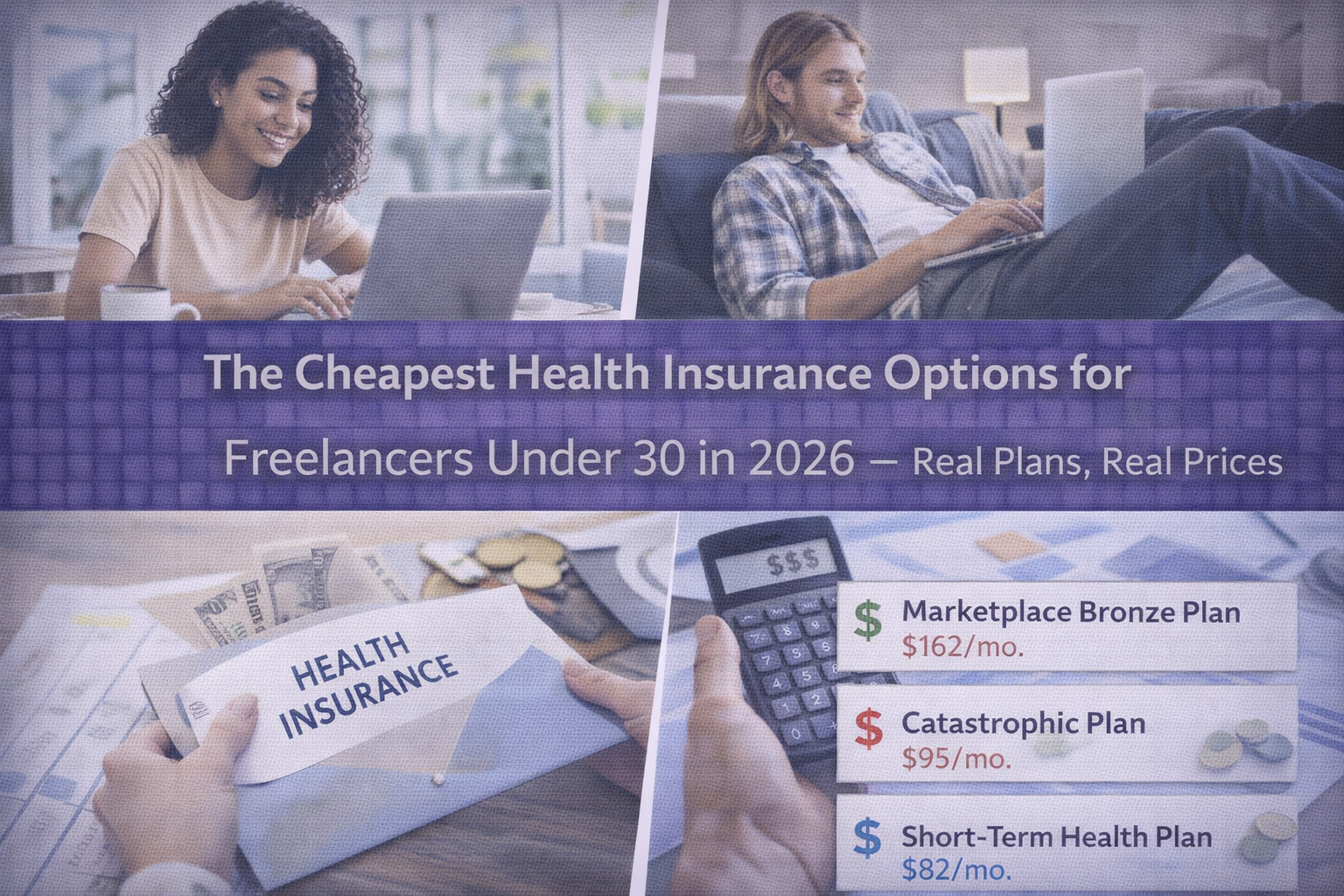
  • The Cheapest Health Insurance Options for Freelancers Under 30 in 2026 — Real Plans, Real Prices

    The Cheapest Health Insurance Options for Freelancers Under 30 in 2026 — Real Plans, Real Prices

    Freelancers under thirty occupy a specific position in the health insurance market that produces genuinely favorable options — options that older freelancers and higher-income self-employed people don’t have access to in the same combination. The age rating that makes health insurance expensive for fifty-year-olds works in reverse for twenty-five-year-olds, producing premiums that reflect the actuarial reality of low healthcare utilization among young healthy adults. The income levels that characterize many early-career freelancers produce subsidy eligibility that further reduces the net premium. And the health status that most people under thirty can claim produces favorable underwriting classification that maximizes the value of every coverage option.

    The challenge is knowing which options to evaluate and how to compare them honestly — because the health insurance landscape for young freelancers includes everything from genuine value to strategically packaged inadequate coverage that looks affordable until a medical event reveals what it doesn’t cover. This guide covers the specific plans and price ranges that represent genuine value for freelancers under thirty in 2026.


    The Marketplace Bronze Plan: The Starting Point for Income-Eligible Freelancers

    The ACA marketplace Bronze plan is the starting point for any freelancer under thirty whose income falls within the subsidy-eligible range — and the combination of age-based low gross premiums and income-based subsidies produces net premiums that are genuinely difficult to undercut through any alternative coverage path.

    The gross premium for a twenty-five-year-old purchasing a Bronze plan in a mid-cost market runs approximately $200 to $280 per month before any subsidies — reflecting the age rating that produces the most favorable baseline for young enrollees. For a freelancer with an income of $30,000 — approximately 240% of the federal poverty level — the premium tax credit reduces this gross premium by approximately $150 to $200 per month, producing a net premium of $50 to $100 per month for catastrophic financial protection that includes a $0 preventive care benefit and out-of-pocket maximum protection that caps annual financial exposure.

    The Bronze plan’s high deductible — typically $6,500 to $8,000 for individual coverage — is the trade-off for the low premium that makes it the cheapest comprehensive option. For a healthy twenty-five-year-old whose annual healthcare usage consists of preventive visits covered at zero cost and perhaps one or two minor care events, the deductible is rarely reached and the out-of-pocket cost of the occasional medical visit is manageable relative to the premium savings compared to higher-tier plans. The financial protection that the out-of-pocket maximum provides — capping total annual exposure at approximately $9,100 for 2026 — is the genuine value that differentiates the Bronze plan from the catastrophic coverage and short-term health insurance that appear cheaper but provide less protection.


    The Catastrophic Plan Option for Freelancers Under Thirty

    The catastrophic health plan is a marketplace option that is exclusively available to people under thirty — an age-limited coverage tier that provides the lowest premiums in the marketplace in exchange for a very high deductible that applies to almost all medical expenses before coverage begins.

    The catastrophic plan’s deductible for 2026 is equal to the ACA’s out-of-pocket maximum — approximately $9,100 for individual coverage — which means the insurer pays essentially nothing until the enrollee has spent $9,100 on covered medical expenses in a coverage year. The coverage above that threshold provides the same financial protection as any other ACA-compliant plan — 100% of covered costs after the deductible is met, with no lifetime or annual benefit maximum.

    The catastrophic plan includes three primary care visits per year at a zero-cost-sharing rate before the deductible — a provision that makes the plan genuinely functional for routine care rather than being purely a financial backstop with no accessible benefits. Preventive care is also covered at zero cost sharing as with all ACA-compliant plans, which means the catastrophic plan provides meaningful access to the care that matters most for maintaining health — preventive screenings, immunizations, and the primary care visits that catch developing conditions before they become expensive.

    The premium for a twenty-five-year-old catastrophic plan enrollee runs approximately $150 to $220 per month in most markets — below the Bronze plan premium but not dramatically so. The limitation that most significantly affects the catastrophic plan’s value for income-eligible freelancers is the subsidy ineligibility — premium tax credits cannot be applied to catastrophic plans, which means a freelancer who qualifies for a substantial subsidy may find that a subsidized Bronze plan produces a lower net premium than an unsubsidized catastrophic plan despite the Bronze plan’s higher gross premium.

    The comparison that determines whether the catastrophic plan or the subsidized Bronze plan produces the better outcome requires calculating the net premium for each option — unsubsidized catastrophic premium versus subsidized Bronze premium — rather than comparing gross premiums that don’t reflect the subsidy’s impact. For freelancers with incomes below 250% of the federal poverty level, the subsidized Bronze plan almost always produces a lower net premium than the unsubsidized catastrophic plan.


    The Silver Plan With Cost-Sharing Reductions: Underutilized by Freelancers Who Need It Most

    The Silver plan with cost-sharing reductions is the most underutilized option in the marketplace for lower-income freelancers — and it’s underutilized because the subsidy calculation that makes it so valuable isn’t intuitive until the specific numbers are presented.

    Cost-sharing reductions are available to enrollees whose income falls between 100% and 250% of the federal poverty level — approximately $15,000 to $37,500 for an individual in 2026. The reductions apply only to Silver plans and reduce the deductible, copayments, and out-of-pocket maximum to levels that make the Silver plan function more like a Gold or Platinum plan in terms of cost-sharing while the premium reflects the Silver plan’s lower baseline.

    The specific improvement that cost-sharing reductions produce at the 200% to 250% of poverty income range — approximately $30,000 to $37,500 for an individual — is significant enough to make the Silver plan financially superior to the Bronze plan at realistic healthcare usage levels despite its higher gross premium. The enhanced Silver plan at this income level might carry a $500 deductible and a $2,500 out-of-pocket maximum rather than the standard $4,000 deductible and $7,900 out-of-pocket maximum — which produces dramatically better cost protection for a freelancer who has any regular healthcare needs.

    The freelancer who selects a Bronze plan because it has the lowest premium without evaluating whether their income qualifies for cost-sharing reductions on the Silver plan may be paying the Bronze plan premium while being eligible for a Silver plan that provides significantly better cost sharing at a net premium that is higher by only $20 to $50 per month after subsidies. The cost-sharing improvement on the Silver plan typically far exceeds the premium difference for freelancers who have any regular healthcare utilization.


    Medicaid: The Genuinely Free Option for Lower-Income Freelancers

    For freelancers whose income falls below 138% of the federal poverty level — approximately $20,700 for an individual in 2026 in states that have expanded Medicaid — Medicaid provides comprehensive health coverage at zero premium with minimal cost sharing. The coverage quality varies by state but universally includes hospital care, physician services, preventive care, mental health services, and prescription drug coverage — the same essential health benefits that marketplace plans provide.

    The Medicaid eligibility threshold that applies to freelancers is based on current monthly income rather than prior-year income — which means a freelancer whose income is variable can qualify for Medicaid during low-income months and transition to marketplace coverage during higher-income months through the special enrollment provisions that exist for income changes. Managing this transition correctly — enrolling in Medicaid when income falls below the threshold and enrolling in a marketplace plan when income rises above it — requires attention to the enrollment timelines and procedures that vary by state but that most state Medicaid agencies are equipped to handle through a streamlined application process.

    The practical consideration that affects Medicaid’s value for freelancers is provider access — Medicaid’s reimbursement rates are lower than commercial insurance rates, which produces a provider acceptance rate that varies significantly by state and by specialty. In states with robust Medicaid provider networks, the coverage functions comparably to commercial insurance for most healthcare needs. In states with limited Medicaid provider networks, accessing specialists and certain services requires more navigation than commercial insurance enrollees experience.


    Health Sharing Ministries: Evaluating Them Honestly

    Health sharing ministries — organizations where members share each other’s medical costs through a structured program rather than purchasing traditional insurance — appear consistently in health insurance comparisons for young freelancers because their monthly share amounts can be significantly below ACA marketplace premiums.

    The honest evaluation of health sharing ministries requires acknowledging both their genuine advantages and their structural limitations relative to traditional insurance. The monthly share amounts for young, healthy members can run $150 to $250 per month for coverage levels that cost $300 to $400 per month on the ACA marketplace without subsidies — a genuine cost difference that reflects the selective membership that health sharing programs maintain rather than the open enrollment that ACA plans must accept.

    The structural limitations that make health sharing ministries inappropriate as a primary coverage solution for many freelancers are specific and consequential. Health sharing programs are not insurance — they have no legal obligation to pay any specific claim, and the sharing decision for each claim is made by the organization rather than determined by a policy contract that creates enforceable rights. Preexisting conditions are typically excluded or subject to waiting periods — a freelancer with a chronic condition who joins a health sharing ministry may find that condition-related expenses are not eligible for sharing. Mental health services and prescription drug coverage are handled inconsistently across programs — some include them and others exclude or significantly limit them.

    The appropriate framing for health sharing ministries in the young freelancer’s coverage evaluation is as a potential option for genuinely healthy individuals with no preexisting conditions, no regular prescription needs, and no mental health service requirements — who are considering the program with full understanding that the cost sharing is voluntary rather than contractually obligated. For freelancers who meet this profile and who have evaluated a specific program’s sharing history and membership agreement carefully, health sharing can represent a legitimate cost management strategy. For freelancers who have any regular healthcare needs, the apparent premium savings carry coverage gaps that make the comparison less favorable than the monthly cost suggests.


    Short-Term Health Insurance: When It Makes Sense and When It Doesn’t

    Short-term health insurance is the coverage option that appears most often in low-cost health insurance searches and that produces the most significant coverage disappointments when claims reveal what the low premium actually buys.

    Short-term health insurance for freelancers under thirty is only appropriate in genuinely short-term gap situations — a freelancer between projects who will have employer-sponsored coverage available within sixty to ninety days, a recent graduate in the sixty-day special enrollment window after aging off parents’ coverage who needs gap coverage while evaluating marketplace options. In these specific situations, a short-term plan’s lower premium is a reasonable cost for temporary coverage of catastrophic risks while the permanent coverage decision is being finalized.

    Short-term health insurance is not appropriate as a long-term coverage strategy for freelancers who need comprehensive protection — the preexisting condition exclusions, benefit limits, and non-ACA-compliant coverage structure that make short-term plans less expensive also make them inadequate substitutes for the comprehensive coverage that ACA marketplace plans provide at net premiums that are genuinely competitive after subsidies for most income-eligible freelancers.


    The Decision Process That Produces the Right Plan

    The coverage decision process that produces the best outcome for freelancers under thirty follows a specific sequence that evaluates options in the order of their financial accessibility rather than their premium alone.

    Starting with Medicaid eligibility — confirming whether current income falls below the Medicaid threshold in the specific state — identifies the zero-premium option before evaluating any paid coverage. If income is above the Medicaid threshold, calculating the premium tax credit for the benchmark Silver plan at the specific income level determines the subsidy amount that applies to any marketplace plan. Comparing the net cost of the subsidized Silver plan — particularly if cost-sharing reductions apply — against the unsubsidized catastrophic plan identifies which produces the lower net premium for the specific income and usage profile. Evaluating whether the self-employed health insurance deduction applies and how it affects the effective cost of the chosen option produces the final after-tax cost that represents the true out-of-pocket impact.


    Finding the cheapest health insurance is one dimension of the coverage decision — choosing between the HMO, PPO, and HDHP plan structures that exist within each price tier is the other dimension that affects how the coverage actually works when healthcare is needed. Our guide on how to choose a health insurance plan without a finance degree — HMO vs PPO vs HDHP explained covers the plan structure decision in plain English so the coverage that’s selected actually functions the way the premium suggests it should.


    Currently a freelancer under thirty navigating the health insurance decision for the first time — or already on a plan that felt like the right choice at enrollment but is producing higher out-of-pocket costs than expected? Leave a comment with your state, approximate income, and the plan type you’re currently on or evaluating. We’ll help you identify whether a different option would produce better total cost for your specific situation.

  • How Much Does Health Insurance Cost Per Month in 2026 — Real Numbers by Age, Plan Type, and State

    How Much Does Health Insurance Cost Per Month in 2026 — Real Numbers by Age, Plan Type, and State

    The health insurance cost question that most people ask — “how much does health insurance cost per month?” — produces answers that range from $150 to $2,000 or more depending on the variables that the question doesn’t specify. Age, plan type, geographic market, household size, and income level all affect the premium independently and in combination, which means the answer that’s accurate for a twenty-eight-year-old in Texas is genuinely different from the answer that’s accurate for a fifty-two-year-old in New York — not because the insurers are arbitrary but because the risk and regulatory factors that drive premium calculations vary enough across those dimensions to produce dramatically different results.

    This guide provides the specific numbers that the general question doesn’t — organized by the variables that matter most so the reader can locate the relevant range for their specific situation rather than averaging across a population whose characteristics may be entirely different.


    The Variables That Determine Your Specific Premium

    Before the numbers, understanding which variables drive premium calculations prevents the mistake of applying a figure that was accurate for a different profile to a situation where it produces a misleading estimate.

    Age is the most significant premium driver in the individual and small group health insurance markets — ACA regulations allow insurers to charge older enrollees up to three times the premium of younger enrollees for the same plan, producing a premium range within a single plan that varies by a factor of three across the age distribution. A Bronze plan that costs $200 per month for a twenty-five-year-old might cost $550 per month for a fifty-five-year-old on the same plan in the same market — not because the coverage is different but because the age rating produces a different base premium for each age.

    Plan metal tier determines the actuarial value and therefore the cost-sharing structure — which affects both the premium and the out-of-pocket costs that determine the total effective cost of coverage at any usage level. Bronze plans carry the lowest premiums and the highest deductibles and cost-sharing. Platinum plans carry the highest premiums and the lowest deductibles and cost-sharing. Silver plans occupy the middle position and are the only tier at which cost-sharing reductions apply for income-eligible enrollees.

    Geographic market — specifically the rating area within each state — affects premium because health insurance premiums are set at the local level rather than the national level. Provider costs, hospital prices, utilization rates, and insurer competition vary enough across geographic markets to produce meaningful premium differences for identical coverage. Rural areas often have less insurer competition and higher provider prices relative to the local economy — producing premiums that can be higher than urban markets despite lower overall cost of living.

    Income level affects the net premium — the amount the enrollee actually pays after premium tax credits — more than any other variable for ACA marketplace enrollees. The premium tax credit calculation produces a net premium that is pegged to a specific percentage of income for benchmark Silver plan coverage — which means the net premium is determined more by income than by the gross premium in many subsidy-eligible situations.


    Individual Coverage Premiums by Age — Unsubsidized Marketplace Rates

    The unsubsidized marketplace premium ranges below reflect 2026 benchmark data across major markets — they represent the gross premium before any tax credits are applied and before the self-employed health insurance deduction reduces the effective cost. The ranges reflect the variation across geographic markets rather than national averages that may be far from any specific location’s actual pricing.

    For a twenty-five-year-old individual purchasing a Silver plan, the monthly premium range across major markets runs from approximately $280 to $420 — with lower-cost markets in the South and Midwest and higher-cost markets in the Northeast and West Coast urban areas. The Bronze plan for the same individual runs approximately $200 to $300 per month — and the Gold plan runs approximately $360 to $520 per month.

    For a thirty-five-year-old individual, the age rating increase produces Silver plan premiums in the range of $320 to $480 per month — approximately 14% to 18% above the twenty-five-year-old rate in the same market. The Bronze and Gold tiers scale proportionally with the same age rating multiplier.

    For a forty-five-year-old individual, the Silver plan premium range moves to approximately $420 to $640 per month — approximately 50% above the twenty-five-year-old rate reflecting the steeper age rating that applies in the middle age ranges. The premium increase between thirty-five and forty-five is typically larger than the increase between twenty-five and thirty-five because the mortality and utilization rate increases accelerate in the mid-forties.

    For a fifty-five-year-old individual, the Silver plan premium range reaches approximately $590 to $900 per month in most markets — approaching the three-to-one age rating maximum relative to the youngest enrollees. The fifty-five-year-old premium reflects the combination of the maximum age rating and the typically higher provider utilization that older enrollees experience.

    For a sixty-four-year-old — the oldest age at which marketplace coverage applies before Medicare eligibility at sixty-five — the Silver plan premium range reaches approximately $650 to $1,100 per month unsubsidized in major markets. The combination of the maximum age rating and the high-cost geographic markets produces premiums at this age that make marketplace coverage genuinely expensive for income-ineligible enrollees.


    Family Coverage Premiums and How They Scale

    Family coverage premiums are calculated by adding the individual premiums for each covered family member — the family doesn’t receive a single family rate but rather an aggregation of individual premiums with an age cap that limits the number of children’s premiums charged regardless of family size.

    A family of four — two adults at thirty-five and two children — in a mid-cost market might pay approximately $1,100 to $1,600 per month for a Silver plan unsubsidized. The children’s premiums reflect the youngest age rating tier rather than the parents’ age tier, which makes children’s premiums significantly lower than adult premiums on a per-person basis. The family out-of-pocket maximum — which is twice the individual out-of-pocket maximum for ACA-compliant family plans — determines the maximum financial exposure the family faces regardless of how many family members experience medical events in a coverage year.

    The subsidy calculation for family coverage is based on the premium for the benchmark Silver plan covering all family members — which means the subsidy for a family is proportionally larger than for an individual in many income scenarios, producing a net family premium that is more affordable relative to income than the unsubsidized comparison suggests.


    What Subsidies Do to These Numbers

    The premium tax credits that apply to marketplace enrollment for income-eligible enrollees transform the premium landscape significantly — producing net premiums that bear little relationship to the unsubsidized rates above for a substantial portion of the self-employed and individual market population.

    For a single individual with an income of $35,000 in 2026 — approximately 280% of the federal poverty level — the premium tax credit for a benchmark Silver plan in a typical market might reduce the gross premium by $250 to $400 per month, producing a net premium of $80 to $150 per month for coverage that costs $330 to $550 per month unsubsidized. The effective net premium at this income level reflects a subsidy that covers the majority of the gross premium — making marketplace coverage genuinely affordable for many self-employed people whose gross income appears too high for assistance until the subsidy calculation is actually performed.

    For a family of four with a household income of $75,000 — approximately 290% of the federal poverty level for a four-person household — the premium tax credit might reduce the benchmark Silver plan premium by $800 to $1,200 per month, producing a net family premium in the range of $200 to $400 per month. The subsidy at this income and household size reflects the ACA’s design to make family coverage affordable for working and middle-class households that lack employer-sponsored coverage.

    The cliff that ended enhanced subsidies has been replaced by a more gradual phase-out under the current law extending the American Rescue Plan’s enhanced premium tax credits — which means there is no longer an income level at which a small increase produces a dramatic subsidy loss. The phase-out is gradual enough that modest income management through retirement and HSA contributions can produce meaningful subsidy increases for self-employed people near the phase-out ranges.


    Employer-Sponsored Coverage Premiums for Comparison

    The employer-sponsored coverage premium that employees see in their paycheck deductions dramatically understates the true cost of the coverage — which is an important reference point for self-employed people who are comparing their health insurance cost against what they paid as employees.

    The average employer-sponsored family plan premium in 2026 runs approximately $24,000 to $26,000 per year — of which employees pay approximately $6,000 to $7,000 and employers pay approximately $18,000 to $19,000. The employee’s perception of health insurance cost as $500 per month reflects only the employee contribution — not the $1,500 per month employer contribution that represents the full insurance cost.

    The self-employed person comparing marketplace coverage against employer-sponsored coverage should compare the marketplace net premium against the employee contribution from the former employment — not the total employer-sponsored plan cost. A marketplace Silver plan at a net $300 per month after subsidies and the self-employed deduction is a reasonable comparison against a $450 per month employee contribution for employer-sponsored coverage — but not an unfavorable comparison against the full $2,000 per month employer-sponsored plan cost that the employer was paying.


    State Variations That Produce the Most Significant Premium Differences

    The geographic premium variation that produces the most significant real-world differences reflects both insurer competition dynamics and state regulatory environments that affect how plans are priced and what they must cover.

    States with robust insurer competition — states where five or more insurers actively compete across all rating areas — typically produce lower benchmark premiums than states where one or two insurers dominate specific markets. States that have expanded Medicaid under the ACA have lower individual marketplace enrollment among lower-income populations — which concentrates marketplace enrollment in income ranges that produce lower average risk and therefore lower benchmark premiums in some market configurations.

    The states with the lowest average marketplace premiums in 2026 include several Southern and Midwestern states — Georgia, Mississippi, Indiana — where lower underlying healthcare costs and provider prices produce lower insurer costs that translate into lower premiums. The states with the highest average marketplace premiums include Alaska, Wyoming, and several Northeastern states where provider costs, state regulatory requirements, and market concentration produce higher insurer costs.

    The variation between the lowest-cost and highest-cost states for equivalent coverage can reach 100% or more — a thirty-five-year-old purchasing a Silver plan might pay $300 per month in a low-cost state and $600 per month in a high-cost state for equivalent coverage. For self-employed people whose work location is flexible — fully remote workers, consultants who can choose their state of residence — the geographic premium variation is a genuine financial consideration that can produce thousands of dollars in annual premium savings through residential location decisions.


    The Total Cost of Coverage: Premium Plus Out-of-Pocket Exposure

    The premium comparison that most health insurance evaluations center on is incomplete without the out-of-pocket cost comparison — because the total effective cost of coverage at any usage level reflects both the premium and the deductibles, copayments, and coinsurance that apply when care is received.

    A Bronze plan’s lower premium is funded by a higher deductible — typically $6,000 to $8,000 for individual coverage — which means the Bronze enrollee who uses moderate amounts of healthcare pays the full cost of care up to the deductible before insurance coverage begins. The Silver plan’s higher premium comes with a lower deductible — typically $2,000 to $4,000 — which means insurance coverage begins earlier in the usage cycle. The break-even analysis between Bronze and Silver — the healthcare usage level at which the Silver plan’s higher premium is offset by its lower deductible — typically falls somewhere between $2,000 and $6,000 in annual healthcare costs.

    For a consistently healthy person who uses minimal healthcare — annual preventive visits and nothing beyond — the Bronze plan’s lower premium produces lower total costs because the deductible is never reached. For a person with regular medication needs, chronic condition management, or any predictable annual healthcare usage, the total cost analysis frequently favors the Silver or Gold plan despite the higher premium — because the cost sharing that applies at moderate usage levels produces total costs that exceed the Silver plan’s total costs at equivalent usage.


    The premium numbers in this guide establish the cost baseline — the next question for most self-employed people and freelancers is which specific plan structure produces the best coverage at the lowest cost for their specific situation. Our guide on the cheapest health insurance options for freelancers under 30 in 2026 covers the specific plan combinations and subsidy scenarios that produce the most favorable outcomes for younger self-employed people whose health status and income profile make specific options particularly advantageous.


    Looking at these premium ranges and finding that your current health insurance cost is significantly above what the numbers here suggest for your age and income level — or trying to determine whether a Bronze, Silver, or Gold plan produces better total cost at your typical healthcare usage level? Leave a comment with your age, state, household size, and approximate income range. We’ll help you identify whether there’s a more cost-effective option available for your specific profile.

  • The Best Health Insurance for Self-Employed People in 2026 (Ranked by Cost and Coverage)

    The Best Health Insurance for Self-Employed People in 2026 (Ranked by Cost and Coverage)

    Health insurance is the financial challenge that stops more people from pursuing self-employment than any other single factor — and for good reason. The employer-sponsored health insurance that most American workers take for granted represents a significant subsidy that disappears the moment someone leaves traditional employment. The self-employed person who replaces that subsidy with individual market coverage faces premiums that reflect the full cost of the coverage rather than the fraction that employees see in their paycheck deductions — and that full cost is high enough to be genuinely disruptive to the financial planning of someone building a business or freelance practice from scratch.

    The good news is that the health insurance options available to self-employed people in 2026 are more varied and more financially accessible than the sticker shock of individual market premiums suggests — because the combination of Affordable Care Act marketplace subsidies, health sharing arrangements, professional association group plans, and high-deductible plan structures creates a range of options that produce coverage at costs significantly below the unsubsidized individual market rate for most self-employed people.


    The Subsidy Calculation That Changes Everything for Lower and Middle Income Self-Employed

    The most important piece of information for any self-employed person evaluating health insurance is the income threshold at which ACA marketplace subsidies — the premium tax credits that reduce the cost of marketplace plans — apply to their situation. For self-employed people whose income falls within the subsidy-eligible range, the effective cost of marketplace coverage is dramatically lower than the unsubsidized premium that dominates the headline comparison.

    The premium tax credits that reduce marketplace plan costs are calculated based on modified adjusted gross income — which for self-employed people includes business income minus the self-employment tax deduction and other above-the-line deductions. The subsidy calculation is on a sliding scale that provides the most generous credits to lower incomes and phases out as income rises — with the exact phase-out threshold varying based on household size and the benchmark plan premium in the specific geographic market.

    The practical implication for a self-employed individual whose income is variable — as most self-employed income is — is that proactive income management can affect subsidy eligibility in ways that produce meaningful health insurance cost reductions. A self-employed person who can manage their MAGI to remain within the subsidy-eligible range through retirement account contributions, health savings account contributions, and business expense deductions may produce a subsidy that reduces their effective health insurance premium significantly below what the unsubsidized rate would suggest.

    The enrollment process for marketplace coverage — through healthcare.gov for most states or the state-specific exchange for states with their own platforms — requires income estimation rather than income documentation, which means self-employed people can enroll based on their best estimate of the current year’s income and reconcile with actual income at tax filing. The reconciliation produces either additional credits if actual income was below the estimate or repayment of excess credits if actual income exceeded the estimate — a dynamic that requires careful income monitoring throughout the year rather than one-time enrollment.


    The Four Main Coverage Options and What Each Produces

    The health insurance landscape for self-employed people in 2026 includes four main coverage pathways — each with different premium structures, coverage characteristics, and financial implications that make them appropriate for different self-employed profiles.

    The ACA marketplace plan is the most comprehensive and most regulated option — plans that meet the ACA’s minimum essential coverage requirements, cover preexisting conditions without exclusions or premium surcharges, and provide the essential health benefits that include hospitalization, prescription drug coverage, mental health services, and preventive care. For self-employed people who qualify for premium tax credits, the marketplace plan often provides the best combination of coverage quality and net cost after subsidies.

    The metal tier structure within the marketplace — Bronze, Silver, Gold, and Platinum — reflects the actuarial value of each plan level and determines the cost-sharing structure rather than the coverage breadth. Bronze plans have the lowest premiums and the highest out-of-pocket costs, with actuarial values around 60% — meaning the plan covers approximately 60% of average covered medical costs. Silver plans at 70% actuarial value balance premium and cost-sharing more evenly and are the tier at which cost-sharing reductions apply for income-eligible enrollees. Gold plans at 80% and Platinum plans at 90% produce lower out-of-pocket costs in exchange for higher premiums.

    The cost-sharing reduction that applies to Silver plans for income-eligible self-employed people is one of the most underutilized benefits in the marketplace — providing enhanced cost-sharing that reduces deductibles, copayments, and out-of-pocket maximums for enrollees whose income falls within the eligible range. A self-employed person who qualifies for both a premium tax credit and cost-sharing reductions on a Silver plan receives a combination of premium reduction and cost-sharing improvement that can make a Silver plan more financially favorable than a Bronze plan despite the higher premium — because the effective out-of-pocket maximum at actual usage levels is lower for the enhanced Silver plan than for the Bronze plan.


    The High-Deductible Health Plan and HSA Combination for Higher Income Self-Employed

    For self-employed people whose income exceeds the subsidy threshold — or who have sufficient income that the premium reduction from subsidies doesn’t significantly change the financial analysis — the high-deductible health plan paired with a health savings account is the coverage structure that produces the best combination of premium savings and tax efficiency.

    High-deductible health plans carry lower premiums than equivalent comprehensive plans — reflecting the higher out-of-pocket exposure that the deductible structure creates. For 2026, an HDHP must have a minimum deductible of $1,650 for individual coverage and $3,300 for family coverage, with out-of-pocket maximums of $8,300 for individuals and $16,600 for families.

    The health savings account that pairs with the HDHP creates the tax efficiency that makes the combination particularly advantageous for self-employed people. HSA contributions are tax-deductible regardless of whether the contributor itemizes — which means the contribution reduces federal income tax and self-employment tax simultaneously. For a self-employed person in the 24% federal tax bracket with a 15.3% self-employment tax rate, each dollar contributed to the HSA produces approximately $0.39 in combined federal income and self-employment tax savings — a 39% effective return on the HSA contribution before any investment return on the account balance.

    The 2026 HSA contribution limits of $4,300 for individual coverage and $8,550 for family coverage produce maximum annual tax savings of approximately $1,677 for individuals and $3,335 for families at the 24% federal bracket plus the self-employment tax deduction. These savings partially offset the HDHP’s lower premium relative to comprehensive coverage, making the total effective cost of the HDHP-HSA combination lower than the headline premium comparison suggests.


    COBRA as a Transition Option

    Self-employed people who recently left employer-sponsored coverage have a transitional option that exists for eighteen months following the employment separation — COBRA continuation coverage that extends the former employer’s group health plan coverage at the employee’s expense.

    COBRA coverage is the most expensive health insurance option for most people — the premium reflects the full group plan cost including the employer’s contribution that the employment relationship previously subsidized — but it provides continuity of coverage without underwriting, which means preexisting conditions, ongoing treatments, and established provider relationships continue without interruption during the transition period.

    The COBRA comparison against marketplace coverage requires looking at both premium and coverage quality simultaneously rather than premium alone. COBRA’s premium is typically higher than the unsubsidized marketplace alternative but may be lower than the net marketplace premium after subsidy for income-eligible self-employed people. COBRA’s coverage quality — the specific plan that the former employer provided — may be higher or lower than available marketplace plans depending on the former employer’s plan quality and the available marketplace options in the specific geographic market.

    The eighteen-month COBRA window provides enough time to establish the self-employment income history that makes marketplace enrollment and subsidy estimation more accurate — which makes COBRA a rational transition strategy for people who are uncertain about their first-year self-employment income and who want to delay marketplace enrollment until the income picture is clearer.


    Professional Association and Trade Organization Group Plans

    The health insurance options that most self-employed people overlook are the group plans available through professional associations, trade organizations, and industry groups — coverage that is structured as group insurance rather than individual coverage and that sometimes produces pricing advantages not available in the individual market.

    The Freelancers Union, the National Association for the Self-Employed, various industry-specific professional associations, and some chambers of commerce offer health insurance products to members at group pricing that reflects the collective bargaining power of the membership. The specific products and pricing vary significantly by organization and geographic market — some offer genuinely competitive coverage at rates below the individual market, and others offer products that aren’t competitive with marketplace alternatives after subsidies.

    The evaluation process for association health plans requires the same comparison as any other coverage option — getting the specific premium and coverage details and comparing them against the marketplace alternatives available in the same geographic market. The comparison should account for the membership cost of the association alongside the insurance premium to produce a total effective cost that’s comparable to the marketplace option that doesn’t require membership.


    Short-Term Health Insurance for Specific Gap Situations

    Short-term health insurance — coverage that provides limited benefits for defined periods of ninety days to twelve months depending on state regulations — is available to self-employed people who need gap coverage during transition periods or who are in specific situations where comprehensive coverage isn’t the right immediate solution.

    Short-term health insurance is explicitly not ACA-compliant coverage — it doesn’t cover preexisting conditions, doesn’t provide the essential health benefits that ACA plans require, and can impose benefit limits that comprehensive coverage doesn’t. These limitations make short-term health insurance inappropriate as a primary coverage solution for self-employed people who need comprehensive protection — but potentially useful for specific short gap situations where the alternative is a period of complete uninsurance rather than inadequate coverage.

    The specific situations where short-term coverage is worth considering — a self-employed person waiting for the next ACA open enrollment period, someone between business launches who expects comprehensive coverage to be available within ninety days — are narrower than the marketing for short-term health insurance suggests. For most self-employed people, the qualifying life event provisions that allow marketplace special enrollment outside the standard open enrollment period — including the loss of employer coverage that triggers a sixty-day special enrollment window — make short-term insurance less necessary than it appears.


    The Deduction That Reduces the Effective Cost for All Self-Employed People

    The self-employed health insurance deduction is a tax provision that allows self-employed individuals to deduct 100% of health insurance premiums paid for themselves and their families from federal income tax — an above-the-line deduction that reduces adjusted gross income regardless of whether the taxpayer itemizes.

    The deduction applies to premiums paid for medical, dental, and long-term care insurance — not to out-of-pocket medical costs but to the premium itself. The deduction is limited to the net profit of the self-employment activity — a self-employed person whose business produces $30,000 in net profit can deduct up to $30,000 in health insurance premiums but not more than the profit amount.

    The effective cost reduction from the self-employed health insurance deduction depends on the marginal tax rate — at a 22% federal tax rate, a $600 monthly premium produces a $1,584 annual tax savings that reduces the effective premium from $7,200 to $5,616. At a 24% rate, the same premium produces a $1,728 annual savings. The deduction doesn’t reduce self-employment tax — only income tax — but it reduces the MAGI that determines subsidy eligibility, which can affect the subsidy calculation for income-borderline self-employed people in a way that compounds the direct deduction benefit.


    Understanding the health insurance options for self-employed people is the foundation — understanding exactly what those plans cost at different ages and income levels is the next layer of specificity that makes the coverage decision concrete. Our guide on how much does health insurance cost per month in 2026 — real numbers by age, plan type, and state covers the specific premium ranges that self-employed people actually pay across the major coverage options, with enough geographic and demographic specificity to make the comparison relevant to your specific situation.


    Currently self-employed and navigating the health insurance decision for the first time — or already covering yourself as a self-employed person but wondering whether you’re on the most cost-effective option for your current income level? Leave a comment with your approximate income range, household size, and state. We’ll help you identify which coverage pathway is most likely to produce the best combination of coverage and cost for your specific situation.