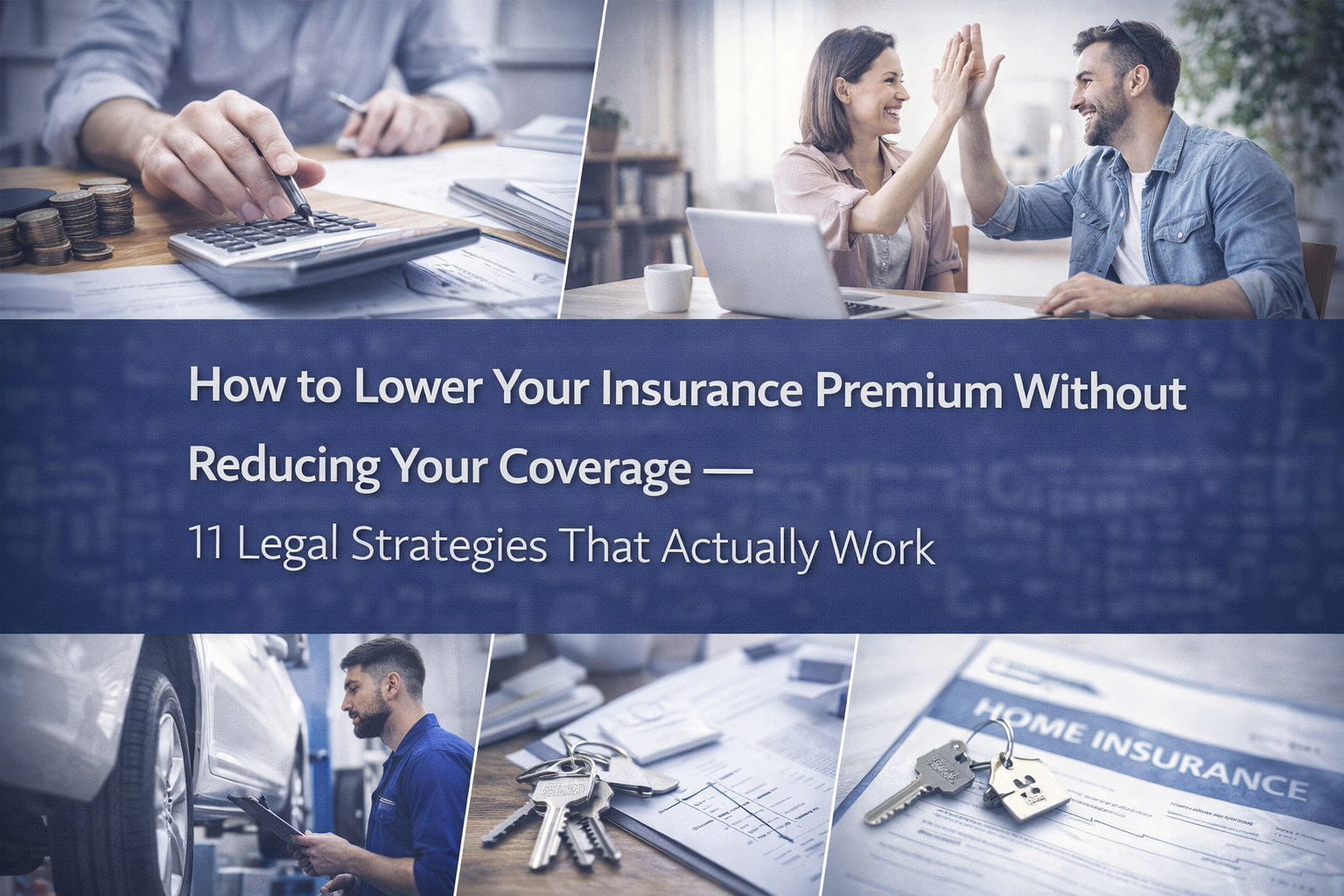
The instinct to reduce insurance costs by reducing coverage is the most common and most financially dangerous response to premium increases — because it produces lower monthly costs at the expense of the protection that made the insurance worth buying in the first place. The driver who drops liability limits to save $40 per month, the homeowner who removes replacement cost coverage to reduce the annual premium by $200, and the small business owner who lets a professional liability policy lapse between engagements are all making the same mistake — eliminating protection that was providing genuine value in exchange for savings that will be reversed and exceeded the first time a significant claim occurs without adequate coverage in place.
This guide covers eleven strategies that produce genuine premium reductions without creating coverage gaps — approaches that lower the cost of insurance by reducing the insurer’s risk, improving the information used in rating, or optimizing the coverage structure rather than by reducing the protection the coverage provides.
Strategy One: Shop Competitively at Every Renewal
The premium that an insurance company charges at renewal is not necessarily the lowest price available in the market for the same coverage — and the loyalty that most policyholders extend to their current insurer produces a premium that is frequently above what a competitive shopping process would reveal.
Insurance companies price new business differently from renewal business — new customer acquisition pricing reflects competitive market pressure that renewal pricing doesn’t always match. A policyholder who has been with the same insurer for five years may be paying 15% to 30% more than a new customer with an identical risk profile who switched to the same insurer recently. Shopping coverage at every renewal rather than accepting the renewal premium without comparison produces savings that compound annually for policyholders who find and switch to more competitive alternatives when the differential justifies the switching cost.
The comparison that produces the most complete picture gets quotes from at least three insurers — including at least one the current insurer doesn’t know is being evaluated — for identical coverage. Identical coverage means the same limits, the same deductibles, the same endorsements, and the same coverage types. A lower premium on different coverage is not a competitive comparison — it’s a coverage trade-off that looks like savings until the coverage difference matters.
Strategy Two: Raise Deductibles to the Level Your Emergency Fund Supports
The deductible adjustment is the most direct premium reduction lever available across every insurance category — and the relationship between deductible level and premium is consistent and calculable rather than uncertain. Higher deductibles produce lower premiums. The question is which deductible level produces the best financial outcome for the specific financial situation.
The correct deductible level is the highest amount that liquid emergency savings can absorb without creating financial hardship — not the highest level available, not the lowest level that feels comfortable, but the amount that reflects the household’s or business’s actual financial resilience at the worst possible moment. A household with $8,000 in accessible emergency savings can rationally carry a $2,500 homeowners deductible — the emergency fund covers the deductible if needed without creating a crisis. The same deductible on a household with $800 in savings produces a payment problem at exactly the moment when the financial pressure of the covered loss is already significant.
The premium savings from raising deductibles are specific enough to calculate before implementing the change — calling the current insurer and asking for the premium difference between the current deductible and a higher deductible produces the specific savings figure that makes the financial analysis concrete rather than estimated.
Strategy Three: Bundle Policies With the Same Insurer — But Verify the Math
The bundling discount — the premium reduction available when multiple policies are purchased from the same insurer — is the most widely advertised insurance saving strategy and the one most frequently accepted without verification that it actually produces net savings.
The bundling discount is real — typically 5% to 25% on each bundled policy. But whether it produces genuine net savings depends on whether the bundled insurer’s base rates are competitive enough that the discount closes the gap with unbundled alternatives. The insurer offering a 20% bundling discount on homeowners insurance that is 35% more expensive than a competing insurer’s homeowners rate produces a net homeowners cost that is still 15% above the competitor — not savings, despite the advertised discount.
The verification that most policyholders skip is comparing the total bundled cost against the total unbundled cost of the best available quote for each coverage from the most competitive carrier in each category. When the bundled total is lower, bundle. When the unbundled total is lower, buy each coverage from the most competitive carrier regardless of the bundling discount. The verification takes thirty minutes and produces the correct answer rather than the assumption that bundling always saves money.
Strategy Four: Improve the Rating Factors That Drive Your Premium
Insurance premiums are calculated from rating factors that the insurer uses to assess risk — and several of those factors are within the policyholder’s control over time even when they can’t be changed immediately. Improving the controllable rating factors produces premium reductions that compound annually rather than producing a one-time savings.
Credit score is a rating factor for auto and homeowners insurance in most states — and the relationship between credit improvement and premium reduction is meaningful enough to treat credit improvement as an insurance savings strategy rather than purely a general financial goal. A policyholder who moves from a fair credit tier to a good credit tier may reduce auto insurance premiums by 20% to 40% in states where credit rating is permitted — savings that persist annually rather than requiring repeated action.
Claims history is the rating factor most directly within the policyholder’s control through the claim filing decision — the choice to file a small claim or pay out of pocket. Every at-fault claim filed creates a claims history record that affects premiums for three to five years. For claims where the recovery is only modestly above the deductible, paying out of pocket preserves the claim-free history and avoids surcharges that may exceed the recovery amount over the surcharge period.
Driving record affects auto insurance premiums through the violation and accident surcharges that apply for three to five years following the events — surcharges that compound the base rate by 20% to 50% per violation or accident. The premium cost of driving violations extends well beyond the fine and point assessment — modeling the total insurance cost of a speeding ticket over the full surcharge period produces a cost that typically exceeds the fine by a factor of three to five.
Strategy Five: Claim Every Discount You Qualify For
The discount gap — the difference between the discounts a policyholder qualifies for and the discounts actually applied to the policy — costs the average policyholder hundreds of dollars annually. Insurers offer discounts willingly but rarely volunteer them proactively — the policyholder who doesn’t ask doesn’t receive discounts that the insurer would apply if asked.
The systematic discount audit that produces the most complete discount capture asks specifically about each major discount category rather than asking generally whether discounts are available. The categories worth asking about specifically include good driver and claim-free discounts for auto and home, professional and organizational affiliation discounts across all lines, safety device and security system discounts for auto and home, defensive driving course discounts for auto, loyalty discounts for multi-year policyholders, and administrative discounts for paperless billing and autopay enrollment.
The affinity discount category is the most frequently unclaimed — many employers, professional associations, alumni organizations, and military service organizations have negotiated insurance discounts that members qualify for without knowing the discount exists. Asking the insurer specifically about affiliation discounts for each organizational membership produces the information needed to claim discounts that may not appear in the online quote process without the specific prompt.
Strategy Six: Eliminate Coverage That No Longer Applies to Your Situation
The coverage portfolio that was appropriate at an earlier life stage may include coverage types that no longer address genuine financial exposures — and eliminating coverage that doesn’t apply to the current situation produces premium savings without creating coverage gaps because the protection was already providing no practical value.
Collision and comprehensive coverage on a vehicle whose value has depreciated to the point where the maximum insurance payout — actual cash value minus deductible — is smaller than the annual premium multiplied by the expected holding period is the most common example of coverage that no longer justifies its cost. A vehicle worth $3,500 with a $1,000 deductible and $700 annual collision and comprehensive premium produces a maximum net payout of $2,500 that requires only 3.6 years of premium to exceed — suggesting that self-insuring the remaining vehicle value through emergency savings produces better expected financial outcomes than continuing the coverage.
Rental car reimbursement coverage on a household with multiple vehicles is coverage that provides minimal practical value — the household can use another vehicle during repairs rather than needing a rental reimbursement. Roadside assistance coverage on a vehicle already covered by a membership service like AAA duplicates a benefit already paid for through the membership fee. Each of these coverage types represents premium spending with limited practical benefit that, when identified specifically, produces savings through elimination rather than through coverage reduction.
Strategy Seven: Install Safety and Security Features
The safety and security devices that reduce the probability or severity of covered losses also reduce the premium that insurers charge for the coverage — because the insurer’s expected claim cost is lower for properties and vehicles with effective loss prevention features.
Home security systems that include professional monitoring produce homeowners insurance discounts of 5% to 20% at most major insurers — reflecting the actuarial reduction in theft claim frequency for monitored properties relative to unmonitored ones. The annual discount typically exceeds the annual monitoring cost for security systems at the lower end of the monitoring fee range, producing a net financial benefit from the security system installation beyond the direct security benefit.
Vehicle safety features that reduce accident frequency and severity produce auto insurance discounts that vary by insurer and feature type. Anti-lock brakes, airbags, automatic emergency braking, lane departure warning, and blind spot monitoring all produce discounts that reflect the actuarial reduction in accident frequency and injury severity associated with each feature. For vehicles purchased without confirming that available safety discounts are applied to the policy, specifically requesting the safety feature discount review produces savings without any additional investment.
Business safety programs for workers compensation produce the most significant safety investment return in the insurance cost context — because the experience modification improvement from reduced claims compounds annually across the modification calculation period. A safety investment that reduces workers compensation claims by 30% produces an experience modification improvement that reduces the workers compensation premium by 15% to 20% annually for several years following the claims reduction.
Strategy Eight: Review Coverage Limits for Accuracy
Coverage limits that are set above the actual financial exposure they’re designed to protect produce premiums for excess protection that would never be needed — and adjusting limits to reflect the actual exposure eliminates excess premium without reducing the protection that addresses genuine financial risk.
Life insurance coverage that exceeds the actual income replacement and financial dependency needs produced by the DIME or needs analysis calculation is the most common over-coverage example — the policyholder who purchased $1.5 million in coverage when the needs analysis supports $800,000 is paying premiums for $700,000 in excess coverage that would never produce a benefit beyond what the $800,000 policy provides. Adjusting the coverage to the accurate amount eliminates the excess premium while maintaining the full protection the actual financial dependency requires.
Personal property coverage on a homeowners or renters policy that is set at a percentage-based default rather than an actual inventory-based calculation may be over or under the actual replacement cost of the contents — and in either direction, correcting the inaccuracy produces either premium savings from reducing excess coverage or better protection from increasing inadequate coverage. The home inventory that produces accurate personal property coverage reflects the actual replacement cost of the contents rather than a formula-based approximation.
Strategy Nine: Enroll in Usage-Based and Telematics Programs
Usage-based insurance programs — telematics programs that monitor driving behavior for auto insurance and usage-based pricing for other coverage types — produce premium adjustments based on actual behavior rather than demographic proxies that may overstate the risk for policyholders whose actual behavior is lower-risk than their demographics suggest.
Auto insurance telematics programs that monitor acceleration, braking, speed, mileage, and time of day produce discounts for drivers whose monitored behavior confirms the low-risk profile that standard underwriting factors don’t fully reflect. A driver whose demographics suggest elevated risk — a young driver, a driver in a high-accident urban area — but whose actual driving behavior is consistently safe may receive telematics discounts that bring the premium to a level that the demographic factors alone would never produce.
The low mileage discount that applies for drivers who drive fewer miles annually than the insurer’s standard assumption is one of the most straightforward usage-based savings for remote workers, retirees, and others whose annual mileage is significantly below the national average. Reporting actual mileage rather than accepting the default mileage assumption produces a premium that reflects the lower exposure rather than the standard exposure.
Strategy Ten: Pay Annually and Go Paperless
The administrative discounts that insurers offer for reducing their processing costs — paperless billing enrollment, automatic payment setup, and annual premium payment rather than monthly installments — are the easiest discounts to claim and the ones most frequently overlooked because they don’t require any underwriting action.
The annual payment discount eliminates the installment fees that monthly billing adds — typically $3 to $8 per payment — which compounds to $36 to $96 per year on a monthly-pay policy. For policyholders whose cash flow allows the annual payment, the fee elimination produces a guaranteed savings that doesn’t depend on claims experience, market conditions, or insurer decisions. The paperless billing and autopay discounts add modest additional savings — typically $2 to $10 per coverage per year — that accumulate across multiple policies to a meaningful annual amount.
Strategy Eleven: Conduct an Annual Coverage Audit
The annual coverage audit — a systematic review of every active insurance policy against current circumstances, current asset values, and current financial exposure — is the strategy that prevents the premium from growing through accumulation of coverage that no longer applies rather than through market price increases.
The audit identifies three types of coverage inefficiency that compound annually if left unaddressed — excess coverage that insures above the actual financial exposure, redundant coverage that duplicates protection already provided by another policy, and obsolete coverage that addresses risks that no longer exist for the current situation. Each inefficiency represents premium spending that produces no additional protection value and that the audit identifies and eliminates.
The annual audit also identifies coverage gaps — risks that have emerged through life changes, business growth, or asset acquisition that are not addressed by the current coverage portfolio. Catching gaps before a claim makes them relevant is the protective value of the audit alongside the cost savings from eliminating inefficiencies — together producing a coverage portfolio that is both adequate and efficient rather than either over-insured at too high a cost or under-insured at too high a risk.
Applying these premium reduction strategies across every insurance category requires knowing which policies to review and how to structure the coverage audit that produces the most complete picture of the current insurance portfolio. Our guide on the complete insurance audit — how to review all your policies once a year and save money every time covers the step-by-step audit process that applies these strategies systematically rather than in isolation, producing the cumulative savings that reviewing each policy independently doesn’t capture as completely.
Applied one of these strategies and found that the savings were significantly larger or smaller than expected — or tried to negotiate a discount that the insurer declined without a clear explanation of why? Leave a comment with the specific strategy, the coverage type, and what happened. Real experiences with specific discount and savings approaches help other policyholders understand what to expect when applying the same strategy to their own coverage.