Category: Insurance Fundamentals

  • The Most Common Insurance Mistakes That Cost People Thousands Every Year

    The Most Common Insurance Mistakes That Cost People Thousands Every Year

    Insurance mistakes are expensive in a specific way that most financial mistakes aren’t — they’re invisible until the moment they’re most costly. A bad investment produces a visible loss that informs future decisions. A bad insurance decision produces no visible consequence until a claim occurs, at which point the mistake’s full financial impact arrives simultaneously with the stress of whatever event triggered the claim. The combination of financial loss and life disruption makes insurance mistakes particularly painful — and particularly worth preventing before they happen rather than correcting after.

    The mistakes covered in this guide are not obscure edge cases. They’re the errors that insurance adjusters, financial advisors, and independent agents encounter repeatedly across every coverage category — the patterns that show up consistently enough to describe with specificity and prevent with straightforward adjustments to coverage decisions most people make without enough information.


    Insuring the Home for Market Value Instead of Replacement Cost

    The single most expensive homeowners insurance mistake — and the one that produces the most genuinely devastating claim outcomes — is setting the dwelling coverage limit based on the home’s market value rather than its replacement cost.

    Market value is what the home would sell for in the current real estate market, including the land it sits on. Replacement cost is what it would cost to rebuild the home from the foundation up using current materials and labor at current prices. These two numbers are frequently different — sometimes dramatically so — and it’s the replacement cost that matters when a home is destroyed and needs to be rebuilt.

    In markets where land values are high, the market value of a home can significantly exceed its replacement cost — a $700,000 home in a city where land accounts for $400,000 of the value would cost $300,000 to rebuild. In markets where construction costs have risen faster than home values, the replacement cost can significantly exceed the market value — a $250,000 home in a rural area might cost $320,000 to rebuild with current lumber and labor prices. Insuring based on market value in the second scenario leaves a $70,000 gap that the homeowner must fund personally after a total loss.

    The correction is straightforward — requesting a replacement cost estimate from the insurer rather than setting coverage at the purchase price or the assessed value. Most insurers provide replacement cost calculators or offer replacement cost endorsements that automatically adjust coverage as construction costs change. The premium difference for replacement cost coverage is typically modest relative to the protection it provides.


    Choosing the Highest Deductible Without the Savings to Back It Up

    The deductible trade-off — lower premium in exchange for higher out-of-pocket cost at claim time — is financially rational when the policyholder has the savings to cover the deductible at the worst possible moment. It’s financially irrational when the higher deductible represents a cost the policyholder couldn’t actually pay if a claim occurred tomorrow.

    The mistake isn’t choosing a high deductible — it’s choosing a high deductible without maintaining the liquid savings that make the deductible payable without creating a financial crisis. A $2,500 auto insurance deductible that saves $400 per year in premium is a reasonable trade-off for a household with $10,000 in emergency savings. The same deductible on a household with $500 in savings creates a situation where an accident that triggers the insurance also triggers a financial emergency — because the deductible payment requires credit card debt, borrowed money, or delayed repair that compounds the original problem.

    The correction requires both a financial and an insurance decision. The financial decision is maintaining emergency savings that cover the highest deductible on any active policy. The insurance decision is setting the deductible at the highest level the emergency fund can cover rather than the highest level that produces a premium discount — which is a different calculation and produces a different answer for different financial situations.


    Dropping Umbrella Coverage to Save on Premiums

    Umbrella insurance — the standalone liability policy that extends coverage above the liability limits of auto and homeowners policies — is the coverage that most financially vulnerable people don’t have and that most financially comfortable people have at inadequate limits. The decision to go without it in the interest of premium savings is one of the most financially consequential coverage gaps most households carry.

    The premium for a $1 million personal umbrella policy typically runs $150 to $300 per year — less than $1 per day. The coverage it provides extends the liability limits of the underlying auto and homeowners policies by $1 million, meaning that a serious auto accident or a liability claim from an injury on the property that exceeds the underlying policy limits is covered by the umbrella rather than by personal assets.

    The households most exposed to the risk that umbrella coverage addresses are the ones that appear least likely to need it — households with significant assets that would satisfy a large judgment, households with teenage drivers whose accident risk is elevated, households with pools, trampolines, or dogs that create premises liability exposure. The households with the least to lose financially are paradoxically the most comfortable going without umbrella coverage because they have less to protect — which means umbrella coverage is most valuable for exactly the people who can most easily afford it and who most often question whether they need it.


    Not Reading the Exclusions Before Filing a Claim

    The exclusions section of every insurance policy defines the situations, events, and damage types the policy does not cover — and it’s the section most policyholders never read until a claim reveals that the loss they assumed was covered isn’t.

    The most consequential exclusions across major insurance categories follow patterns consistent enough to describe specifically. Standard homeowners policies exclude flood damage — one of the most common and most expensive causes of home damage in the United States — which requires a separate flood insurance policy through the National Flood Insurance Program or a private flood insurer. The same homeowners policies exclude earthquake damage in most states, sewer backup in many policies, and business activity conducted from the home in nearly all standard policies.

    Standard auto policies exclude coverage for vehicles used for commercial purposes — which is why rideshare drivers who don’t carry rideshare endorsements or rideshare-specific policies have coverage gaps during the periods when they’re driving for Uber or Lyft. Standard health policies exclude certain elective procedures, out-of-network providers at in-network rates, and specific treatments that the insurer classifies as experimental.

    The correction is reading the exclusions before a claim makes the reading urgent — specifically, reading the exclusions for the risks most likely to affect the specific property or situation being insured. A homeowner in a flood-prone area who reads the homeowners policy exclusions before the first major rain event has time to purchase flood coverage. The same homeowner who reads those exclusions after a flood has already damaged the home has the information too late to act on it.


    Filing Small Claims That Cost More Than They Recover

    The decision to file a claim is not simply a matter of whether the loss is covered — it’s a financial calculation that should include the effect of the claim on future premiums. Most policyholders either don’t know that claims affect premiums or don’t model that effect before filing, which leads to claim decisions that recover a small amount in the short term while costing significantly more in premium increases over the following three to five years.

    The pattern is consistent across auto and homeowners insurance. A policyholder with a $500 deductible and a $1,500 covered loss files a claim to recover $1,000. The claim triggers a surcharge at renewal that increases the annual premium by $200 to $400 for three to five years — a cumulative premium increase of $600 to $2,000 that exceeds the $1,000 recovery from the claim. The policyholder received $1,000 from the insurer and paid $600 to $2,000 more over the following years — a net financial loss from filing a claim they would have been better off paying out of pocket.

    The correction is calculating the expected premium impact before filing any claim that’s close to the deductible. For losses that are only modestly above the deductible, paying out of pocket rather than filing preserves the claim-free discount and avoids surcharges that exceed the recovery. For large losses where the claim recovery significantly exceeds any realistic premium impact, filing is clearly the right decision.


    Underinsuring Liability Coverage

    Liability coverage limits are the number that most policyholders set once and never revisit — usually at the state minimum for auto insurance or at a default level suggested by the insurer for homeowners insurance. The problem is that minimum and default limits often represent inadequate protection for households with meaningful assets that a judgment could reach.

    The minimum liability limits required by most states for auto insurance — commonly $25,000 per person and $50,000 per accident for bodily injury — are limits set decades ago that haven’t kept pace with medical cost inflation. A serious accident causing significant injuries to multiple people can produce a judgment far exceeding these minimums, with the difference between the judgment and the policy limit becoming the personal liability of the at-fault driver. A driver with $200,000 in home equity, retirement savings, and other assets who carries minimum limits is gambling those assets against the difference between the minimum limit and any judgment above it.

    The correction is carrying liability limits that reflect the assets worth protecting rather than the minimum required to comply with the law — and adding a personal umbrella policy above those limits for households with significant assets. The premium cost of higher liability limits is modest because the probability of claims reaching those levels is low, making the coverage among the best value available in the insurance market.


    Letting Policies Auto-Renew Without Annual Review

    The auto-renewal that most insurance policies default to is a convenience feature that becomes a financial liability when it substitutes for the annual review that keeps coverage aligned with current circumstances. Policies that renew without review accumulate mismatches between the coverage structure and the actual risk exposure — vehicles covered at values that no longer reflect their worth, homes insured for replacement costs that haven’t kept pace with construction price increases, life insurance amounts that reflect an earlier life stage rather than the current one.

    The annual review that prevents this accumulation takes approximately one hour applied to all active policies — confirming that coverage limits reflect current asset values, that deductibles are aligned with current savings levels, that discounts available for current circumstances are being applied, and that coverage types still match current needs. The hour investment produces savings and coverage improvements that compound annually — eliminating coverage that no longer applies, adding coverage for risks that have emerged, and ensuring that the premiums paid are buying genuine protection rather than the ghost of a coverage decision made years ago.


    The Mistake That Underlies All the Others

    Reading through these specific mistakes reveals a common thread — most of them stem from the same underlying error, which is treating insurance as a set-and-forget expense rather than as a financial tool that requires periodic attention to remain effective. The policyholder who set the homeowners coverage limit five years ago and hasn’t reviewed it since, who chose the deductible at policy inception and hasn’t reconsidered it as savings have changed, who accepted default liability limits without modeling the assets they’re protecting — is making all of these mistakes simultaneously through a single act of inattention.

    The correction that addresses all of them together is the annual insurance audit — a structured review of every active policy against current circumstances, current asset values, and current financial position. It’s the single most productive insurance action available to most households, and it’s the subject of the dedicated guide elsewhere on this site that covers the audit process step by step.


    You’ve now covered the full Insurance Fundamentals picture — how insurance works, what happens without it, how premiums are calculated, and where the most expensive mistakes happen. The natural next step is applying that foundation to the coverage category where most Americans spend the most on insurance. Our guide on the best auto insurance companies in 2026 covers the specific insurers worth considering, what each does better than the others, and how to evaluate quotes with enough context to recognize the difference between a genuinely good rate and a good-looking rate that trades coverage for price.


    Which of these mistakes do you recognize in your own current coverage — and which one are you going to address first? Leave a comment with the specific situation. Knowing which mistakes are most common among real readers helps us prioritize the most useful follow-up guides.

  • Is Insurance Actually Worth the Money — or Are You Paying for Coverage You’ll Never Use?

    Is Insurance Actually Worth the Money — or Are You Paying for Coverage You’ll Never Use?

    The question of whether insurance is worth the money is one that most financial content refuses to answer honestly — either because the answer is complicated enough to resist simplification or because the people producing the content have a financial interest in the answer being yes. This guide attempts something different: an honest examination of when insurance genuinely is worth paying for, when it isn’t, and how to think about the question in a way that produces better financial decisions than either reflexive coverage or reflexive skepticism.

    The answer is not the same for every type of coverage, every financial situation, or every risk profile. Insurance is genuinely worth the money in some situations and genuinely not worth it in others — and the framework for distinguishing between those situations is more useful than a universal recommendation in either direction.


    The Financial Case For Insurance: When It Clearly Makes Sense

    Insurance makes unambiguous financial sense when the potential loss it covers would be catastrophic relative to the policyholder’s ability to absorb it — when the gap between the worst-case outcome and the policyholder’s financial resources is large enough that paying to eliminate that gap is rational regardless of the probability of the loss occurring.

    A family with $50,000 in savings and a $400,000 home cannot self-insure against the total loss of that home. The worst-case outcome — losing the home and being unable to rebuild — is financially catastrophic relative to their resources. Paying $1,500 per year to eliminate that possibility is rational even if the probability of a total loss in any given year is very small, because the downside of the uninsured outcome so dramatically exceeds the cost of the premium that the expected value calculation is not close.

    The same logic applies to health insurance for most people, to liability coverage for anyone with meaningful assets, to life insurance for anyone with financial dependents, and to business insurance for any business owner whose personal finances are intertwined with the business. In each case, the potential loss is large enough relative to the policyholder’s resources that the premium represents a rational purchase regardless of probability.

    The financial case for insurance is strongest when three conditions are simultaneously present. The potential loss is large relative to available resources. The probability of the loss, while not certain, is not negligible. And the policyholder cannot meaningfully reduce the probability of the loss through behavior or investment. When all three conditions apply, insurance is clearly worth buying. When none of them apply, insurance is clearly not worth buying. The interesting cases are in between.


    The Financial Case Against Insurance: When It Doesn’t Make Sense

    Insurance doesn’t make financial sense when the potential loss it covers is small enough relative to the policyholder’s resources that absorbing the loss directly would be less expensive than paying premiums to avoid it — or when the probability of the loss is so low that the expected value of the insurance is negative by a large enough margin to make self-insurance rational.

    Extended warranties on consumer electronics are the clearest example of insurance that routinely fails this test. The premium — the warranty cost — is typically priced at 15% to 25% of the product’s purchase price. The probability that the product will fail in a way the warranty covers during the warranty period is low enough that the expected payout is well below the premium cost. And the financial impact of a product failure — replacing a $300 appliance or a $500 electronics device — is manageable for most households without insurance. The combination of high premium, low probability, and manageable loss makes extended warranties a poor financial purchase for most people most of the time.

    Collision and comprehensive coverage on a vehicle whose value has declined to a low level fails the same test in a different way. If a car is worth $3,500 and the annual premium for collision and comprehensive coverage is $800, the insurance is covering a maximum potential loss that isn’t much larger than a few years of premiums. When the maximum payout approaches the cumulative premium cost over a realistic ownership period, the insurance stops representing genuine financial protection and starts representing a transaction where the expected payout is lower than the cumulative cost.

    Credit card insurance — coverage that pays minimum payments if the cardholder becomes unemployed or disabled — almost always fails the financial test. The coverage is expensive relative to the benefit, the benefit applies only to minimum payments rather than the full balance, and the exclusions typically make the coverage inapplicable to the most common scenarios that would trigger a claim.


    The Probability Question That Most People Get Wrong

    The most common error in evaluating whether insurance is worth buying is the probability error — either overestimating the probability of a loss and buying insurance that isn’t financially justified, or underestimating the probability of a loss and going without insurance that is financially justified.

    People consistently overestimate the probability of vivid, easily imagined losses — plane crashes, dramatic house fires, exotic illnesses — and underestimate the probability of mundane, statistically common losses — car accidents, slip-and-fall liability claims, ordinary medical events. Insurance marketing exploits this tendency by advertising coverage for dramatic scenarios while the actuarial reality is that most claims involve the ordinary and mundane rather than the dramatic and exceptional.

    The corrective to the probability error is not developing precise probability estimates for every risk — that’s neither practical nor necessary. It’s understanding the general category of probability that applies to a given risk and evaluating coverage accordingly. Catastrophic medical events are low probability but sufficiently common across the population that the absence of health insurance is a genuine risk rather than a theoretical one. Total house fires are rare enough that the expected value of fire coverage, taken alone, is negative for most homeowners — but homeowners insurance covers the full range of property risks collectively, making the expected value calculation more favorable than any single covered peril suggests.


    The Asymmetry That Makes Insurance Rational Even With Negative Expected Value

    The expected value argument against insurance — that the expected payout of an insurance policy is always less than the premium, because the insurance company must profit — is technically correct and practically misleading. It correctly identifies that on average, policyholders pay more in premiums than they receive in claims. It incorrectly implies that this makes insurance a poor financial decision.

    The reason insurance can be financially rational even with negative expected value is the asymmetry between what the loss costs and what the insurance costs. A $2,000 annual health insurance premium that produces a $1,600 average expected payout represents a $400 annual loss on the expected value calculation. But the same policy eliminates the possibility of a $200,000 medical bill that would financially devastate the policyholder. The $400 expected annual cost is the price of eliminating a potential outcome whose financial impact is so much larger than the premium that the negative expected value is irrelevant to the rational purchase decision.

    This asymmetry is the core financial logic of insurance — and it’s the reason that insurance is rational for catastrophic risks even when it’s irrational for small ones. The utility of eliminating a catastrophic outcome is not proportional to the probability of that outcome in the way that expected value calculations assume. For most people, eliminating a 1% chance of losing everything they own is worth more than 1% of everything they own — which makes insurance rational for catastrophic risks at premiums that would be irrational for smaller risks.


    The Coverage Types Worth Paying For and the Ones That Deserve Scrutiny

    Applying the framework above to specific coverage types produces a clearer picture of where insurance spending is clearly justified and where it deserves more critical evaluation.

    Health insurance is almost always worth buying for people who don’t have the financial resources to self-insure against a catastrophic medical event — which describes the vast majority of Americans. The premium is high, often frustratingly so, but the potential loss it covers is large enough that the purchase is rational across a wide range of financial situations.

    Liability coverage — whether as part of auto insurance, homeowners insurance, or a standalone umbrella policy — is worth buying at higher limits than most people carry because the asymmetry between premium cost and potential liability is among the most favorable in the insurance market. Increasing liability limits from $100,000 to $500,000 typically costs a fraction of the premium difference you’d expect because the probability of claims reaching $500,000 is much lower than the probability of claims reaching $100,000.

    Life insurance is worth buying for anyone with financial dependents whose financial security would be materially compromised by the policyholder’s death. The case against life insurance applies to people with no dependents, substantial assets that would cover survivors’ needs, or dependents who are financially independent. The case for it applies to everyone else — and term life insurance for young, healthy people is priced low enough that the financial protection it provides is among the highest-value insurance purchases available.

    Property insurance on high-value assets — homes, vehicles, business equipment — is worth buying at replacement cost rather than actual cash value because the gap between what it costs to replace an asset and what an aging asset is currently worth is the gap that leaves policyholders underinsured when a major loss occurs.

    The coverage types that deserve scrutiny are the ones that cover small, manageable losses at premiums that approach the expected loss value — extended warranties, rental car coverage for households with multiple vehicles, travel insurance for low-cost trips where the loss of the trip cost wouldn’t be financially significant.


    The Question That Produces the Right Answer Every Time

    The question that cuts through the complexity of every insurance evaluation is this: if this loss occurred today, without insurance, would it be financially catastrophic or financially manageable?

    Financially catastrophic means a loss large enough to materially and durably alter the household’s or business’s financial trajectory — a loss that depletes savings, forces the sale of assets, creates debt that takes years to service, or makes continued operation impossible. For losses in this category, insurance is almost always worth buying because the premium cost of eliminating the catastrophic outcome is small relative to the impact of the outcome itself.

    Financially manageable means a loss that’s painful and inconvenient but absorbable — a loss that reduces savings without depleting them, that creates a setback without creating a crisis, that requires adjustment without requiring fundamental change. For losses in this category, insurance is worth scrutinizing — the premium may exceed the rational price of eliminating a manageable loss, and self-insurance through adequate emergency savings may produce better financial outcomes than premium payments over time.

    Applying this question honestly to every insurance purchase — including the coverage already in place — produces an insurance portfolio that’s neither reflexively comprehensive nor naively bare. It’s coverage calibrated to the actual financial risks that would be catastrophic without it, rather than coverage accumulated through habit, sales pressure, or the vague anxiety that more coverage is always better.


    The Annual Conversation Worth Having

    Insurance worth is not a one-time determination — it changes as financial circumstances change, as asset values change, and as life stage changes. Coverage that was clearly worth buying ten years ago may no longer be worth buying today, and coverage that seemed unnecessary at one life stage may become essential at another.

    The annual insurance review that evaluates every policy against the catastrophic-or-manageable framework produces better long-term insurance outcomes than setting policies and forgetting them. It identifies coverage that has become redundant, limits that have become inadequate, and deductibles that no longer reflect the household’s financial resilience — and it produces adjustments that either reduce unnecessary spending or close gaps that have quietly opened as circumstances changed.


    With a clear framework for when insurance is worth buying, the natural next question is which specific mistakes cause people to pay too much or get too little. Our guide on the most common insurance mistakes that cost people thousands every year covers the errors that erode insurance value across every coverage category — so you can confirm that your current coverage is working as hard as the premiums you’re paying for it.


    Where do you land on the insurance-worth-it question for your own coverage — do you feel like you’re paying for protection you genuinely need, or have you started wondering whether some of your policies are covering risks you could absorb yourself? Leave a comment with the specific coverage you’re questioning. We’ll give you a direct take on whether the scrutiny is warranted.

  • How Insurance Companies Decide What You Pay — And How to Use That Knowledge to Lower Your Rate

    How Insurance Companies Decide What You Pay — And How to Use That Knowledge to Lower Your Rate

    The premium on your insurance policy is not an arbitrary number. It’s the output of a detailed risk assessment process that insurance companies have refined over decades — a calculation that considers dozens of variables about you, your property, and your behavior to produce a price that reflects their best estimate of what insuring you will cost them. Understanding how that calculation works doesn’t just satisfy intellectual curiosity. It identifies the specific variables you can influence to produce a lower premium without reducing the coverage that actually protects you.

    Most people approach insurance pricing as something that happens to them rather than something they can affect — a number that arrives in the mail and gets paid without question. The people who pay the least for equivalent coverage are the ones who understand which levers move the number and who pull those levers deliberately rather than accidentally.


    The Fundamental Logic Behind Insurance Pricing

    Every insurance premium starts from the same foundational question — how likely is this specific person to file a claim, and how much will that claim cost if they do? The premium is the answer to that question expressed in dollars, adjusted for the company’s operating costs and profit margin.

    Insurance companies answer that question using actuarial science — the statistical analysis of historical claims data to identify the characteristics that predict future claims with enough accuracy to price risk profitably across a large pool of policyholders. The variables that actuaries identify as predictive of claims become the rating factors that underwriters apply to individual applications. The more strongly a variable correlates with claim frequency or claim severity in the historical data, the more weight it carries in the premium calculation.

    This process is why two people buying identical coverage from the same company on the same day pay different premiums. Their risk profiles are different — their histories, locations, behaviors, and characteristics produce different predictions about their likelihood of filing claims — and the premium reflects those predictions rather than the coverage itself.


    The Rating Factors That Drive Your Premium

    The specific factors that insurance companies use to calculate premiums vary by coverage type and by state — some states restrict or prohibit certain rating factors that others allow — but the categories of factors are consistent enough across the industry to describe clearly.

    Claims history is the most direct predictor of future claims across every insurance category. A driver who has filed two auto insurance claims in the past three years is statistically more likely to file another claim than a driver with a clean record — which is why claims history is among the most heavily weighted rating factors in auto insurance pricing. The same logic applies in homeowners insurance, where a history of filed claims signals either elevated risk exposure or a higher propensity to use the insurance, both of which predict future claim costs.

    Credit score is used as a rating factor in most states for auto and homeowners insurance — a practice that generates controversy but reflects a genuine statistical correlation between credit management and insurance claims in the actuarial data. The correlation isn’t perfect and the causal mechanism isn’t fully understood, but the predictive relationship is strong enough that most insurers apply it where regulations allow. Improving credit score produces premium reductions that are among the most significant available — a shift from poor to good credit can reduce auto insurance premiums by 30% to 50% in states where credit scoring is permitted.

    Location affects premium in ways that operate at multiple geographic scales simultaneously. Your state affects premium because state regulations, litigation environments, and medical cost levels vary significantly. Your zip code affects premium because crime rates, weather patterns, traffic density, and local repair costs vary at the local level. For homeowners insurance, proximity to fire stations, flood zones, and coastal exposure all affect the premium independently. You can’t change most location factors without moving — but understanding them explains premium differences that otherwise seem inexplicable and helps evaluate the real cost of living in specific areas.

    Age and experience affect premiums most dramatically in auto insurance, where young drivers under 25 pay significantly higher premiums than experienced adult drivers because the historical claims data shows elevated accident frequency in that age group. The premium reduction that comes with age and experience is automatic — it happens as the actuarial prediction of your accident likelihood improves with each year of claim-free driving. What isn’t automatic is the specific actions that accelerate that reduction.

    The type and value of what’s being insured affects premium in ways that seem obvious but have non-obvious implications. A newer, more expensive car costs more to insure than an older, less valuable one — not just because comprehensive and collision coverage costs are higher on a more valuable vehicle, but because repair costs on newer vehicles with advanced driver assistance systems and complex electronics are significantly higher than on simpler older vehicles. A larger home in an area with high construction costs carries a higher homeowners premium than a smaller home in an area with lower rebuild costs — not because the home is more likely to be damaged, but because the cost of the damage when it occurs is higher.


    The Factors You Can Actually Control

    Understanding which rating factors you can influence — and which you can’t — focuses the premium reduction effort on variables where action produces results rather than frustration.

    Your deductible choice is the most direct lever available on any policy. Raising the deductible from $500 to $1,000 on an auto policy typically reduces the collision and comprehensive premium by 10% to 20%. Raising it from $1,000 to $2,000 produces additional savings. The trade-off is the higher out-of-pocket cost at claim time — but the premium savings compound annually while the higher deductible is only paid when a claim occurs, which makes the math favorable for people with adequate emergency savings.

    Your coverage selections affect premium in ways that go beyond the deductible. Dropping comprehensive and collision coverage on a vehicle whose value has declined to the point where the coverage cost approaches or exceeds the vehicle’s value produces savings with minimal practical downside. Removing coverage types that don’t apply to your current situation — roadside assistance on a vehicle covered by a membership service, rental reimbursement on a household with multiple vehicles — eliminates premium without eliminating relevant protection.

    Your claims behavior affects future premiums in a way that most policyholders don’t model before filing. Every claim filed creates a claims history record that affects renewals and future applications for typically three to five years. A claim for a loss that’s only modestly above the deductible — a $1,200 loss with a $500 deductible producing a $700 insurance payment — may cost more in cumulative premium increases over the following three years than the $700 recovery was worth. Before filing a small claim, calculating the potential premium impact of that claim against the recovery amount is a legitimate financial analysis rather than a cynical one.

    Your loyalty to a single insurer is worth less than the insurance industry’s marketing suggests — and shopping your coverage periodically is worth more than most policyholders realize. Insurance companies price new business differently from renewal business, and the competitive dynamics of new customer acquisition produce quotes that are often meaningfully lower than the renewal price for equivalent existing coverage. Shopping your auto and homeowners insurance every two to three years and being willing to switch when the differential is significant produces savings that compound over time without requiring any reduction in coverage quality.


    The Discounts That Most Policyholders Leave on the Table

    Insurance discounts are premium reductions that the insurer is willing to offer for specific characteristics or behaviors that predict lower claim likelihood — and they’re available to more policyholders than actually receive them, because most policyholders don’t know to ask and most insurers don’t volunteer them proactively.

    Bundling discounts — for carrying multiple policies with the same insurer — are the most widely advertised discount category and typically range from 5% to 25% on each bundled policy. The discount is real and significant, but bundling is not automatically the best financial decision — comparing the bundled price against separate policies from different carriers occasionally reveals that the discount doesn’t close the gap between the bundled insurer’s rates and the competitive rates available elsewhere.

    Safety and security discounts reflect the insurer’s interest in reducing claim likelihood. Homeowners with monitored alarm systems, deadbolts, and smoke detectors pay lower premiums because those features reduce the probability and severity of claims. Drivers with vehicles equipped with specific safety features — automatic emergency braking, lane departure warning, backup cameras — receive discounts reflecting the reduced accident likelihood those features produce. Completing a defensive driving course produces a discount on auto insurance that costs less time and money than the premium reduction it generates.

    Professional and organizational affiliation discounts are among the least known and most valuable discount categories. Membership in specific professional associations, alumni organizations, employer groups, and affinity organizations produces insurance discounts that the member may not know exist until they ask. The insurer’s appetite for affinity discounts reflects their interest in acquiring specific demographic groups that the actuarial data suggests are lower-risk — and those discounts can be substantial.


    The Shopping Process That Produces Real Savings

    Understanding rating factors and discounts is most valuable when combined with a shopping process that puts that understanding to work. The shopping process that produces the best outcomes is more structured than visiting a comparison website and selecting the lowest quote — and less time-consuming than most people assume.

    Getting quotes from at least three insurers — including at least one direct insurer, one independent agent who represents multiple carriers, and the current insurer — produces a comparison set wide enough to identify whether current pricing is competitive or whether the market offers meaningfully better rates. Direct insurers like Geico and Progressive price competitively for specific risk profiles. Regional insurers often price competitively for specific geographic areas. Independent agents access multiple carriers simultaneously and can identify the best pricing across their portfolio without requiring separate applications to each.

    When requesting quotes, providing identical information to each insurer — same coverage types, same limits, same deductibles — is essential for an apples-to-apples comparison. A quote comparison that varies deductibles or coverage limits between insurers produces a price comparison that reflects coverage differences rather than insurer pricing differences, which defeats the purpose of the comparison.

    Reviewing the quote for accuracy before accepting it is the step most policyholders skip and most frequently produces premium surprises at renewal. Every rating factor applied in the quote — vehicle information, home characteristics, claims history, credit tier — should be verified against the actual facts before the policy is bound. Incorrect information in the quote that’s corrected at renewal produces a mid-term premium adjustment that feels like a rate increase but is actually a correction.


    The Annual Review That Keeps Your Rate Optimized

    Insurance premiums are not static — they change at renewal based on your claims history, changes to your risk profile, and changes in the insurer’s overall loss experience. The annual review that takes advantage of this dynamic is not just about shopping for lower rates — it’s about ensuring that the rating factors applied to your policy accurately reflect your current situation.

    Life changes that affect insurance rating are surprisingly common — a new vehicle, a home renovation that changes the replacement cost, a credit score improvement, a teenager added to an auto policy, a home business that changes liability exposure. Each of these changes should trigger a policy review that confirms the coverage is still structured correctly and the premium reflects the updated risk profile rather than the outdated one.

    The insurer’s loss experience in your area changes independently of your personal risk profile and affects your premium at renewal even when nothing about your situation has changed. Years with high claims activity — major storms, elevated accident rates, increased theft — produce industry-wide rate increases that affect everyone in the affected category. Understanding that your premium increase reflects market conditions rather than personal behavior eliminates the confusion and frustration that unexplained premium increases produce, and frames the shopping response appropriately.


    Understanding how your premium is calculated is one piece of the insurance optimization picture. Knowing the specific mistakes that erode coverage value and create unnecessary costs is the other. Our guide on the most common insurance mistakes that cost people thousands every year covers the errors that show up repeatedly across auto, home, health, and life insurance — with enough specificity to recognize whether any of them are currently affecting your coverage.


    Has your insurance premium increased recently without an obvious explanation — or have you found a specific strategy that produced meaningful savings on your coverage? Leave a comment with the situation and what you learned from it. Real examples from real policyholders make these guides more useful for everyone reading them.

  • The Difference Between a Deductible, Premium, and Coverage Limit (Explained Simply)

    The Difference Between a Deductible, Premium, and Coverage Limit (Explained Simply)

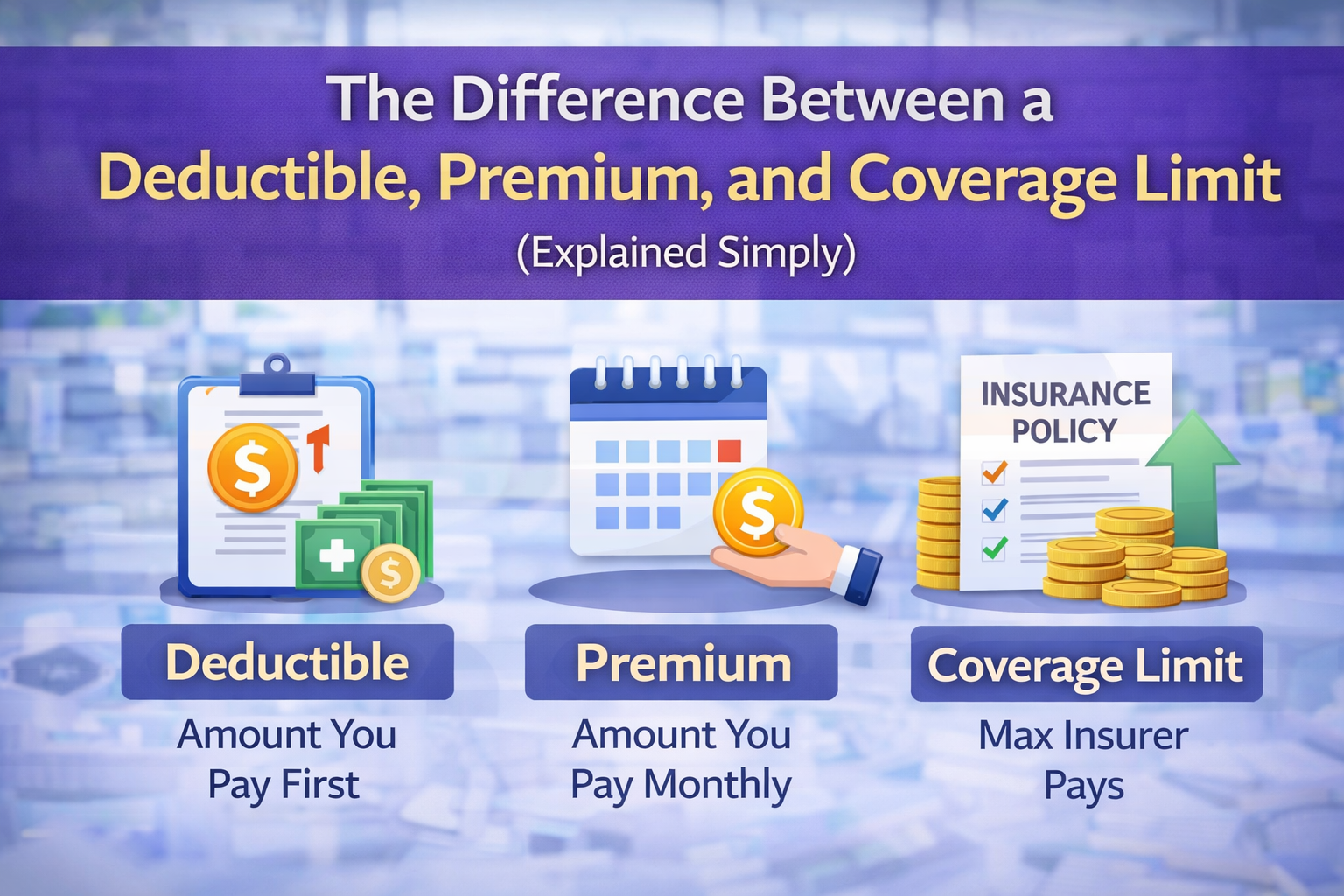
    Three numbers define every insurance policy you’ll ever buy — the premium, the deductible, and the coverage limit. Most people who have been buying insurance for years couldn’t give a precise definition of all three, which is less a reflection of their intelligence than of how rarely insurance is explained clearly rather than sold aggressively. Understanding exactly what each number means, how the three interact with each other, and how changing one affects the others is the foundation of every intelligent insurance decision — from choosing a policy to filing a claim to evaluating whether your current coverage still makes sense.

    This guide explains all three with the specificity that makes them genuinely useful rather than just technically understood.


    The Premium: What You Pay to Have the Coverage

    The premium is the amount you pay the insurance company for the coverage the policy provides — monthly, quarterly, or annually depending on how the policy is structured. It’s the only number in the three that you pay regardless of whether anything bad happens, which is why it’s the number most people focus on when comparing policies and the number that insurance companies compete most visibly on in their advertising.

    What the premium actually represents is the insurance company’s assessment of how much it will cost, on average, to cover you — factoring in the probability that you’ll file a claim, the expected cost of that claim if you do, and the company’s operating costs and profit margin. When an insurance company quotes you a higher premium than another company for identical coverage, it’s because their risk assessment of your specific profile produces a different expected claim cost. When your premium increases at renewal without any apparent change in your circumstances, it’s almost always because either your risk profile changed in ways you may not have noticed or the company’s overall loss experience in your area or category changed.

    The premium is the most visible insurance cost but rarely the most important one for evaluating the actual value of a policy. Two policies with different premiums can represent dramatically different value depending on what the coverage limit and deductible look like — which is why premium comparisons without looking at the full policy structure produce the kind of false economy that leaves people underinsured at a lower monthly cost.


    The Deductible: What You Pay When Something Goes Wrong

    The deductible is the amount you pay out of pocket before the insurance company begins paying a covered claim. If your car insurance has a $1,000 collision deductible and you have an accident that causes $4,000 in damage, you pay $1,000 and the insurance company pays $3,000. If the damage is $800 — less than your deductible — the insurance company pays nothing and you cover the full $800 yourself.

    The deductible’s primary function in insurance design is risk sharing — it ensures that the policyholder absorbs a portion of every claim rather than having the insurance company cover every loss from the first dollar. This serves two purposes simultaneously. It reduces the premium because the insurance company’s expected payout is lower when the policyholder is absorbing the first portion of every claim. And it reduces the frequency of small claims that would cost more to administer than they’re worth — nobody files a claim for a $200 scratch when they have a $500 deductible.

    The deductible decision is fundamentally a financial trade-off between certain savings now — a lower premium from a higher deductible — and uncertain costs later — the higher out-of-pocket expense if a claim occurs. The math that makes this trade-off rational is straightforward. If choosing a $2,000 deductible over a $500 deductible saves $400 per year in premium, and if you file one claim every five years on average, you save $2,000 in premiums over that period while potentially paying $1,500 more in deductible costs — a net saving of $500. If you file claims more frequently, the higher deductible costs more than it saves.

    The deductible decision becomes less about math and more about financial resilience when the higher deductible requires paying out of pocket at a moment when the financial pressure is already significant. A $2,000 deductible is a rational financial choice for someone with $10,000 in emergency savings and a much less rational one for someone with $500. The premium savings from a higher deductible should always be evaluated against the realistic ability to pay that deductible at the worst possible moment — which is, by definition, when a claim occurs.

    One important distinction that catches policyholders off guard is the difference between per-occurrence deductibles and annual deductibles. Auto and homeowners insurance typically use per-occurrence deductibles — you pay the deductible each time a separate claim is filed. Health insurance typically uses an annual deductible — you pay out of pocket until you’ve reached the deductible amount for the year, and then the insurance covers costs above that threshold for the remainder of the year. The practical difference is significant — a health insurance annual deductible of $3,000 means the first $3,000 in medical costs each year comes entirely from your pocket, regardless of how many separate medical events produce those costs.


    The Coverage Limit: The Maximum the Insurance Company Will Pay

    The coverage limit is the maximum dollar amount the insurance company will pay for a covered loss — and it’s the number that matters most when a major claim actually occurs, which makes it the most underexamined of the three in most insurance purchase decisions.

    Coverage limits exist at multiple levels depending on the type of insurance. A homeowners policy might have a $400,000 dwelling coverage limit — the maximum it will pay to rebuild the home — alongside a $100,000 personal liability limit and a $50,000 personal property limit. An auto policy might have a $100,000 per-person bodily injury limit, a $300,000 per-accident bodily injury limit, and a $100,000 property damage limit. Each limit applies independently to the category it covers, which means a claim can exceed the limit in one category while remaining well below the limit in another.

    The coverage limit problem that most policyholders experience is discovering after a claim that the limit that seemed adequate at policy purchase is inadequate given the actual cost of the loss. This happens in two common scenarios. The first is the underinsured home — a homeowner who insures the house for its market value rather than its replacement cost discovers after a total loss that rebuilding costs significantly more than the policy pays out, because construction costs have increased and market value doesn’t equal replacement cost. The second is the inadequate liability limit — a policyholder with a $100,000 liability limit who causes an accident resulting in $300,000 in injuries is personally responsible for the $200,000 difference between the claim and the limit.

    Setting coverage limits requires modeling the worst realistic outcome rather than the average one. The question that produces the right liability limit is not “what does the average car accident cost?” but “what would a serious accident with significant injuries cost, and could I personally absorb anything above my coverage limit?” For most people, the honest answer to the second question is no — which means adequate liability limits are one of the most important and most frequently underestimated aspects of insurance coverage.


    How the Three Numbers Interact With Each Other

    The premium, deductible, and coverage limit don’t exist independently — they’re connected through a set of relationships that understanding makes every insurance decision more productive.

    The most direct relationship is between the deductible and the premium. Higher deductibles produce lower premiums because the insurance company’s expected payout is lower when the policyholder absorbs more of each claim. Lower deductibles produce higher premiums because the company pays more of every claim. This relationship is predictable and calculable, which is why comparing policies with different deductibles requires adjusting for the premium difference rather than comparing deductibles in isolation.

    The relationship between coverage limits and premiums is similar but less symmetrical. Increasing a liability limit from $100,000 to $300,000 typically adds much less to the premium than the coverage increase might suggest — because the probability of a claim reaching $300,000 is lower than the probability of a claim reaching $100,000, and the premium reflects that probability difference. This asymmetry means that increasing coverage limits is often more cost-effective than people assume, and underinsuring to save on premiums at the coverage limit level is a worse trade-off than underinsuring at the deductible level.

    The relationship between all three and the actual value of the policy is where most insurance purchase decisions fall apart. A policy with a low premium, a high deductible, and a low coverage limit might appear affordable until a major claim reveals that the low premium was purchased with the certainty of high out-of-pocket costs and inadequate recovery. Evaluating the three together — the total cost of the premium plus the expected deductible cost plus the exposure above the coverage limit — produces a more accurate picture of what a policy actually costs and provides than any single number comparison does.


    The Practical Application: Using These Three Numbers to Compare Policies

    Understanding the three numbers in isolation is useful. Using them together to compare policies is where the understanding produces financial value.

    When comparing two auto insurance quotes, the comparison that matters is not which policy has the lower premium. It’s which policy produces the better outcome across the range of scenarios you’re realistically likely to face. A policy with a $500 lower annual premium and a $1,000 higher deductible is a better value if you have a strong emergency fund and file claims infrequently. It’s a worse value if your financial cushion is thin and a $1,500 deductible at claim time would create genuine hardship.

    When evaluating coverage limits, the comparison that matters is not which policy has limits that seem adequate in the abstract. It’s which policy provides limits adequate to cover the realistic worst-case outcome — and whether the premium difference between adequate and inadequate limits is worth paying. In most cases, the answer is yes, because the premium difference for higher limits is modest and the financial exposure of inadequate limits is potentially catastrophic.

    The single most productive insurance exercise most people can do is reviewing their current policies with these three numbers as the framework — not to find the cheapest coverage but to confirm that the deductible is a number they could realistically pay at a bad moment, the coverage limit is a number that would actually cover a major loss, and the premium represents the cost of genuine protection rather than the cost of technically having a policy.


    What Knowing This Changes

    Understanding the premium, deductible, and coverage limit doesn’t make insurance shopping effortless. Insurance policies are still complex documents with exclusions, conditions, and endorsements that affect coverage in ways that the three main numbers don’t capture. But understanding the three numbers changes the starting point for every insurance evaluation from confusion to a clear framework — and that framework makes every subsequent insurance decision more grounded in what the policy actually does rather than what the premium suggests.

    The most expensive insurance mistakes — the ones that leave people facing five- and six-figure out-of-pocket costs after a major loss — almost always trace back to a misunderstanding of one of these three numbers. A deductible that wasn’t affordable at claim time. A coverage limit that was set at a number that felt large without being adequate. A premium that was optimized at the expense of the protection it represented. Knowing the difference prevents those mistakes before they happen rather than explaining them after.


    Now that the three core numbers make sense, the next question most people have is why their specific premium is higher than they expected — and what they can legally do about it. Our guide on how insurance companies decide what you pay — and how to use that knowledge to lower your rate covers the specific factors that drive premium calculations and the legitimate strategies that produce real savings without reducing real coverage.

    Which of these three numbers — premium, deductible, or coverage limit — has caused the most confusion or the most unexpected cost in your insurance experience? Leave a comment with the specific situation. Real examples from real policyholders help us make these explanations more useful for everyone who reads them.

  • What Really Happens If You Don’t Have Insurance — The Financial Risks Most People Underestimate

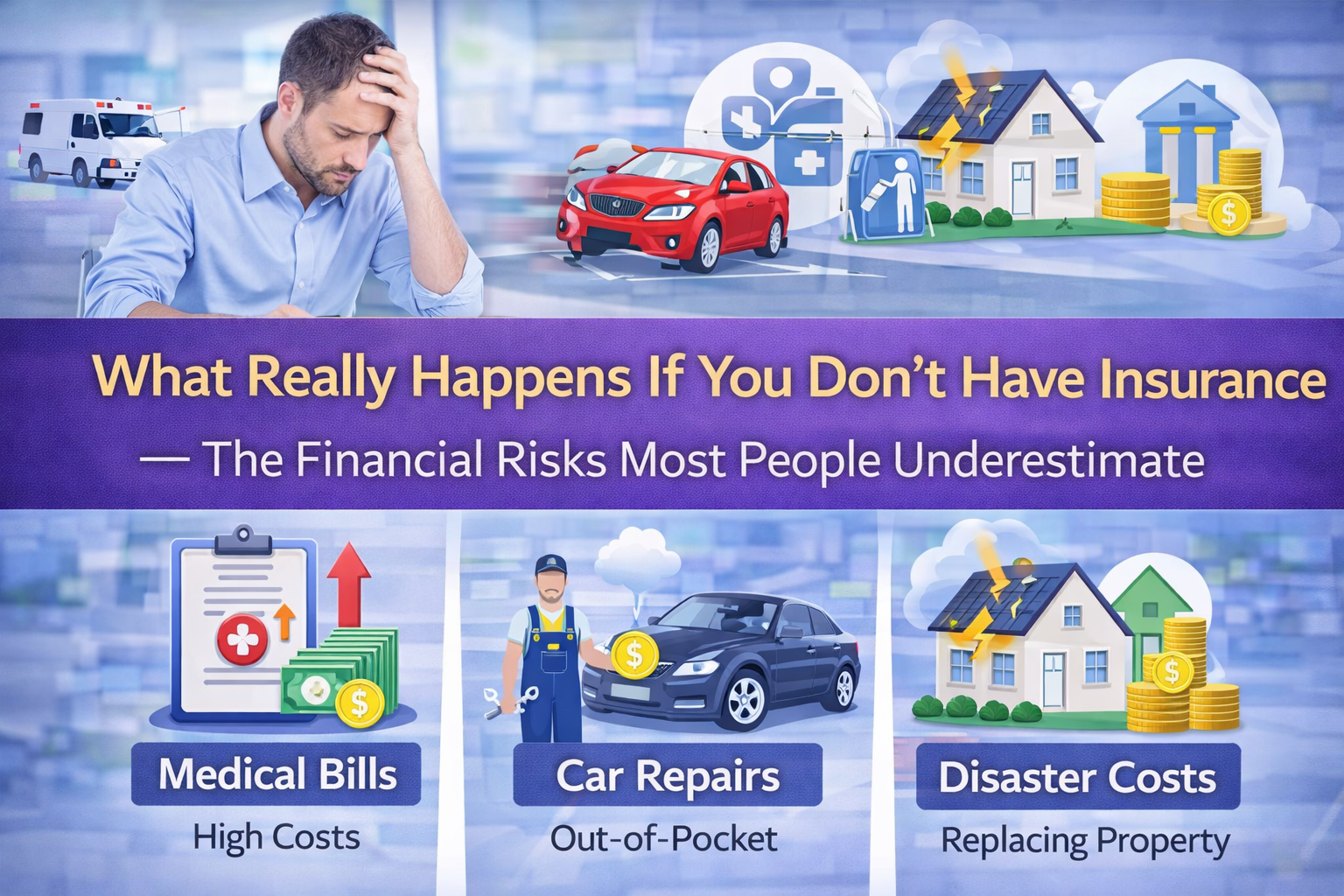
    What Really Happens If You Don’t Have Insurance — The Financial Risks Most People Underestimate

    The decision to go without insurance — whether it’s skipping health coverage between jobs, dropping collision on an older car, or operating a small business without liability protection — almost never feels like a dangerous decision at the time. It feels like a practical one. The premium is a real cost that shows up every month. The risk is a theoretical one that may never materialize. When money is tight, eliminating a certain expense to avoid an uncertain one feels rational.

    The problem with that reasoning is that the uncertain expense, when it does materialize, is almost always larger than the cumulative premiums that were saved by going without coverage — often by an order of magnitude. The financial risks of being uninsured are not evenly distributed across the possibility space. They’re concentrated in a small number of outcomes that are individually catastrophic rather than spread across many outcomes that are individually manageable.

    This guide covers what actually happens — financially, legally, and practically — when specific types of insurance are absent at the moment a covered event occurs. Not hypothetically. Specifically.


    What Happens When You Don’t Have Health Insurance

    The financial consequences of being uninsured at the moment of a serious medical event are the most severe of any insurance category — because healthcare costs in the United States have reached levels where even a single hospitalization can produce a bill that exceeds most people’s net worth.

    The average cost of a three-day hospital stay in the United States is approximately $30,000. A major surgery — a cardiac procedure, a cancer treatment, a serious accident — routinely produces bills in the $100,000 to $500,000 range. An extended ICU stay can exceed $1 million. These are not worst-case numbers. They are typical costs for common medical events that happen to uninsured Americans every day.

    The legal consequence of unpaid medical bills is a debt collection process that can include wage garnishment, bank account levies, and liens on property — legal mechanisms that creditors use to recover unpaid balances that the uninsured patient cannot pay. Medical debt is the leading cause of personal bankruptcy in the United States, accounting for a significant proportion of all bankruptcy filings annually. The people filing those bankruptcies are not primarily people who were financially irresponsible in other areas of their lives — they are people who experienced a medical event without insurance and found themselves with a debt that no income or savings could realistically service.

    The less catastrophic but still significant consequence of being uninsured is the cost of routine care without insurance negotiated rates. Insured patients pay the contracted rate that their insurance company has negotiated with providers — typically 30% to 60% lower than the list price billed to uninsured patients. An uninsured patient paying list price for a routine blood panel, a specialist visit, or a prescription drug pays significantly more than an insured patient receiving identical care, which compounds the cost of being uninsured beyond the dramatic acute care scenarios.


    What Happens When You Don’t Have Car Insurance

    Driving without car insurance is illegal in 49 of 50 US states — Virginia being the exception with a fee-based alternative — and the consequences of being caught without it before an accident are significant. The consequences of being in an accident without it are potentially life-altering.

    The legal consequences of driving uninsured vary by state but commonly include license suspension, vehicle registration revocation, fines ranging from $500 to $5,000, and in some states, misdemeanor charges that can result in jail time. These consequences apply regardless of whether an accident occurred — simply being stopped and found uninsured triggers them.

    When an uninsured driver causes an accident that injures another person or damages another vehicle, the financial consequences become personal liability. Without liability insurance to cover the claim, the at-fault driver is personally responsible for the medical bills, lost wages, and property damage of everyone affected by the accident. In a serious accident involving significant injuries, that personal liability can easily reach $100,000 to $500,000 or more — a debt that follows the uninsured driver through wage garnishment and asset seizure until it’s satisfied.

    The consequence that surprises uninsured drivers most is what happens to their own vehicle after an accident they didn’t cause. An uninsured driver hit by an at-fault insured driver can recover damages from the at-fault driver’s liability insurance. But an uninsured driver hit by another uninsured driver — or by a hit-and-run driver — has no uninsured motorist coverage to fall back on and no recourse for their own vehicle damage or injuries beyond suing the other driver directly, which produces a judgment that may be uncollectable if the other driver has no assets.


    What Happens When You Don’t Have Homeowners or Renters Insurance

    The consequences of being uninsured for home and property losses divide into two scenarios with different financial dynamics — owning without homeowners insurance and renting without renters insurance.

    For homeowners, carrying insurance is typically required by the mortgage lender as a condition of the loan — which means most homeowners with mortgages are insured not by choice but by contractual obligation. The uninsured homeowner scenario primarily affects people who own their homes outright and have chosen to self-insure, or people whose insurance lapsed without their mortgage servicer’s knowledge. In these cases, a total loss from fire, tornado, or other covered peril means rebuilding the home entirely from personal funds — a cost that typically ranges from $150,000 to $400,000 or more depending on location and home size.

    The more common scenario is homeowners who are technically insured but significantly underinsured — carrying coverage limits that were set years ago and have not kept pace with construction cost increases that have been significant over the past several years. An underinsured homeowner who experiences a total loss discovers that their policy pays out $250,000 in a market where rebuilding the same home now costs $380,000 — leaving a $130,000 gap that personal savings or a second mortgage must fill.

    For renters, the consequences of being uninsured are less dramatic but still significant. Renters insurance covers personal property — clothing, electronics, furniture, and other belongings — against theft, fire, and certain water damage events. A renter without coverage who experiences a fire or burglary replaces their belongings entirely out of pocket. The average renters insurance policy costs $15 to $20 per month and covers $20,000 to $30,000 in personal property — a premium-to-coverage ratio that makes renters insurance one of the most cost-effective insurance products available and one of the most frequently skipped by the people who need it most.


    What Happens When a Small Business Operates Without Insurance

    The financial consequences of operating a business without insurance are the least understood of any insurance category — partly because small business owners tend to be optimistic about risk, and partly because business insurance is a category where the consequences of being uninsured are entirely avoidable through a relatively modest annual investment.

    A business without general liability insurance that is sued for a customer injury, property damage, or advertising injury faces the full cost of legal defense and any judgment or settlement from business assets — and when business assets are insufficient, from the personal assets of the business owner in the case of a sole proprietorship or partnership. A single slip-and-fall lawsuit can produce defense costs of $50,000 to $100,000 before any judgment is rendered, and settlements in injury cases regularly reach six figures.

    A business without property insurance that experiences a fire, flood, or theft loses its physical assets — equipment, inventory, fixtures, and improvements — without any recovery mechanism. For a business that operates from a physical location with significant equipment or inventory investment, the uninsured loss of those assets can make continued operation impossible rather than merely difficult.

    The consequence that most small business owners don’t anticipate is the reputational and contractual impact of being uninsured rather than the direct financial impact. Many commercial leases require tenants to carry liability insurance as a lease condition. Many client contracts — particularly with larger businesses and government entities — require vendors to carry specific insurance coverages and provide certificates of insurance before work begins. A small business without insurance loses those opportunities entirely rather than being exposed to risk — which affects revenue in ways that the premium savings don’t compensate for.


    What Happens When You Don’t Have Life Insurance

    The consequences of dying without life insurance are not experienced by the person who dies — they’re experienced by the people left behind, which is what makes life insurance the most emotionally complex insurance category and the one where the financial consequences of being uninsured are most directly felt by people other than the policyholder.

    A family that loses its primary earner without life insurance coverage faces the simultaneous loss of income and the ongoing cost of living — mortgage payments, car payments, childcare, education costs, and daily living expenses that don’t pause because the income stopped. The financial pressure that follows an uninsured death is the leading cause of forced home sales, children’s education plans being abandoned, and the long-term financial setback of surviving family members who had built their financial lives around an income that no longer exists.

    The cost of that outcome — measured in the financial disruption to the survivors — is almost always larger than the cumulative life insurance premiums that would have prevented it. A healthy 30-year-old can purchase a $500,000 term life insurance policy for $20 to $30 per month. The financial protection that $20 to $30 per month provides to a family with dependents is among the highest-value insurance purchases available — and the decision to go without it is one of the most financially consequential underinsurance decisions a family with dependents can make.


    The Pattern That Connects Every Uninsured Scenario

    Reading through the specific consequences of being uninsured across different coverage categories reveals a pattern that applies to every scenario regardless of the insurance type. The financial risk of being uninsured is not evenly distributed across all possible outcomes — it’s concentrated in low-probability, high-severity events that are individually catastrophic rather than frequent and manageable.

    Most people who drive without car insurance for a year don’t have a major accident. Most people who operate a business without liability insurance for a year don’t get sued. Most people who skip health insurance for six months between jobs don’t experience a $200,000 medical event. The problem is that some people do — and the consequences for those people are severe enough to make the insurance purchase rational for everyone, because identifying in advance which people will be among those who do is impossible.

    The decision to go without insurance is not a financial decision with a predictable outcome — it’s a bet that you will be among the people for whom the low-probability event doesn’t occur. That bet wins most of the time and loses catastrophically the rest of the time. Understanding that asymmetry is the foundation of every rational insurance decision.


    Taking Stock of Where You Actually Stand

    The most useful response to understanding the consequences of being uninsured is not anxiety about every possible risk — it’s an honest assessment of which coverage gaps currently exist in your insurance portfolio and which of those gaps represent the most significant financial exposure. Some coverage gaps are acceptable given your specific financial situation and risk tolerance. Others represent exposure to outcomes that would genuinely alter your financial trajectory.

    Identifying which is which requires looking at your actual coverage levels against your actual financial exposure — which is a different exercise than checking whether you have a policy in each major category. Having a policy and having adequate coverage are not the same thing, and the gap between them can be as financially consequential as having no coverage at all.


    Understanding what’s at risk when you’re uninsured is the first step — understanding the specific mistakes that leave people underinsured or overpaying is the next. Our guide on the most common insurance mistakes that cost people thousands every year covers the errors that create coverage gaps and unnecessary costs across every insurance category, with enough specificity to recognize whether any of them apply to your current situation.


    After reading this, where do you feel the most exposed in your current insurance coverage — health, auto, home, life, or business? Leave a comment with your situation and what’s making you reconsider your coverage. We read every response and use the most common concerns to prioritize what we cover next.

  • What Is Insurance and How Does It Actually Work — A Plain-English Guide for 2026

    What Is Insurance and How Does It Actually Work — A Plain-English Guide for 2026

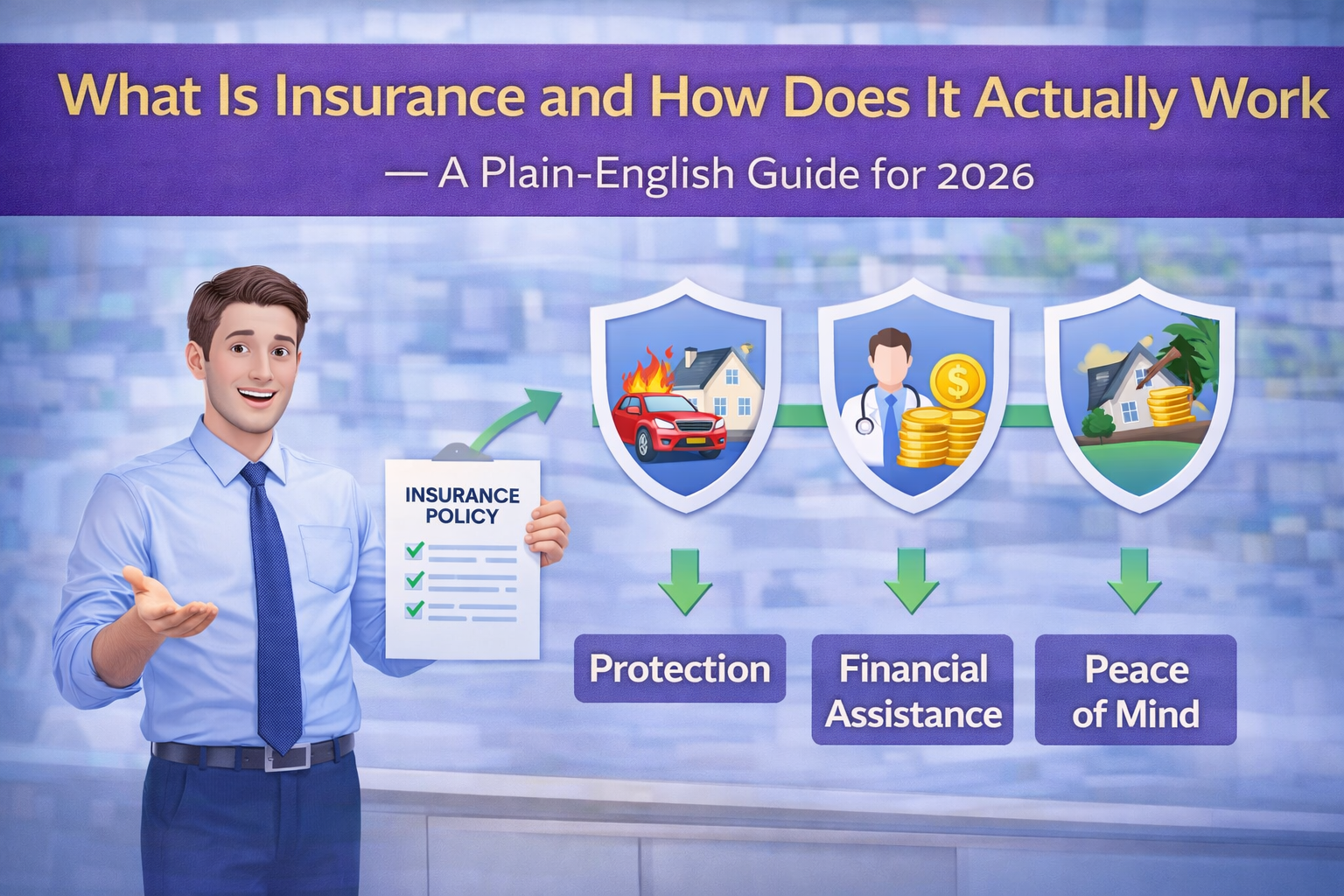
    Most people buy insurance without fully understanding what they’re actually purchasing — and that gap between paying for coverage and understanding it is where the most expensive insurance mistakes happen. The person who buys the wrong policy, underinsures their home, or files a claim incorrectly isn’t usually making a careless decision. They’re making an uninformed one — and the difference between those two situations is that uninformed decisions are fixable once the information is clear.

    This guide explains what insurance actually is, how the financial mechanism behind it works, and why understanding the basics changes every insurance decision you’ll make — from the policy you buy this year to the claim you might file years from now. No jargon, no assumption of prior knowledge, and no agenda beyond making the concept genuinely clear.


    The Core Idea Behind Every Insurance Policy Ever Written

    Insurance is a financial arrangement where a large number of people each contribute a relatively small amount of money into a shared pool, and that pool pays out to whoever among them experiences a specific type of financial loss. The insurance company manages the pool, prices the contributions, and pays the claims — earning its profit from the difference between what comes in and what goes out.

    The reason this arrangement works financially is probability. Not everyone who insures their car will have an accident this year. Not everyone who insures their home will experience a fire or a flood. Not everyone who buys life insurance will die during the coverage period. The insurance company uses historical data and statistical modeling to predict, with reasonable accuracy, how many claims they’ll receive and how much those claims will cost — and they set premiums high enough to cover those expected claims, their operating costs, and a profit margin.

    From the individual’s perspective, insurance converts an unpredictable large loss — a $40,000 car accident, a $300,000 house fire, a $500,000 medical event — into a predictable small cost, which is the monthly or annual premium. That conversion is the fundamental value of insurance regardless of the type of coverage being purchased.


    Why Insurance Exists: The Problem It Solves

    The problem that insurance solves is not the risk of bad things happening — it’s the financial devastation that follows when bad things happen without financial preparation. Most people cannot self-insure against catastrophic losses. A family with $30,000 in savings cannot absorb a $200,000 medical bill. A small business owner with $50,000 in reserves cannot absorb a $500,000 liability lawsuit. A homeowner with a mortgage cannot absorb the total loss of a $400,000 home.

    Insurance exists because the alternative — absorbing catastrophic financial losses out of pocket — is impossible for most people and financially ruinous for nearly everyone else. The premium paid for insurance is not lost money when no claim is filed. It’s the cost of eliminating the possibility of a catastrophic outcome — a cost that most financial advisors would describe as one of the most rational purchases a person or business can make.

    The analogy that makes this clearest is this: you don’t consider your car’s seatbelt a waste of money because you didn’t have an accident this year. The seatbelt’s value is in what it prevents if something goes wrong — not in the daily experience of wearing it when nothing does. Insurance works the same way.


    The Four Elements Every Insurance Policy Contains

    Every insurance policy ever written — regardless of the type of coverage, the insurance company, or the country where it was issued — contains four fundamental elements that define what the policy does and doesn’t do.

    The premium is the amount you pay for the coverage — monthly, quarterly, or annually. The premium is determined by the insurance company based on the assessed risk of insuring you specifically, which is why two people buying identical policies from the same company often pay different premiums. Your age, location, claims history, credit score in most states, and dozens of other factors all affect what the company charges for your specific risk profile.

    The deductible is the amount you pay out of pocket before the insurance coverage begins. A $1,000 deductible on a car insurance policy means that if you have a $5,000 accident, you pay the first $1,000 and the insurance company pays the remaining $4,000. Higher deductibles produce lower premiums because you’re absorbing more of the risk yourself — a trade-off that makes financial sense for some people and not for others depending on their savings and risk tolerance.

    The coverage limit is the maximum amount the insurance company will pay for a covered loss. A $300,000 liability limit on a homeowners policy means the company will pay up to $300,000 for a covered liability claim — but not a dollar more. Understanding the coverage limit is essential because a limit that seems adequate at policy purchase can be dangerously inadequate when a major claim actually occurs.

    The exclusions are the specific situations, events, and types of damage that the policy explicitly does not cover. Every policy has them, most policyholders don’t read them carefully, and the exclusions are almost always where the most painful surprises occur at claim time. Flood damage excluded from a standard homeowners policy. Wear and tear excluded from an auto policy. Pre-existing conditions excluded from some health policies. The exclusions define the boundary of what the policy actually does — and that boundary is as important as what the policy covers.


    How Insurance Companies Make Money

    Understanding how insurance companies make money demystifies the relationship between policyholders and insurers in a way that makes every insurance interaction more navigable.

    Insurance companies make money through two primary mechanisms. The first is underwriting profit — the difference between the premiums they collect and the claims they pay out plus their operating costs. When an insurance company collects $100 million in premiums and pays out $85 million in claims and $10 million in operating costs, it earns a $5 million underwriting profit. When claims exceed premiums — which happens in catastrophic loss years for property insurers — underwriting produces a loss.

    The second mechanism is investment income. Insurance companies hold the premiums they collect before paying them out as claims — and during that time, they invest those funds in bonds, stocks, and other financial instruments. The investment returns on this float — the term for the money held between collection and payout — represent a significant portion of insurance company revenue that exists independently of underwriting results.

    Understanding these mechanisms explains several insurance behaviors that seem puzzling without context. Why do insurance companies raise rates after a major hurricane even for customers far from the affected area? Because catastrophic losses affect the entire pool, and the company needs to rebuild reserves to cover future claims. Why do insurance companies sometimes deny claims on technicalities? Because underwriting profit depends on paying legitimate claims while controlling illegitimate or inflated ones. Understanding the financial logic behind insurance company behavior makes you a more effective insurance consumer.


    The Difference Between Types of Insurance

    Insurance products fall into three broad categories that cover different types of risk — and understanding which category addresses which risk clarifies why specific types of coverage exist and when each is appropriate.

    Property insurance protects against financial loss from damage to or destruction of physical assets — your car, your home, your business equipment. The covered loss is the cost of repairing or replacing the physical property, and the coverage is relevant any time you own an asset whose loss would create financial hardship.

    Liability insurance protects against financial loss from legal claims made against you by others — a car accident where you injure another driver, a customer who slips and falls in your business, a professional mistake that causes financial harm to a client. The covered loss is the legal judgment or settlement plus defense costs, and the coverage is relevant any time your actions could create legal liability for others’ losses.

    Life and health insurance protect against financial loss from events affecting your physical wellbeing — illness, injury, disability, and death. The covered loss ranges from medical bills to income replacement to the financial impact of death on dependents, and the coverage is relevant any time your health or continued life represents a financial dependency for yourself or others.

    Most people and businesses need coverage from all three categories — which is why a complete insurance review looks at property, liability, and life and health coverage together rather than addressing each category in isolation.


    Why Most People Are Either Over-Insured or Under-Insured

    The uncomfortable truth about how most people manage their insurance is that they’re rarely at the right coverage level — they’re either paying for coverage they don’t need or exposed to risks their current coverage doesn’t address. Both situations are common, both are expensive, and both are correctable once the underlying dynamic is understood.

    Over-insurance happens when people keep coverage levels, deductibles, and policy types that made sense at an earlier life stage without reassessing as circumstances change. The comprehensive coverage on a ten-year-old car worth $4,000 may cost more annually than the car is worth replacing. The life insurance policy purchased when children were young and a mortgage was new may exceed what’s needed once the children are grown and the mortgage is paid down.

    Under-insurance happens when people choose minimum coverage to minimize premiums without modeling what a major claim would actually cost. The liability limit that seemed adequate at policy purchase represents a fraction of the judgment in a serious lawsuit. The homeowners coverage that insures the home for its purchase price rather than its replacement cost leaves a gap that the policyholder discovers only when rebuilding after a total loss.

    The solution to both problems is the same — an honest annual review of every insurance policy against current circumstances, current asset values, and current risk exposure. That review is the most financially productive hour most people spend on their finances each year, and it’s the subject of the insurance audit guide covered elsewhere on this site.


    What Understanding Insurance Actually Changes

    Reading a plain-English explanation of how insurance works doesn’t make you an insurance expert. What it does is give you the framework for asking better questions, evaluating coverage decisions more critically, and recognizing the moments when the gap between what you’re paying for and what you actually need is costing you money in one direction or the other.

    Every insurance decision — the policy you buy, the deductible you choose, the coverage limit you set, the claim you decide whether to file — is a financial decision with calculable consequences. Making those decisions from a position of understanding rather than from a position of trusting that whoever sold you the policy made the right choices on your behalf produces better financial outcomes over the course of a lifetime than any specific policy optimization can.

    The guides throughout CoverageMastery cover every major insurance category with the same level of honest, specific, actionable detail that this introduction aims for — because the difference between informed and uninformed insurance decisions compounds in your favor every year you make the informed ones.


    The next step after understanding how insurance works is understanding the mistakes that cost people the most money — before you make them yourself. Our guide on the most common insurance mistakes that cost people thousands every year covers the specific errors that show up repeatedly across every insurance category, with enough detail to recognize and avoid them before they affect your coverage or your wallet.


    Just starting to think seriously about your insurance coverage and not sure where the biggest gaps or overpayments are in your current policies? Leave a comment describing your situation — what you’re currently covered for, what you’re unsure about, and what’s prompted the review. We read every comment and often turn the most common questions into dedicated guides.